6 Omega-3 Benefits For Skin And Hair (Backed By Science)
9 min read
Most people associate omega-3 fatty acids with heart and brain health. Fair enough, that’s where the bulk of research has focused for decades. But the omega 3 benefits for skin and hair are just as compelling, and they’re finally getting the attention they deserve. These essential fats play a direct role in how your skin holds moisture, how it handles inflammation, and whether your hair follicles get what they need to grow and stay strong.
At Afterglow Supplements, we build science-backed formulas that help your body recover and function at its best, especially after intense experiences. We know that real well-being starts at the cellular level, and omega-3s are a perfect example of that principle. They’re not a trend. They’re a foundational nutrient that most people simply don’t get enough of.
In this article, we break down six specific, research-supported ways omega-3 fatty acids benefit your skin and hair, from reducing chronic dryness to supporting scalp health and slowing visible signs of aging. No hype, just what the science actually shows.
1. Reduce acne and inflammatory breakouts
Acne is an inflammatory condition, and that distinction matters for how you approach it. If your diet is high in processed foods and vegetable oils, you’re likely consuming far more omega-6 fatty acids than omega-3s, which pushes your body toward a pro-inflammatory state. That imbalance can make breakouts more frequent and harder to clear.
What the research says so far
Several clinical studies have examined omega-3 supplementation and acne outcomes. A 2012 study in Lipids in Health and Disease found that participants who supplemented with EPA and DHA for 10 weeks saw significant reductions in both inflammatory and non-inflammatory acne lesions. Other trials have shown that fish oil supplementation consistently lowers acne severity scores, particularly in people dealing with moderate-to-severe breakouts. The evidence isn’t definitive yet, but the direction is clear.
Multiple controlled trials show omega-3 supplementation reduces acne lesion counts, especially for people with moderate-to-severe inflammation.
How omega-3 may calm acne-related inflammation
EPA and DHA work by competing with arachidonic acid, an omega-6 fat, for the same metabolic pathways. By crowding it out, they reduce the production of pro-inflammatory prostaglandins and cytokines that drive redness, swelling, and deep, painful cysts.
With consistent intake, your skin’s inflammatory response becomes less aggressive. That means fewer active lesions and faster recovery time when breakouts do occur, which is one of the more practical omega 3 benefits for skin and hair worth understanding.
How to get enough EPA and DHA for this goal
Most acne-related trials used doses of 1,000 mg to 2,000 mg of combined EPA and DHA per day. You can reach this target through whole foods or supplements:
Fatty fish (salmon, sardines, mackerel): 3 to 4 servings per week
Fish oil capsules: a reliable and concentrated option
Algae oil: the best plant-based choice, as it delivers DHA directly without depending on your body’s slow conversion of ALA
When to expect changes and what to pair it with
Give omega-3 supplementation at least eight to twelve weeks before drawing conclusions. Skin turnover is slow, and anti-inflammatory effects build gradually over time.
Pairing omega-3s with reduced sugar intake and a zinc supplement can improve your results further. Both factors influence sebum production and the bacterial environment on the skin, so combining them gives you a stronger foundation for clearer skin.
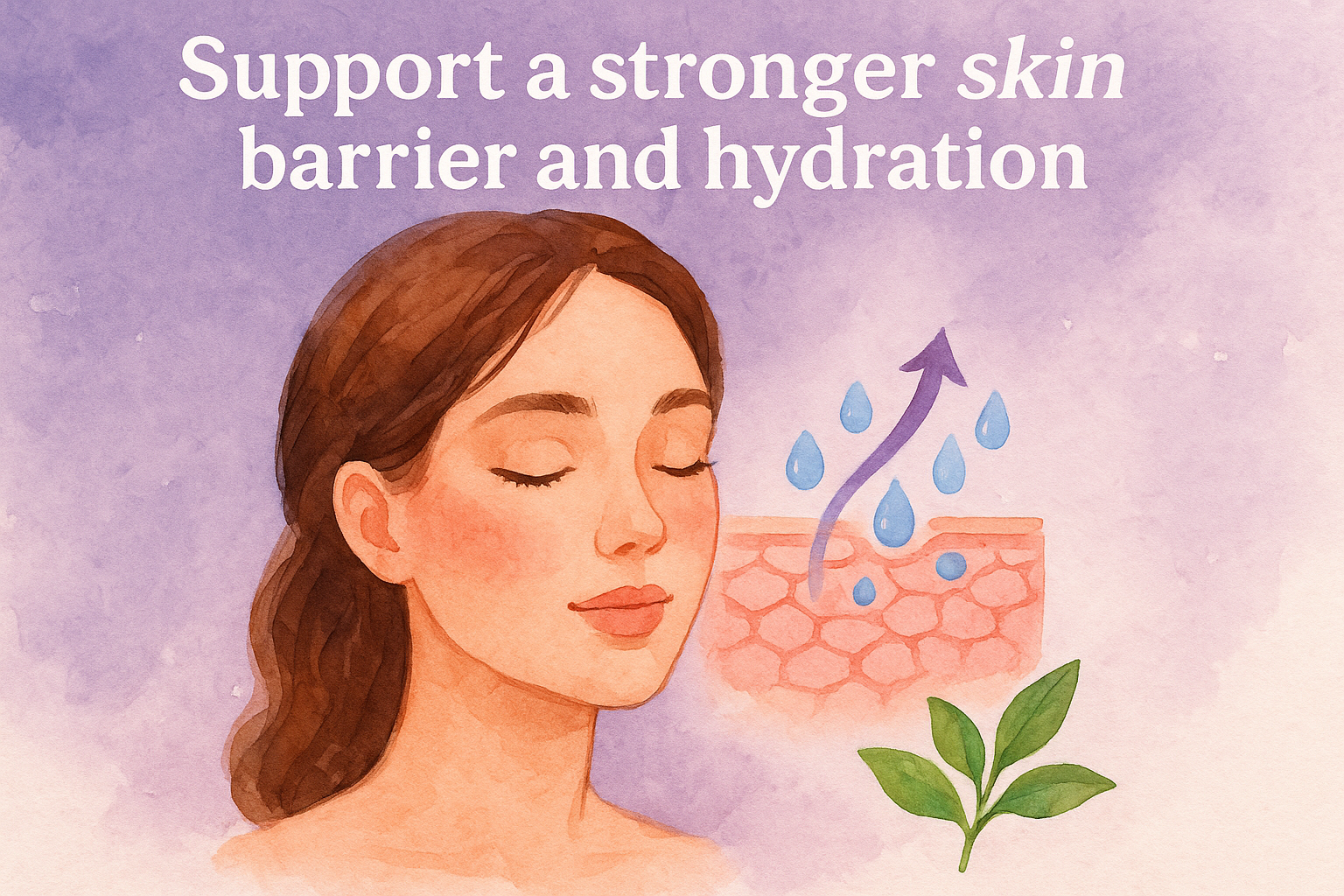
2. Support a stronger skin barrier and hydration
Your skin barrier is your body’s first line of defense against moisture loss, irritants, and pathogens. When it breaks down, you get dryness, redness, and increased sensitivity. Omega-3 fatty acids are structural components of cell membranes, so they directly influence how well that barrier holds together.
What the research says so far
Research consistently links low omega-3 intake with compromised skin hydration. A 2011 study published in the Journal of Lipid Research found that omega-3 deficiency disrupts the skin’s lamellar bodies, the structures responsible for sealing moisture in. Supplementation with EPA and DHA has been shown to reduce transepidermal water loss (TEWL) and improve overall skin hydration markers in both healthy subjects and people with skin conditions like atopic dermatitis.
Omega-3 supplementation measurably reduces transepidermal water loss, which is one of the most direct omega 3 benefits for skin and hair you can track.
How omega-3 supports the moisture barrier and reduces water loss
EPA and DHA incorporate into phospholipid cell membranes, making them more flexible and permeable in the right ways. This structural role helps your skin cells lock moisture in and keep environmental aggressors out, reducing the cycle of irritation and dryness.
What this can mean for dry, itchy, or sensitive skin
If your skin feels tight after washing or flares up easily, barrier dysfunction is often a factor. Regular omega-3 intake can reduce itching and flaking, particularly in conditions like eczema where the barrier is chronically compromised.
Best food sources and supplement options
Your best dietary sources include fatty fish, walnuts, and flaxseeds. For targeted support, fish oil or algae-based supplements delivering at least 1,000 mg of combined EPA and DHA daily give your skin the concentration it needs to rebuild effectively.
3. Protect against sun damage and photoaging
Sun exposure triggers oxidative stress and inflammation in your skin. Over time, that damage accumulates as fine lines, uneven tone, and a loss of elasticity. Omega-3 fatty acids have shown the ability to blunt some of that UV-triggered inflammatory response, which puts them in a useful supporting role alongside your regular sun protection habits.
What the research says so far
A 2013 study in the American Journal of Clinical Nutrition found that participants who consumed omega-3-rich fish oil daily for three months showed a measurably reduced inflammatory response to UV radiation. Separate research has linked higher omega-3 intake with lower markers of oxidative stress in skin cells exposed to sunlight, suggesting a consistent protective effect with regular use.
Higher omega-3 intake is associated with reduced UV-triggered inflammation, making this one of the more overlooked omega 3 benefits for skin and hair.
How omega-3 may change UV response and redness
EPA in particular inhibits cyclooxygenase enzymes that produce inflammatory prostaglandins after sun exposure. This can reduce the redness and swelling you notice after UV contact, and may slow the cellular damage that leads to premature photoaging over years of repeated exposure.
What omega-3 can and cannot replace in sun protection
Omega-3s do not block UV radiation. They work downstream by reducing the inflammatory cascade that UV triggers rather than stopping the rays themselves. Sunscreen remains non-negotiable for protecting your skin from burns, DNA damage, and long-term skin cancer risk.
Practical routine tips for better results
Take your omega-3 supplement with a meal containing healthy fats to maximize absorption. Combining consistent daily intake with broad-spectrum SPF 30 or higher gives your skin both a physical shield and internal anti-inflammatory support at the same time.
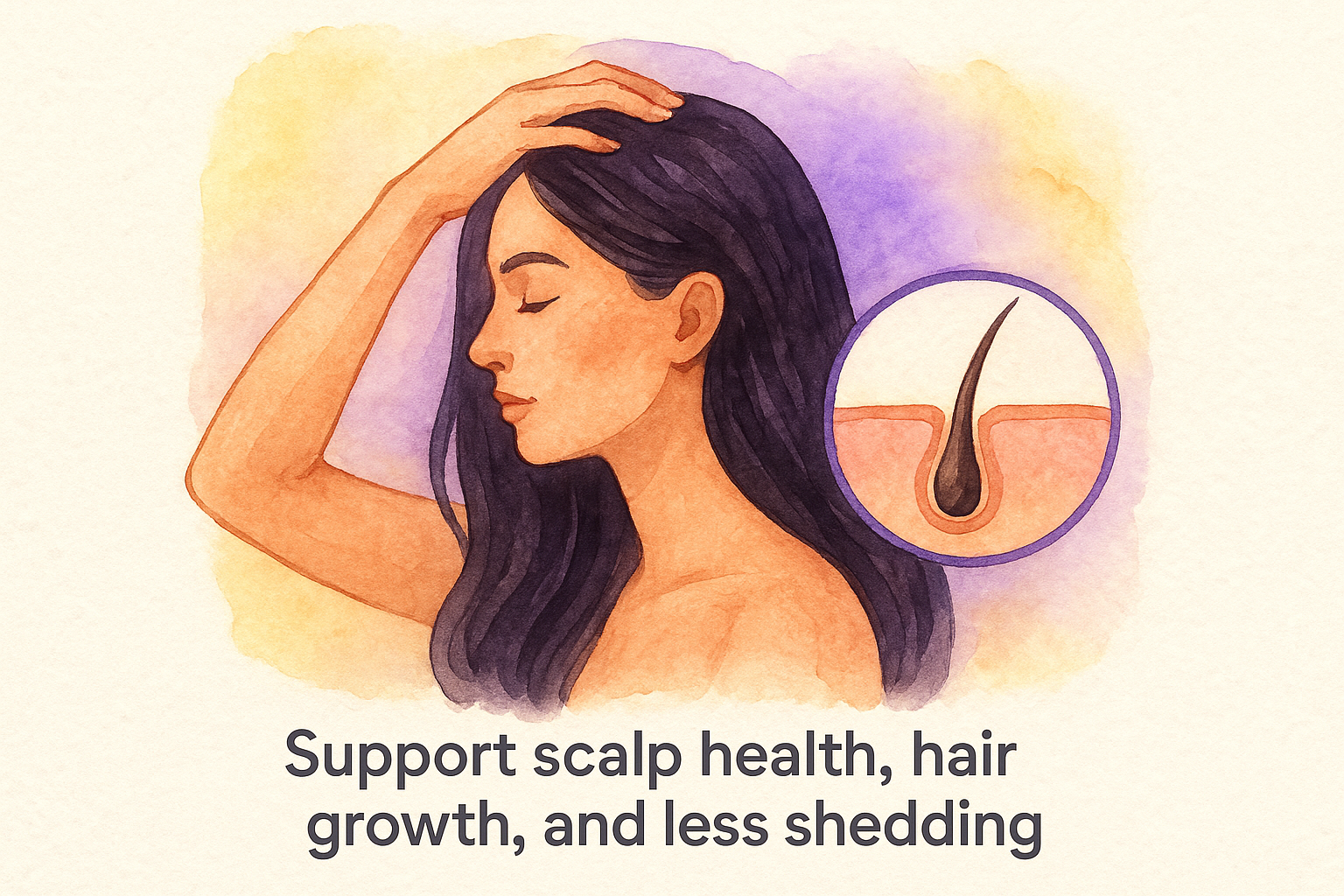
4. Support scalp health, hair growth, and less shedding
Your scalp is skin, and it responds to omega-3 fatty acids the same way your face and body do. When your scalp is inflamed or undernourished, hair follicles can’t perform properly, which shows up as increased shedding, thinning, or slow regrowth. This link between fatty acid intake and hair health is one of the less-discussed omega 3 benefits for skin and hair.
What the research says so far
A 2015 study in the Journal of Cosmetic Dermatology found that women who supplemented with omega-3 and omega-6 fatty acids over six months experienced significantly less hair shedding and improved density compared to a control group. Researchers tracked changes using standardized photography and self-assessment scores, giving the findings solid clinical grounding.
Controlled research shows omega-3 supplementation over six months reduced shedding and increased hair density in women with thinning hair.
How omega-3 may support follicles and reduce scalp inflammation
EPA and DHA reduce pro-inflammatory cytokines that can push follicles out of the active growth phase. A follicle needs stable blood flow and a calm local environment to stay productive, and omega-3s support both circulation and inflammation control at that level.
Who is most likely to notice a difference
People with visible scalp dryness, flaking, or diffuse thinning tend to see the clearest improvements. If your shedding connects to a nutritional gap rather than genetics, consistent omega-3 intake is particularly worth prioritizing.
How to choose an omega-3 for hair goals
Look for a supplement delivering at least 1,000 mg of combined EPA and DHA per serving. Triglyceride-form fish oil absorbs more efficiently than ethyl ester forms, making it the stronger option when targeting a specific outcome like hair density.
5. Support wound healing and skin defenses
Omega-3 fatty acids don’t just shape how your skin looks on the surface. They actively participate in how your skin repairs itself and defends against damage at the cellular level, making this one of the more underrated omega 3 benefits for skin and hair.
What the research says about wound healing
Studies show that EPA and DHA support collagen synthesis and immune cell activity at wound sites. A 2019 review in Nutrients found omega-3 supplementation improved healing outcomes in surgical and chronic wound patients, particularly by reducing excessive inflammation that slows tissue closure.
What the research says about skin cancer risk
Research has linked higher omega-3 intake to reduced risk of certain non-melanoma skin cancers. A study published in the American Journal of Clinical Nutrition found regular fish oil consumption correlated with lower rates of squamous cell carcinoma, though this effect works alongside, not instead of, proper sun protection and medical monitoring.
Higher omega-3 intake correlates with reduced non-melanoma skin cancer risk, but supplementation is not a substitute for dermatological care or sunscreen.
How omega-3 may support repair and resilience
EPA and DHA regulate prostaglandin production at injury sites, helping your skin move through inflammation phases efficiently. This supports faster barrier restoration after cuts, burns, or flare-ups without suppressing the immune signals your skin needs to fight infection.
Safety notes, interactions, and who should ask a clinician
Most adults tolerate omega-3 supplements well at doses up to 3,000 mg daily. If you take blood thinners or anticoagulants, speak to your doctor before supplementing, as higher doses can affect clotting time. You should ask a clinician first if you:
Take prescription anticoagulants like warfarin
Have surgery scheduled within two weeks
Are pregnant and considering doses above standard recommendations
Next steps
The omega 3 benefits for skin and hair covered in this article share a common thread: consistent intake matters more than any single high dose. Your skin rebuilds slowly, your follicles operate on long cycles, and your body needs weeks of steady EPA and DHA before you see meaningful changes. Pick a starting dose of 1,000 to 2,000 mg of combined EPA and DHA daily, track how your skin feels over eight to twelve weeks, and adjust from there.
Beyond omega-3s, your skin and hair recovery depend on how well your body manages stress, sleep, and nutrient depletion overall. If you push your system hard, whether through intense exercise, travel, or other demanding experiences, the right support protocol can make a real difference in how you bounce back. Afterglow’s science-backed recovery formula is built around exactly that principle. Learn more about how the ingredients work together on our science page.
Lukas Nelpela
writes on neuroscience, mental health, and mindful exploration. With a passion in research-driven wellness and years focused on set & setting, integration, and recovery, he turns complex ideas into clear, usable insight.
Sleep quality shapes how you think, feel, and recover, whether you’re bouncing back from a tough week or integrating a psychedelic experience. The Harvard sleep hygiene guidelines, developed by researchers at Harvard Medical School, remain some of the most cited and practical recommendations for improving rest. They’re not trendy hacks
If you’ve ever woken up after a psychedelic experience with a locked jaw, tight shoulders, or a neck that barely turns, you already know the toll that sustained muscle tension can take on your body. That tightness doesn’t just sit on the surface, it often lives deeper, in the connective
Your mitochondria produce roughly 90% of the energy your body runs on. Every thought, every heartbeat, every moment of focus or fatigue traces back to these tiny organelles inside your cells. When they’re thriving, you feel sharp, resilient, and recharged. When they’re not, you feel it, brain fog, sluggish recovery,
Stiff hips, locked-up shoulders, a jaw that still feels like a vice grip from last weekend, your body keeps a receipt for everything you put it through. Whether you’re recovering from a heavy festival, an intense psychedelic session, or just sitting at a desk for ten hours straight, mobility work
You already know the drill: you’re lying in bed after a long day (or a long night), scrolling your phone, and sleep feels miles away. Your brain won’t shut off, your eyes sting, and that melatonin you took 40 minutes ago hasn’t kicked in. One of the simplest fixes? Blue
We use various cookies on our website. Some are essential for the website to function properly, while others we may only use with your consent. You can find more information about cookies on our website here.
This website uses cookies to improve your experience while you navigate through the website. Out of these cookies, the cookies that are categorized as necessary are stored on your browser as they are essential for the working of basic functionalities of the website. We also use third-party cookies that help us analyze and understand how you use this website. These cookies will be stored on your browser only with your consent. You also have the option to opt-out of these cookies. However, opting out of some of these cookies may have an impact on your browsing experience.
Necessary cookies are absolutely essential for the website to function properly. These cookies anonymously ensure basic functionalities and security features of the website.
Cookie
Duration
Description
cookielawinfo-checkbox-advertisement
1 year
Set by the GDPR Cookie Consent plugin, this cookie records the user consent for the cookies in the "Advertisement" category.
cookielawinfo-checkbox-analytics
11 months
This cookie is set by GDPR Cookie Consent plugin. The cookie is used to store the user consent for the cookies in the category "Analytics".
cookielawinfo-checkbox-functional
11 months
The cookie is set by GDPR cookie consent to record the user consent for the cookies in the category "Functional".
cookielawinfo-checkbox-necessary
11 months
This cookie is set by GDPR Cookie Consent plugin. The cookies is used to store the user consent for the cookies in the category "Necessary".
cookielawinfo-checkbox-others
11 months
This cookie is set by GDPR Cookie Consent plugin. The cookie is used to store the user consent for the cookies in the category "Other.
cookielawinfo-checkbox-performance
11 months
This cookie is set by GDPR Cookie Consent plugin. The cookie is used to store the user consent for the cookies in the category "Performance".
CookieLawInfoConsent
1 year
CookieYes sets this cookie to record the default button state of the corresponding category and the status of CCPA. It works only in coordination with the primary cookie.
elementor
never
The website's WordPress theme uses this cookie. It allows the website owner to implement or change the website's content in real-time.
fb_event_id_atc
30 minutes
Used to match client and server events for Meta Conversion API deduplication. Contains only anonymous technical IDs; no personal data stored.
fb_event_id_ic
30 minutes
Used to match client and server events for Meta Conversion API deduplication. Contains only anonymous technical IDs; no personal data stored.
fb_event_id_pur
30 minutes
Used to match client and server events for Meta Conversion API deduplication. Contains only anonymous technical IDs; no personal data stored.
fb_event_id_vc
30 minutes
Used to match client and server events for Meta Conversion API deduplication. Contains only anonymous technical IDs; no personal data stored.
rc::a
never
This cookie is set by the Google recaptcha service to identify bots to protect the website against malicious spam attacks.
rc::c
session
This cookie is set by the Google recaptcha service to identify bots to protect the website against malicious spam attacks.
viewed_cookie_policy
11 months
The cookie is set by the GDPR Cookie Consent plugin and is used to store whether or not user has consented to the use of cookies. It does not store any personal data.
VISITOR_PRIVACY_METADATA
6 months
YouTube sets this cookie to store the user's cookie consent state for the current domain.
wpEmojiSettingsSupports
session
WordPress sets this cookie when a user interacts with emojis on a WordPress site. It helps determine if the user's browser can display emojis properly.
Functional cookies help to perform certain functions, such as sharing website content on social media platforms, collecting feedback, and other third-party functions.
Cookie
Duration
Description
sib_cuid
6 months
SendinBlue sets this cookie to store unique visits.
VISITOR_INFO1_LIVE
6 months
A cookie set by YouTube to measure bandwidth that determines whether the user gets the new or old player interface.
yt-remote-cast-available
session
The yt-remote-cast-available cookie is used to store the user's preferences regarding whether casting is available on their YouTube video player.
yt-remote-cast-installed
session
The yt-remote-cast-installed cookie is used to store the user's video player preferences using embedded YouTube video.
yt-remote-connected-devices
never
YouTube sets this cookie to store the user's video preferences using embedded YouTube videos.
yt-remote-device-id
never
YouTube sets this cookie to store the user's video preferences using embedded YouTube videos.
yt-remote-fast-check-period
session
The yt-remote-fast-check-period cookie is used by YouTube to store the user's video player preferences for embedded YouTube videos.
yt-remote-session-app
session
The yt-remote-session-app cookie is used by YouTube to store user preferences and information about the interface of the embedded YouTube video player.
yt-remote-session-name
session
The yt-remote-session-name cookie is used by YouTube to store the user's video player preferences using embedded YouTube video.
ytidb::LAST_RESULT_ENTRY_KEY
never
The cookie ytidb::LAST_RESULT_ENTRY_KEY is used by YouTube to store the last search result entry that was clicked by the user. This information is used to improve the user experience by providing more relevant search results in the future.
Performance cookies are used to understand and analyze key website performance indexes, which helps in providing a better user experience for visitors.
Cookie
Duration
Description
SRM_B
1 year 24 days
Used by Microsoft Advertising as a unique ID for visitors.
Analytical cookies are used to understand how visitors interact with the website. These cookies help provide information on metrics such as the number of visitors, bounce rate, traffic source, etc.
Cookie
Duration
Description
_clck
1 year
Microsoft Clarity sets this cookie to retain the browser's Clarity User ID and settings exclusive to that website. This guarantees that actions taken during subsequent visits to the same website will be linked to the same user ID.
_clsk
1 day
Microsoft Clarity sets this cookie to store and consolidate a user's pageviews into a single session recording.
_fbp
3 months
Facebook sets this cookie to display advertisements when either on Facebook or on a digital platform powered by Facebook advertising after visiting the website.
_ga
1 year 1 month 4 days
Google Analytics sets this cookie to calculate visitor, session and campaign data and track site usage for the site's analytics report. The cookie stores information anonymously and assigns a randomly generated number to recognise unique visitors.
_ga_*
1 year 1 month 4 days
Google Analytics sets this cookie to store and count page views.
_gcl_au
3 months
Google Tag Manager sets the cookie to experiment advertisement efficiency of websites using their services.
_hjSession_*
1 hour
Hotjar sets this cookie to ensure data from subsequent visits to the same site is attributed to the same user ID, which persists in the Hotjar User ID, which is unique to that site.
_hjSessionUser_*
1 year
Hotjar sets this cookie to ensure data from subsequent visits to the same site is attributed to the same user ID, which persists in the Hotjar User ID, which is unique to that site.
_hjTLDTest
session
To determine the most generic cookie path that has to be used instead of the page hostname, Hotjar sets the _hjTLDTest cookie to store different URL substring alternatives until it fails.
CLID
1 year
Microsoft Clarity set this cookie to store information about how visitors interact with the website. The cookie helps to provide an analysis report. The data collection includes the number of visitors, where they visit the website, and the pages visited.
MR
7 days
This cookie, set by Bing, is used to collect user information for analytics purposes.
sbjs_current
session
Sourcebuster sets this cookie to identify the source of a visit and stores user action information in cookies. This analytical and behavioural cookie is used to enhance the visitor experience on the website.
sbjs_current_add
session
Sourcebuster sets this cookie to identify the source of a visit and stores user action information in cookies. This analytical and behavioural cookie is used to enhance the visitor experience on the website.
sbjs_first
session
Sourcebuster sets this cookie to identify the source of a visit and stores user action information in cookies. This analytical and behavioural cookie is used to enhance the visitor experience on the website.
sbjs_first_add
session
Sourcebuster sets this cookie to identify the source of a visit and stores user action information in cookies. This analytical and behavioural cookie is used to enhance the visitor experience on the website.
sbjs_migrations
session
Sourcebuster sets this cookie to identify the source of a visit and stores user action information in cookies. This analytical and behavioural cookie is used to enhance the visitor experience on the website.
sbjs_session
1 hour
Sourcebuster sets this cookie to identify the source of a visit and stores user action information in cookies. This analytical and behavioural cookie is used to enhance the visitor experience on the website.
sbjs_udata
session
Sourcebuster sets this cookie to identify the source of a visit and stores user action information in cookies. This analytical and behavioural cookie is used to enhance the visitor experience on the website.
SM
session
Microsoft Clarity cookie set this cookie for synchronizing the MUID across Microsoft domains.
YSC
session
YSC cookie is set by Youtube and is used to track the views of embedded videos on Youtube pages.
Advertising cookies are used to deliver relevant advertisements and marketing campaigns to visitors. These cookies track visitors across websites and collect information to deliver tailored advertisements.
Cookie
Duration
Description
_rdt_uuid
3 months
Reddit sets this cookie to build a profile of your interests and show you relevant ads.
ANONCHK
10 minutes
The ANONCHK cookie, set by Bing, is used to store a user's session ID and verify ads' clicks on the Bing search engine. The cookie helps in reporting and personalization as well.
MUID
1 year 24 days
Bing sets this cookie to recognise unique web browsers visiting Microsoft sites. This cookie is used for advertising, site analytics, and other operations.
test_cookie
15 minutes
doubleclick.net sets this cookie to determine if the user's browser supports cookies.
yt.innertube::nextId
never
YouTube sets this cookie to register a unique ID to store data on what videos from YouTube the user has seen.
yt.innertube::requests
never
YouTube sets this cookie to register a unique ID to store data on what videos from YouTube the user has seen.