EPA Vs DHA Benefits: Differences for Heart, Brain, and Mood
10 min read
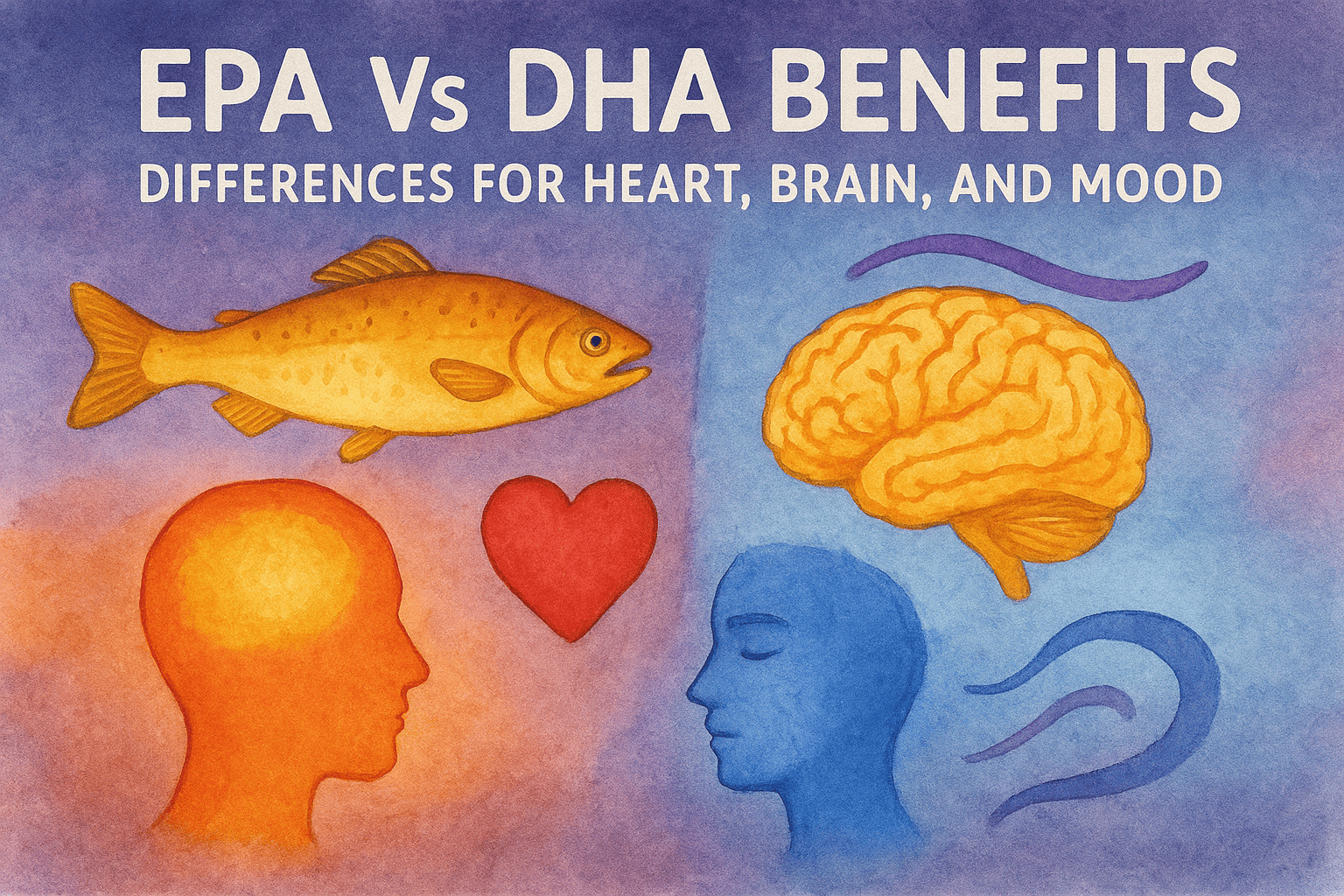
EPA and DHA are both omega-3 fatty acids, both found in fish oil, and both recommended constantly by health professionals. But they’re not the same molecule, and they don’t do the same things in your body. Understanding the epa vs dha benefits can help you make a smarter choice, especially if you’re targeting a specific outcome like mood stability, cognitive recovery, or heart health.
Here’s what most people get wrong: they buy a generic omega-3 supplement and assume they’re covered. In reality, the ratio of EPA to DHA matters a lot depending on your goals. EPA leans heavily into anti-inflammatory and mood-regulating pathways, while DHA is the structural backbone of your brain and retina. One calms the fire; the other rebuilds the house.
This distinction matters to us at Afterglow Supplements. Our protocols focus on helping your brain and body recover after psychedelic experiences, a process that depends on neurotransmitter replenishment, reduced neuroinflammation, and cognitive restoration. EPA and DHA both play roles here, but knowing which one to prioritize (and when) makes your recovery sharper. In this article, we’ll break down how each fatty acid works, where they differ, and which one aligns best with your specific health goals.
Why EPA and DHA matter for health goals
Your body cannot produce omega-3 fatty acids on its own. EPA (eicosapentaenoic acid) and DHA (docosahexaenoic acid) are long-chain omega-3s you must get from food or supplementation, and once inside your body, they behave in fundamentally different ways. Most people treat them as interchangeable because they come packaged together in most fish oil products, but their biological roles are distinct enough that taking the wrong ratio can leave specific health goals completely unaddressed.
How EPA and DHA work differently inside your body
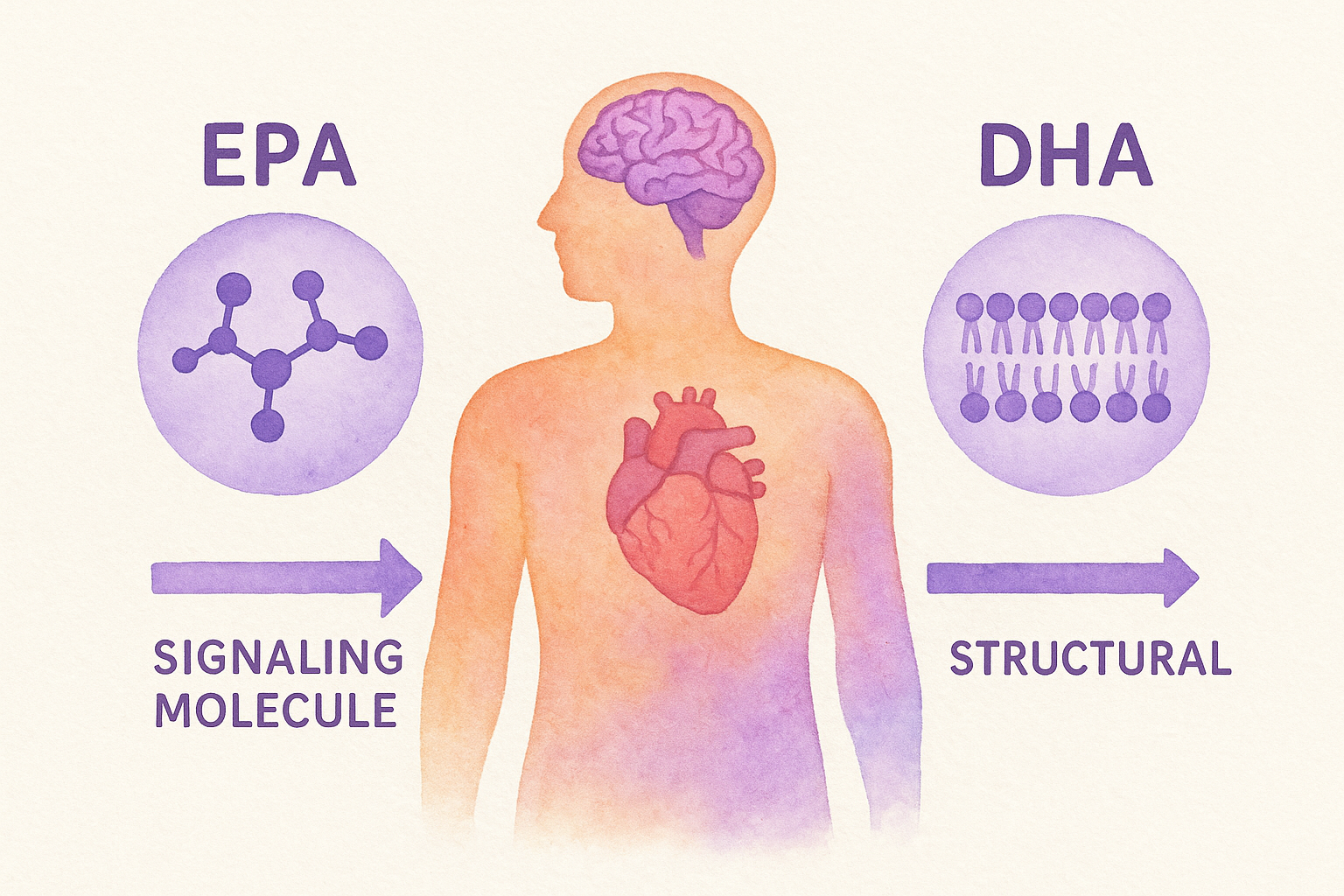
EPA operates primarily as a signaling molecule, acting as a precursor to compounds called eicosanoids, which regulate inflammation, platelet activity, and immune responses. When you consume EPA, your body uses it to produce anti-inflammatory signals that calm overactive immune responses and limit tissue damage. DHA is primarily structural rather than signaling-based. It becomes a physical component of cell membranes, especially in the brain, retina, and nervous system. If EPA is the manager sending instructions, DHA is the actual building material those instructions create.
Your neurons depend on DHA for membrane fluidity, meaning that adequate DHA levels directly affect how efficiently your brain’s receptors can send and receive signals.
Neurotransmitter receptors need fluid, flexible membranes to function at full capacity. DHA provides that fluidity, and without enough of it, cell membranes become more rigid and signal transmission slows down. This becomes especially relevant during cognitive stress, neural recovery, or prolonged periods of mental demand, because your brain continuously turns over membrane material and needs a consistent supply of DHA to maintain its structural integrity.
Why the EPA vs DHA benefits ratio matters for specific goals
Understanding the full picture of epa vs dha benefits means accepting that neither fatty acid is universally better. Both are essential, but your specific health target determines which one your body needs more of at a given time. Research on depression and systemic inflammation consistently highlights EPA as the more active agent, while studies on cognitive function, visual health, and brain development point more directly to DHA.
The problem is that most off-the-shelf fish oil products apply a generic EPA-to-DHA ratio without any goal-specific rationale behind the formulation. That ratio might work for general health maintenance, but it won’t necessarily move the needle for a targeted outcome. Matching your omega-3 profile to your specific goals is the step most people skip, and it’s exactly why two people can take the same supplement and report very different results.
EPA benefits and when to prioritize it
EPA’s strongest advantages show up in conditions where inflammation and mood are the primary concerns. While the full picture of epa vs dha benefits spans multiple systems, EPA’s role as a precursor to anti-inflammatory compounds makes it the more targeted choice when your body is dealing with systemic inflammation, emotional instability, or post-stress recovery. If your brain and body have been through something demanding, EPA is what your body reaches for first to reduce the biochemical noise.
EPA’s role in inflammation and mood
EPA directly reduces the production of pro-inflammatory signaling molecules called cytokines and prostaglandins, which are responsible for driving chronic inflammation when they stay elevated too long. Clinical research consistently shows that EPA reduces markers like C-reactive protein and supports more balanced immune activity, which matters if you’re dealing with fatigue, joint discomfort, or post-stress inflammation.
Studies on omega-3 supplementation for depression have found that formulas with a higher EPA-to-DHA ratio (above 60% EPA) produce more consistent mood improvements than balanced blends.
This effect on mood is not indirect. EPA appears to inhibit the enzyme phospholipase A2, which plays a role in breaking down cell membranes under inflammatory stress, and it also interacts with serotonin signaling pathways. For people experiencing mood crashes, anxiety, or emotional instability after intense physical or psychological events, EPA works on the neuroinflammatory side of the equation in ways DHA simply doesn’t.
When to choose EPA over DHA
You should prioritize EPA when your primary goal is one of the following:
Reducing systemic or neuroinflammation after physical stress, illness, or intense mental strain
Managing low mood, anxiety, or depression symptoms as a supplement alongside professional support
Supporting cardiovascular health, since EPA lowers triglycerides and reduces platelet aggregation more directly than DHA
Recovering from situations where inflammatory load has been elevated for an extended period
DHA benefits and when to prioritize it
While EPA handles the signaling and inflammatory side of the epa vs dha benefits equation, DHA handles something more fundamental: the physical architecture of your brain. DHA makes up roughly 97% of the omega-3 fatty acids found in the brain and about 93% of those in the retina. Without enough DHA, your neurons lose membrane flexibility, receptor function degrades, and cognitive processing slows down in ways that no amount of EPA can compensate for.
DHA’s role in brain structure and cognition
DHA is the primary omega-3 that gets incorporated directly into neuronal cell membranes, where it keeps those membranes fluid and responsive. This fluidity determines how efficiently receptors for serotonin, dopamine, and other neurotransmitters can function. When DHA levels drop, receptor sensitivity decreases and signal transmission between neurons becomes less precise, which shows up as brain fog, slower recall, and reduced mental clarity.
Research published through the National Institutes of Health has linked higher DHA status to better working memory, faster information processing, and lower rates of cognitive decline with age.
DHA also plays a direct role in supporting neuroprotection and reducing oxidative stress inside neurons. After any experience that taxes the brain heavily, whether through sleep deprivation, intense stimulation, or emotional strain, your brain’s demand for DHA rises as it works to repair and maintain its cellular infrastructure.
When to choose DHA over EPA
You should prioritize DHA when your primary goal is one of the following:
Improving focus, memory, and overall cognitive sharpness
Supporting brain recovery after mentally demanding events or periods of cognitive fatigue
Protecting long-term neurological health, particularly if you are concerned about age-related decline
Addressing visual health, since the retina depends on DHA just as much as the brain does
If cognitive restoration is your main target, DHA is the fatty acid that does the structural repair work.
How to choose EPA, DHA, or a blend
Choosing between EPA, DHA, or a combination comes down to matching your supplement to your specific health goal, not defaulting to whatever ratio the label happens to print. Once you understand the epa vs dha benefits that apply to your situation, the decision becomes straightforward rather than overwhelming.
Match your ratio to your primary goal
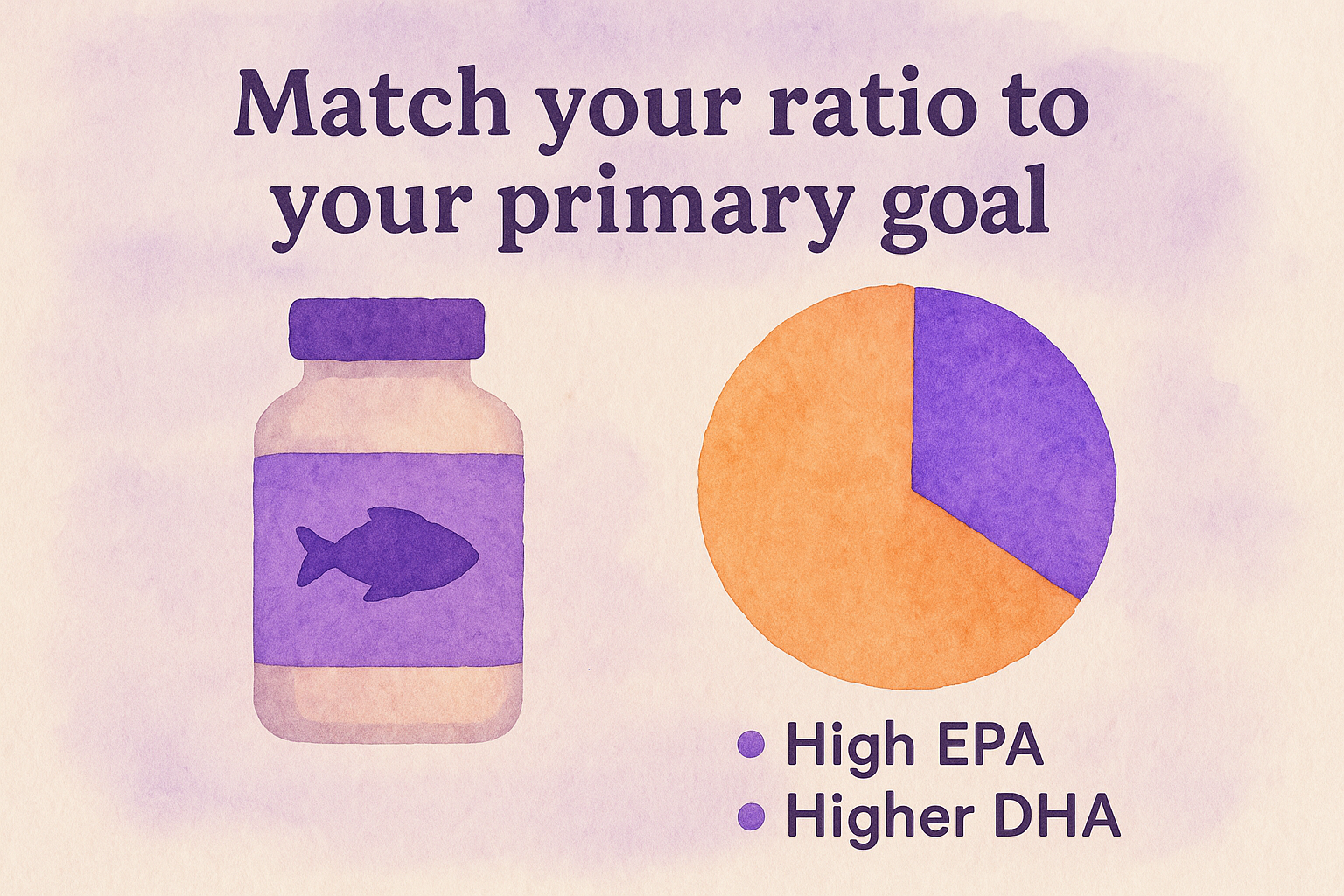
Your ratio should follow your goal directly. If inflammation and mood are your main concerns, reach for a product where EPA represents at least 60% of the total omega-3 content. If brain function, memory, and cognitive recovery are the priority, you want a formula with a higher DHA concentration relative to EPA.
Here’s a quick reference to guide your decision:
Primary goal
Recommended ratio
Mood support and inflammation
High EPA (60%+ EPA)
Brain function and memory
Higher DHA than EPA
Heart health and triglycerides
High EPA
General maintenance
Balanced blend (roughly 2:1 EPA:DHA)
When a blend makes sense
A balanced blend works best when you’re not targeting one specific outcome but want to support overall health across multiple systems simultaneously. If your goal includes both mood stability and cognitive clarity, a blend with a moderate EPA-to-DHA ratio around 2:1 covers both pathways without overcommitting to either.
Blends also make sense during recovery periods where your body faces multiple competing demands at once. After intense experiences that stress both your neurological and cardiovascular systems, a combination formula gives your body the raw materials it needs across the board without requiring you to stack separate products.
Always check the label for the actual EPA and DHA milligrams listed separately, since the total "omega-3" content printed on the front of the bottle often includes other fatty acids that don’t carry the same targeted benefits.
Safety, interactions, and supplement quality checks
Before you adjust your EPA or DHA intake, understanding the safety profile helps you avoid common mistakes. Both fatty acids are well-tolerated at standard doses, but certain health conditions and medications require you to pay closer attention to how you supplement. Knowing the key considerations around the full epa vs dha benefits picture keeps your supplementation both effective and safe.
Dosage, blood thinners, and known interactions
Most research supports a combined EPA and DHA intake of 1,000 to 3,000 mg per day for general health goals, with some clinical studies on mood and inflammation using higher amounts under medical supervision. Going above 3,000 mg daily without guidance raises the risk of prolonged bleeding time, since omega-3s reduce platelet aggregation. If you take anticoagulant medications like warfarin or aspirin regularly, consult your doctor before increasing your omega-3 dose.
Fish oil supplements can also lower blood pressure modestly, which matters if you already take antihypertensive medications and want to avoid stacking effects unintentionally.
People with fish or shellfish allergies should opt for algae-derived DHA and EPA sources, which carry none of the allergen risk while delivering the same molecular compounds your body uses.
How to verify supplement quality
Not all omega-3 products deliver what the label promises. The most reliable way to verify quality is to look for third-party testing certifications from organizations like IFOS (International Fish Oil Standards) or NSF International, which independently test for potency, purity, and the absence of heavy metals.
You should also check the label for oxidation indicators such as peroxide value and anisidine value. Oxidized fish oil loses its potency and can actually increase oxidative stress rather than reduce it. Buying products stored in dark, opaque packaging and checking the freshness date before purchase are two easy steps that significantly reduce your risk of consuming degraded product.
Look for separate EPA and DHA milligram amounts, not just total omega-3
Confirm third-party certification from IFOS or NSF
Check for oxidation values where available
Choose dark packaging to limit light-induced degradation
Key takeaways
The core of epa vs dha benefits comes down to function: EPA works primarily through anti-inflammatory and mood-regulating pathways, while DHA provides the structural material your brain and nervous system depend on daily. Neither one replaces the other, and both are essential for maintaining health across multiple systems simultaneously.
Your specific goal determines which ratio makes the most sense. Mood crashes, systemic inflammation, and cardiovascular support point you toward higher EPA concentrations. Cognitive recovery, memory, and long-term brain health point toward higher DHA. When you face multiple demands at once, a balanced blend around a 2:1 EPA-to-DHA ratio covers both without overcommitting to either.
Quality matters as much as ratio. Always check for separate EPA and DHA milligram values and third-party certification before buying. If your recovery goals go beyond omega-3s, and include neurotransmitter replenishment and post-experience restoration, explore the full Afterglow Recovery Protocol to see how targeted supplementation supports your recovery at every stage.
Lukas Nelpela
writes on neuroscience, mental health, and mindful exploration. With a passion in research-driven wellness and years focused on set & setting, integration, and recovery, he turns complex ideas into clear, usable insight.
You’re staring at your screen, reading the same sentence for the fourth time, and nothing sticks. Your thoughts feel like they’re wading through wet cement. So what is brain fog, exactly? It’s not a medical diagnosis, it’s a catch-all term for that frustrating state of mental cloudiness where focus, memory,
Every process in your body, thinking, moving, recovering, runs on energy produced inside your cells. That energy comes from mitochondria, and when they’re not functioning well, you feel it: brain fog, fatigue, slow recovery, and a general sense of running on empty. Mitochondrial support refers to the nutrients, habits, and
You sit down to focus, stare at your screen, and nothing clicks. Thoughts scatter, simple decisions feel impossible, and your mind moves like it’s stuck in wet concrete. If you’ve been looking up how to get rid of brain fog, you already know the frustration, that heavy, hazy state where
Working nights, rotating schedules, or pulling irregular hours throws your body’s internal clock into a constant state of confusion. Around 20% of the global workforce does some form of shift work, and the majority of those people report poor sleep as their number one complaint. Good sleep hygiene for shift
Stiff ankles affect more than just your squat depth. Limited ankle range of motion can mess with your knees, hips, and lower back, and if you spend long hours on your feet at festivals, retreats, or anywhere that keeps you moving, you’ll feel it. A solid ankle mobility routine takes
We use various cookies on our website. Some are essential for the website to function properly, while others we may only use with your consent. You can find more information about cookies on our website here.
This website uses cookies to improve your experience while you navigate through the website. Out of these cookies, the cookies that are categorized as necessary are stored on your browser as they are essential for the working of basic functionalities of the website. We also use third-party cookies that help us analyze and understand how you use this website. These cookies will be stored on your browser only with your consent. You also have the option to opt-out of these cookies. However, opting out of some of these cookies may have an impact on your browsing experience.
Necessary cookies are absolutely essential for the website to function properly. These cookies anonymously ensure basic functionalities and security features of the website.
Cookie
Duration
Description
cookielawinfo-checkbox-advertisement
1 year
Set by the GDPR Cookie Consent plugin, this cookie records the user consent for the cookies in the "Advertisement" category.
cookielawinfo-checkbox-analytics
11 months
This cookie is set by GDPR Cookie Consent plugin. The cookie is used to store the user consent for the cookies in the category "Analytics".
cookielawinfo-checkbox-functional
11 months
The cookie is set by GDPR cookie consent to record the user consent for the cookies in the category "Functional".
cookielawinfo-checkbox-necessary
11 months
This cookie is set by GDPR Cookie Consent plugin. The cookies is used to store the user consent for the cookies in the category "Necessary".
cookielawinfo-checkbox-others
11 months
This cookie is set by GDPR Cookie Consent plugin. The cookie is used to store the user consent for the cookies in the category "Other.
cookielawinfo-checkbox-performance
11 months
This cookie is set by GDPR Cookie Consent plugin. The cookie is used to store the user consent for the cookies in the category "Performance".
CookieLawInfoConsent
1 year
CookieYes sets this cookie to record the default button state of the corresponding category and the status of CCPA. It works only in coordination with the primary cookie.
elementor
never
The website's WordPress theme uses this cookie. It allows the website owner to implement or change the website's content in real-time.
fb_event_id_atc
30 minutes
Used to match client and server events for Meta Conversion API deduplication. Contains only anonymous technical IDs; no personal data stored.
fb_event_id_ic
30 minutes
Used to match client and server events for Meta Conversion API deduplication. Contains only anonymous technical IDs; no personal data stored.
fb_event_id_pur
30 minutes
Used to match client and server events for Meta Conversion API deduplication. Contains only anonymous technical IDs; no personal data stored.
fb_event_id_vc
30 minutes
Used to match client and server events for Meta Conversion API deduplication. Contains only anonymous technical IDs; no personal data stored.
rc::a
never
This cookie is set by the Google recaptcha service to identify bots to protect the website against malicious spam attacks.
rc::c
session
This cookie is set by the Google recaptcha service to identify bots to protect the website against malicious spam attacks.
viewed_cookie_policy
11 months
The cookie is set by the GDPR Cookie Consent plugin and is used to store whether or not user has consented to the use of cookies. It does not store any personal data.
VISITOR_PRIVACY_METADATA
6 months
YouTube sets this cookie to store the user's cookie consent state for the current domain.
wpEmojiSettingsSupports
session
WordPress sets this cookie when a user interacts with emojis on a WordPress site. It helps determine if the user's browser can display emojis properly.
Functional cookies help to perform certain functions, such as sharing website content on social media platforms, collecting feedback, and other third-party functions.
Cookie
Duration
Description
sib_cuid
6 months
SendinBlue sets this cookie to store unique visits.
VISITOR_INFO1_LIVE
6 months
A cookie set by YouTube to measure bandwidth that determines whether the user gets the new or old player interface.
yt-remote-cast-available
session
The yt-remote-cast-available cookie is used to store the user's preferences regarding whether casting is available on their YouTube video player.
yt-remote-cast-installed
session
The yt-remote-cast-installed cookie is used to store the user's video player preferences using embedded YouTube video.
yt-remote-connected-devices
never
YouTube sets this cookie to store the user's video preferences using embedded YouTube videos.
yt-remote-device-id
never
YouTube sets this cookie to store the user's video preferences using embedded YouTube videos.
yt-remote-fast-check-period
session
The yt-remote-fast-check-period cookie is used by YouTube to store the user's video player preferences for embedded YouTube videos.
yt-remote-session-app
session
The yt-remote-session-app cookie is used by YouTube to store user preferences and information about the interface of the embedded YouTube video player.
yt-remote-session-name
session
The yt-remote-session-name cookie is used by YouTube to store the user's video player preferences using embedded YouTube video.
ytidb::LAST_RESULT_ENTRY_KEY
never
The cookie ytidb::LAST_RESULT_ENTRY_KEY is used by YouTube to store the last search result entry that was clicked by the user. This information is used to improve the user experience by providing more relevant search results in the future.
Performance cookies are used to understand and analyze key website performance indexes, which helps in providing a better user experience for visitors.
Cookie
Duration
Description
SRM_B
1 year 24 days
Used by Microsoft Advertising as a unique ID for visitors.
Analytical cookies are used to understand how visitors interact with the website. These cookies help provide information on metrics such as the number of visitors, bounce rate, traffic source, etc.
Cookie
Duration
Description
_clck
1 year
Microsoft Clarity sets this cookie to retain the browser's Clarity User ID and settings exclusive to that website. This guarantees that actions taken during subsequent visits to the same website will be linked to the same user ID.
_clsk
1 day
Microsoft Clarity sets this cookie to store and consolidate a user's pageviews into a single session recording.
_fbp
3 months
Facebook sets this cookie to display advertisements when either on Facebook or on a digital platform powered by Facebook advertising after visiting the website.
_ga
1 year 1 month 4 days
Google Analytics sets this cookie to calculate visitor, session and campaign data and track site usage for the site's analytics report. The cookie stores information anonymously and assigns a randomly generated number to recognise unique visitors.
_ga_*
1 year 1 month 4 days
Google Analytics sets this cookie to store and count page views.
_gcl_au
3 months
Google Tag Manager sets the cookie to experiment advertisement efficiency of websites using their services.
_hjSession_*
1 hour
Hotjar sets this cookie to ensure data from subsequent visits to the same site is attributed to the same user ID, which persists in the Hotjar User ID, which is unique to that site.
_hjSessionUser_*
1 year
Hotjar sets this cookie to ensure data from subsequent visits to the same site is attributed to the same user ID, which persists in the Hotjar User ID, which is unique to that site.
_hjTLDTest
session
To determine the most generic cookie path that has to be used instead of the page hostname, Hotjar sets the _hjTLDTest cookie to store different URL substring alternatives until it fails.
CLID
1 year
Microsoft Clarity set this cookie to store information about how visitors interact with the website. The cookie helps to provide an analysis report. The data collection includes the number of visitors, where they visit the website, and the pages visited.
MR
7 days
This cookie, set by Bing, is used to collect user information for analytics purposes.
sbjs_current
session
Sourcebuster sets this cookie to identify the source of a visit and stores user action information in cookies. This analytical and behavioural cookie is used to enhance the visitor experience on the website.
sbjs_current_add
session
Sourcebuster sets this cookie to identify the source of a visit and stores user action information in cookies. This analytical and behavioural cookie is used to enhance the visitor experience on the website.
sbjs_first
session
Sourcebuster sets this cookie to identify the source of a visit and stores user action information in cookies. This analytical and behavioural cookie is used to enhance the visitor experience on the website.
sbjs_first_add
session
Sourcebuster sets this cookie to identify the source of a visit and stores user action information in cookies. This analytical and behavioural cookie is used to enhance the visitor experience on the website.
sbjs_migrations
session
Sourcebuster sets this cookie to identify the source of a visit and stores user action information in cookies. This analytical and behavioural cookie is used to enhance the visitor experience on the website.
sbjs_session
1 hour
Sourcebuster sets this cookie to identify the source of a visit and stores user action information in cookies. This analytical and behavioural cookie is used to enhance the visitor experience on the website.
sbjs_udata
session
Sourcebuster sets this cookie to identify the source of a visit and stores user action information in cookies. This analytical and behavioural cookie is used to enhance the visitor experience on the website.
SM
session
Microsoft Clarity cookie set this cookie for synchronizing the MUID across Microsoft domains.
YSC
session
YSC cookie is set by Youtube and is used to track the views of embedded videos on Youtube pages.
Advertising cookies are used to deliver relevant advertisements and marketing campaigns to visitors. These cookies track visitors across websites and collect information to deliver tailored advertisements.
Cookie
Duration
Description
_rdt_uuid
3 months
Reddit sets this cookie to build a profile of your interests and show you relevant ads.
ANONCHK
10 minutes
The ANONCHK cookie, set by Bing, is used to store a user's session ID and verify ads' clicks on the Bing search engine. The cookie helps in reporting and personalization as well.
MUID
1 year 24 days
Bing sets this cookie to recognise unique web browsers visiting Microsoft sites. This cookie is used for advertising, site analytics, and other operations.
test_cookie
15 minutes
doubleclick.net sets this cookie to determine if the user's browser supports cookies.
yt.innertube::nextId
never
YouTube sets this cookie to register a unique ID to store data on what videos from YouTube the user has seen.
yt.innertube::requests
never
YouTube sets this cookie to register a unique ID to store data on what videos from YouTube the user has seen.