Catalyst Athletics Mobility: Drills, Warmups, And Routine
7 min read
If your snatch or clean & jerk stalls out because your shoulders lock up or your ankles collapse, the barbell isn’t the problem, your tissue is. Catalyst Athletics mobility drills are built specifically for Olympic weightlifters who need real, position-specific range of motion, not generic stretching routines borrowed from yoga classes.
At Afterglow Supplements, we’re focused on recovery, whether that’s replenishing your body after an intense psychedelic experience or helping you understand what it takes to bounce back from any demanding physical or mental event. Mobility work falls squarely into that same philosophy: take care of your body so it can perform when it matters.
This guide breaks down the key Catalyst Athletics mobility drills, warmup sequences, and daily routines that target the overhead position, front rack, and deep squat. You’ll get specific movements you can start using immediately, organized into a practical routine you can run before training or on rest days.
What to expect from Catalyst Athletics mobility
Catalyst Athletics mobility content is built around one premise: weightlifters need position-specific range of motion, not general flexibility. The drills target the exact joints and tissue that limit your overhead, squat, and front rack positions. You will not find random stretches here. Every movement traces back to a specific mechanical demand in the snatch or clean & jerk, which makes the training immediately transferable to the platform.
Position-specific work, not generic flexibility
The Catalyst Athletics approach treats mobility as a skill, not a passive activity you do while scrolling your phone. Drills are sequenced to move from joint mobilization to active end-range control, meaning you work through a range and then learn to produce force in that position. This matters because passive flexibility alone does not translate to a stable receiving position under load.
You can be flexible enough to sit in a deep squat and still collapse the moment you catch a heavy clean, because flexibility and positional strength are two different things.
The drills address the shoulders, thoracic spine, hips, ankles, and wrists, which are the five areas most commonly limiting Olympic weightlifting positions. Each drill comes with a clear purpose, so you know exactly which position it feeds into.
Realistic time commitment and results
You do not need to train for hours to see results. Most Catalyst Athletics mobility sessions run between 10 and 20 minutes, and the expectation is daily consistency over weeks, not dramatic improvement in a single session. Here is what a typical week of focused work looks like:
Day
Focus
Duration
Training days
Pre-lift warmup
10 min
Training days
Post-lift tissue work
10 min
Rest days
Full mobility session
15-20 min
Your overhead position and squat depth will improve measurably within two to four weeks of consistent daily work, provided you address the right restrictions.
The six-part mobility system to use year-round
The catalyst athletics mobility framework organizes your training into six distinct components, each targeting a specific joint or tissue system. Running all six consistently throughout the year means you address every positional limitation that can block your snatch, clean, or jerk before it becomes a chronic problem. This is not a program you run for eight weeks and shelve; it is a year-round maintenance system.
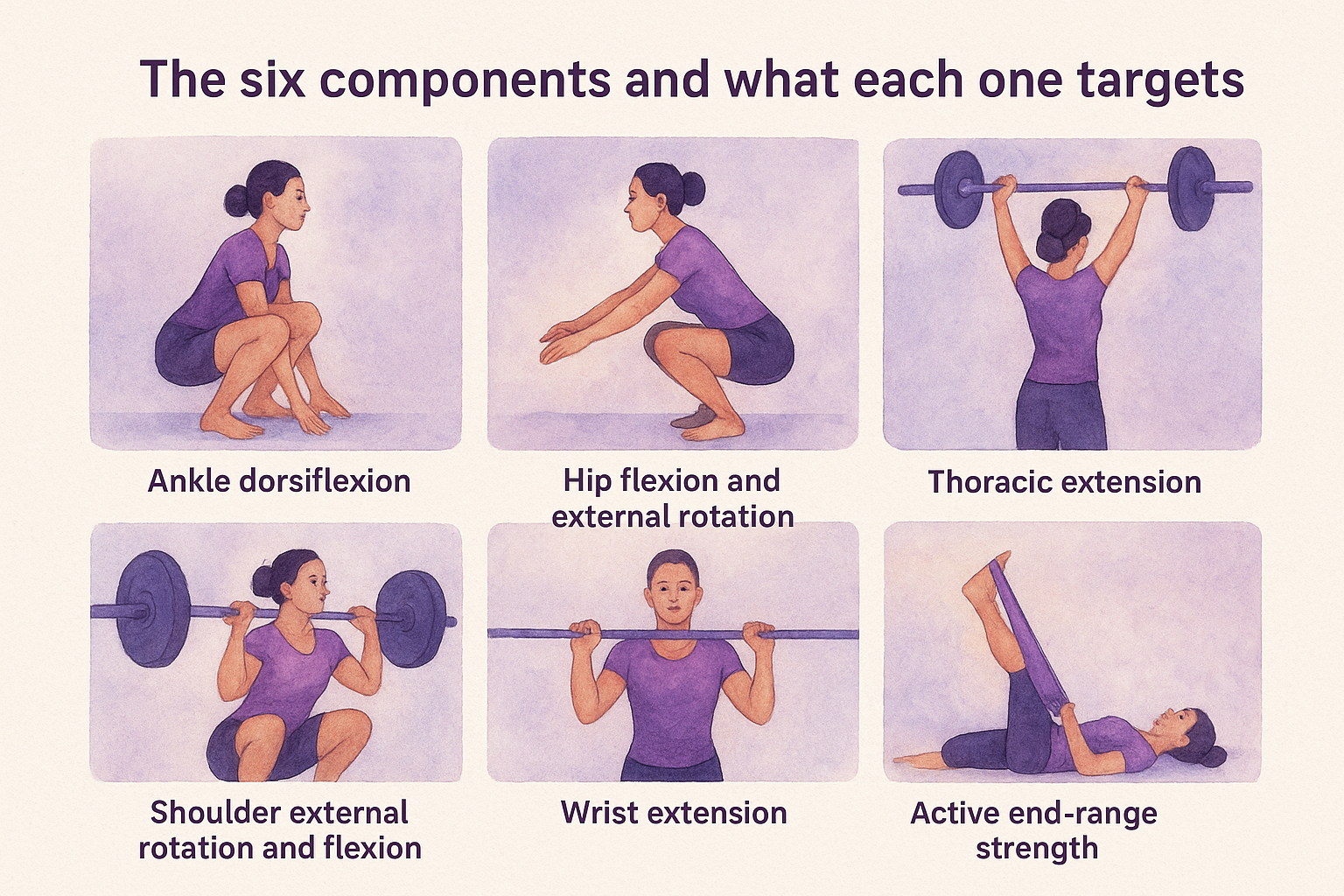
The six components and what each one targets
Structuring your mobility work this way means you avoid the common mistake of chasing one restriction while others quietly compound in the background. Each component has a specific mechanical purpose tied to a real position demand in the lift, and skipping even one area will eventually show up as a failure under load. Check all six at least once every week.
Consistency across all six components beats high intensity in any single one of them.
Here are the six parts of the system:
Ankle dorsiflexion – supports heel position and squat depth
Hip flexion and external rotation – controls your bottom squat position
Thoracic extension – opens the overhead and front rack
Shoulder external rotation and flexion – stabilizes the snatch catch
Wrist extension – holds the front rack under load
Active end-range strength – turns passive flexibility into usable, loaded range
Step 1. 10-minute pre-lift mobility warmup
Your pre-lift warmup should raise tissue temperature and open your key positions before you load the barbell. The catalyst athletics mobility approach keeps this under 10 minutes by targeting only the joints that directly affect your first working set, nothing more. You move through each drill with intent, not speed, staying focused on feeling actual end-range movement rather than just going through the motions.
Do not skip the warmup on days you feel loose. Perceived mobility and actual end-range control are two different things.
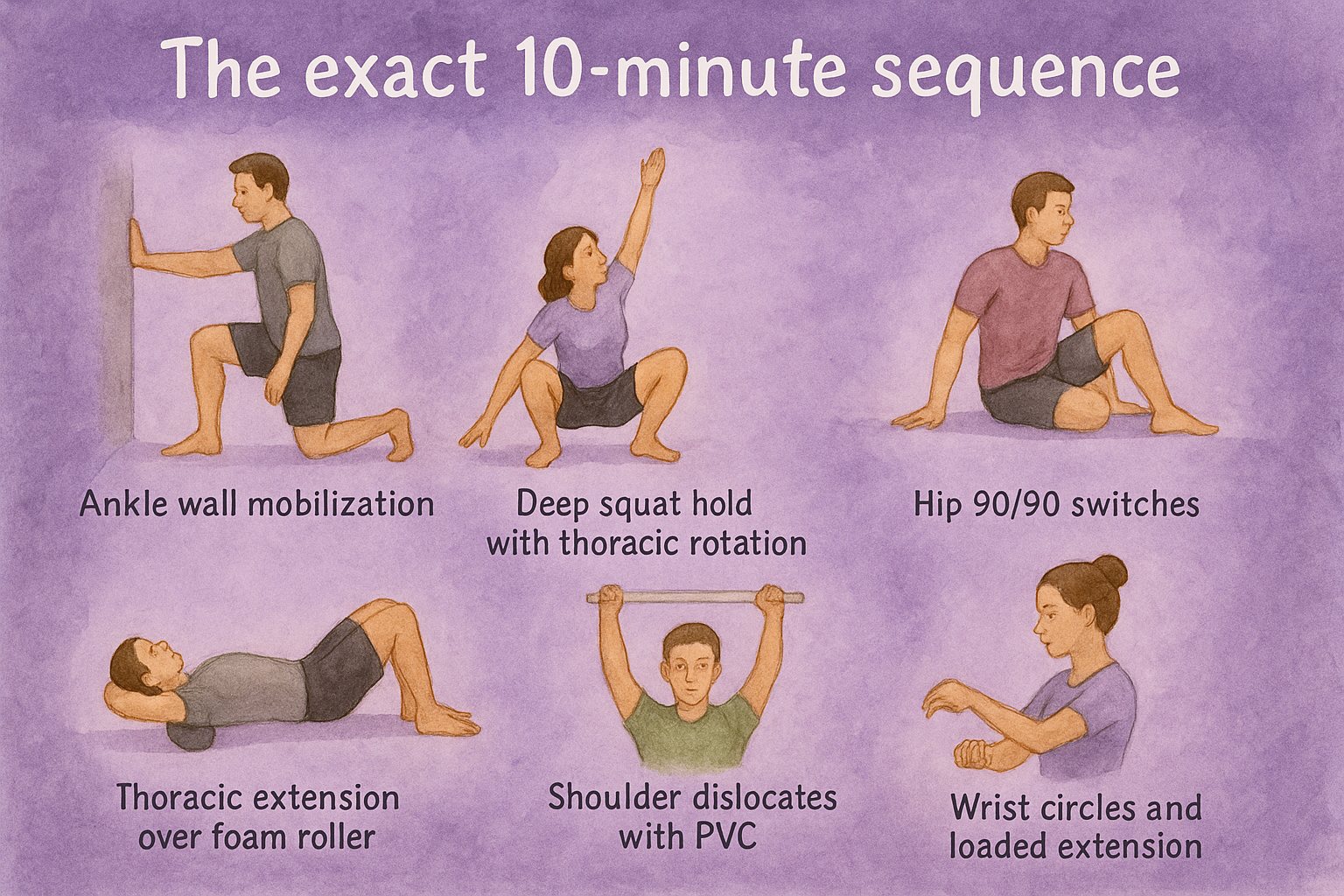
The exact 10-minute sequence
Run this sequence in order before every session. Each drill feeds directly into the next, building from ankle to hip to thoracic spine to shoulder. You do not need equipment beyond a wall and a foam roller.
Order
Drill
Duration
Target
1
Ankle wall mobilization
90 sec
Dorsiflexion
2
Deep squat hold with thoracic rotation
90 sec
Hip and T-spine
3
Hip 90/90 switches
90 sec
Hip external rotation
4
Thoracic extension over foam roller
90 sec
Front rack and overhead
5
Shoulder dislocates with PVC
90 sec
Snatch overhead
6
Wrist circles and loaded extension
60 sec
Front rack
Complete each drill with control, moving to your actual end range and pausing for one second before returning. Six drills done well beats ten drills done fast.
Step 2. Post-lift stretching and tissue work
Post-lift work is where lasting range of motion actually develops. Your tissue is warm, your nervous system is still activated, and your joints have just moved through full range under load. That makes the 10 minutes after your last set the most productive window for static stretching and soft tissue work in your entire training day.
Do your post-lift work before you cool down, not after you have already changed and packed your bag.
Target the tissue you just loaded
The catalyst athletics mobility approach prioritizes the tissue that worked hardest during the session. After a snatch day, you target shoulders and thoracic spine. After a clean and jerk day, you shift focus to hips and wrists. This keeps your post-lift work short and purposeful rather than a generic 20-stretch routine.
The post-lift sequence template
Run this after your cool-down sets. Hold each position for a full 60 seconds, breathing steadily through the stretch.
Order
Drill
Duration
Target
1
Pigeon pose hip stretch
60 sec each side
Hip external rotation
2
Doorway pec stretch
60 sec each side
Shoulder and front rack
3
Thoracic foam roller extension
90 sec
Overhead and posture
4
Wrist flexor stretch
60 sec each side
Front rack recovery
Fix overhead, squat, and front rack limitations
Three positions break down most lifters before they reach elite performance: the overhead lockout, the bottom of the squat, and the front rack. Catalyst athletics mobility drills address each one with targeted protocols that isolate the actual restriction, whether that is tight lats pulling your elbows forward or limited ankle dorsiflexion collapsing your squat depth. Identifying your specific limitation first saves you weeks of working the wrong tissue.
Fix the restriction that shows up earliest in the lift, because that one cascades into every position that follows.
Overhead: open lats and thoracic extension first
Your overhead position fails at two common points: the lat and the thoracic spine. Band-assisted lat stretches held for 90 seconds per side, combined with thoracic extension over a foam roller, directly address both restrictions. Do three rounds of each before any overhead pressing or snatch work, and add shoulder external rotation drills on days you feel the overhead lockout closing off.
Squat and front rack: ankle and hip mobility together
Both your squat depth and your front rack position depend on ankle dorsiflexion and hip external rotation working together efficiently. Run the wall ankle mobilization for two minutes per side, then move immediately into 90/90 hip stretches held for 90 seconds on each side. Stack these drills on consecutive training days until the restriction clears and the position holds under load.
Wrap-up and keep it consistent
The entire catalyst athletics mobility system works only if you run it consistently. One good session followed by two weeks of skipping drills will not move your overhead position or your squat depth. Daily practice of 10 to 20 minutes beats one long session per week every time.
Pick your restrictions first. If your overhead locks out early, start with lats and thoracic extension. If your squat collapses, attack ankle dorsiflexion and hips before anything else. Build the pre-lift warmup and post-lift sequence into your training schedule as fixed blocks, not optional add-ons, and track your positions every two weeks to confirm progress.
Recovery does not stop at the gym. If you push your body hard through training or any other demanding physical event, you need a structured recovery protocol to keep yourself functional between sessions. See the Afterglow Recovery Protocol to find out how targeted supplementation supports your body’s recovery after intense physical work.
Lukas Nelpela
writes on neuroscience, mental health, and mindful exploration. With a passion in research-driven wellness and years focused on set & setting, integration, and recovery, he turns complex ideas into clear, usable insight.
Sleep quality shapes how you think, feel, and recover, whether you’re bouncing back from a tough week or integrating a psychedelic experience. The Harvard sleep hygiene guidelines, developed by researchers at Harvard Medical School, remain some of the most cited and practical recommendations for improving rest. They’re not trendy hacks
If you’ve ever woken up after a psychedelic experience with a locked jaw, tight shoulders, or a neck that barely turns, you already know the toll that sustained muscle tension can take on your body. That tightness doesn’t just sit on the surface, it often lives deeper, in the connective
Your mitochondria produce roughly 90% of the energy your body runs on. Every thought, every heartbeat, every moment of focus or fatigue traces back to these tiny organelles inside your cells. When they’re thriving, you feel sharp, resilient, and recharged. When they’re not, you feel it, brain fog, sluggish recovery,
Stiff hips, locked-up shoulders, a jaw that still feels like a vice grip from last weekend, your body keeps a receipt for everything you put it through. Whether you’re recovering from a heavy festival, an intense psychedelic session, or just sitting at a desk for ten hours straight, mobility work
You already know the drill: you’re lying in bed after a long day (or a long night), scrolling your phone, and sleep feels miles away. Your brain won’t shut off, your eyes sting, and that melatonin you took 40 minutes ago hasn’t kicked in. One of the simplest fixes? Blue
We use various cookies on our website. Some are essential for the website to function properly, while others we may only use with your consent. You can find more information about cookies on our website here.
This website uses cookies to improve your experience while you navigate through the website. Out of these cookies, the cookies that are categorized as necessary are stored on your browser as they are essential for the working of basic functionalities of the website. We also use third-party cookies that help us analyze and understand how you use this website. These cookies will be stored on your browser only with your consent. You also have the option to opt-out of these cookies. However, opting out of some of these cookies may have an impact on your browsing experience.
Necessary cookies are absolutely essential for the website to function properly. These cookies anonymously ensure basic functionalities and security features of the website.
Cookie
Duration
Description
cookielawinfo-checkbox-advertisement
1 year
Set by the GDPR Cookie Consent plugin, this cookie records the user consent for the cookies in the "Advertisement" category.
cookielawinfo-checkbox-analytics
11 months
This cookie is set by GDPR Cookie Consent plugin. The cookie is used to store the user consent for the cookies in the category "Analytics".
cookielawinfo-checkbox-functional
11 months
The cookie is set by GDPR cookie consent to record the user consent for the cookies in the category "Functional".
cookielawinfo-checkbox-necessary
11 months
This cookie is set by GDPR Cookie Consent plugin. The cookies is used to store the user consent for the cookies in the category "Necessary".
cookielawinfo-checkbox-others
11 months
This cookie is set by GDPR Cookie Consent plugin. The cookie is used to store the user consent for the cookies in the category "Other.
cookielawinfo-checkbox-performance
11 months
This cookie is set by GDPR Cookie Consent plugin. The cookie is used to store the user consent for the cookies in the category "Performance".
CookieLawInfoConsent
1 year
CookieYes sets this cookie to record the default button state of the corresponding category and the status of CCPA. It works only in coordination with the primary cookie.
elementor
never
The website's WordPress theme uses this cookie. It allows the website owner to implement or change the website's content in real-time.
fb_event_id_atc
30 minutes
Used to match client and server events for Meta Conversion API deduplication. Contains only anonymous technical IDs; no personal data stored.
fb_event_id_ic
30 minutes
Used to match client and server events for Meta Conversion API deduplication. Contains only anonymous technical IDs; no personal data stored.
fb_event_id_pur
30 minutes
Used to match client and server events for Meta Conversion API deduplication. Contains only anonymous technical IDs; no personal data stored.
fb_event_id_vc
30 minutes
Used to match client and server events for Meta Conversion API deduplication. Contains only anonymous technical IDs; no personal data stored.
rc::a
never
This cookie is set by the Google recaptcha service to identify bots to protect the website against malicious spam attacks.
rc::c
session
This cookie is set by the Google recaptcha service to identify bots to protect the website against malicious spam attacks.
viewed_cookie_policy
11 months
The cookie is set by the GDPR Cookie Consent plugin and is used to store whether or not user has consented to the use of cookies. It does not store any personal data.
VISITOR_PRIVACY_METADATA
6 months
YouTube sets this cookie to store the user's cookie consent state for the current domain.
wpEmojiSettingsSupports
session
WordPress sets this cookie when a user interacts with emojis on a WordPress site. It helps determine if the user's browser can display emojis properly.
Functional cookies help to perform certain functions, such as sharing website content on social media platforms, collecting feedback, and other third-party functions.
Cookie
Duration
Description
sib_cuid
6 months
SendinBlue sets this cookie to store unique visits.
VISITOR_INFO1_LIVE
6 months
A cookie set by YouTube to measure bandwidth that determines whether the user gets the new or old player interface.
yt-remote-cast-available
session
The yt-remote-cast-available cookie is used to store the user's preferences regarding whether casting is available on their YouTube video player.
yt-remote-cast-installed
session
The yt-remote-cast-installed cookie is used to store the user's video player preferences using embedded YouTube video.
yt-remote-connected-devices
never
YouTube sets this cookie to store the user's video preferences using embedded YouTube videos.
yt-remote-device-id
never
YouTube sets this cookie to store the user's video preferences using embedded YouTube videos.
yt-remote-fast-check-period
session
The yt-remote-fast-check-period cookie is used by YouTube to store the user's video player preferences for embedded YouTube videos.
yt-remote-session-app
session
The yt-remote-session-app cookie is used by YouTube to store user preferences and information about the interface of the embedded YouTube video player.
yt-remote-session-name
session
The yt-remote-session-name cookie is used by YouTube to store the user's video player preferences using embedded YouTube video.
ytidb::LAST_RESULT_ENTRY_KEY
never
The cookie ytidb::LAST_RESULT_ENTRY_KEY is used by YouTube to store the last search result entry that was clicked by the user. This information is used to improve the user experience by providing more relevant search results in the future.
Performance cookies are used to understand and analyze key website performance indexes, which helps in providing a better user experience for visitors.
Cookie
Duration
Description
SRM_B
1 year 24 days
Used by Microsoft Advertising as a unique ID for visitors.
Analytical cookies are used to understand how visitors interact with the website. These cookies help provide information on metrics such as the number of visitors, bounce rate, traffic source, etc.
Cookie
Duration
Description
_clck
1 year
Microsoft Clarity sets this cookie to retain the browser's Clarity User ID and settings exclusive to that website. This guarantees that actions taken during subsequent visits to the same website will be linked to the same user ID.
_clsk
1 day
Microsoft Clarity sets this cookie to store and consolidate a user's pageviews into a single session recording.
_fbp
3 months
Facebook sets this cookie to display advertisements when either on Facebook or on a digital platform powered by Facebook advertising after visiting the website.
_ga
1 year 1 month 4 days
Google Analytics sets this cookie to calculate visitor, session and campaign data and track site usage for the site's analytics report. The cookie stores information anonymously and assigns a randomly generated number to recognise unique visitors.
_ga_*
1 year 1 month 4 days
Google Analytics sets this cookie to store and count page views.
_gcl_au
3 months
Google Tag Manager sets the cookie to experiment advertisement efficiency of websites using their services.
_hjSession_*
1 hour
Hotjar sets this cookie to ensure data from subsequent visits to the same site is attributed to the same user ID, which persists in the Hotjar User ID, which is unique to that site.
_hjSessionUser_*
1 year
Hotjar sets this cookie to ensure data from subsequent visits to the same site is attributed to the same user ID, which persists in the Hotjar User ID, which is unique to that site.
_hjTLDTest
session
To determine the most generic cookie path that has to be used instead of the page hostname, Hotjar sets the _hjTLDTest cookie to store different URL substring alternatives until it fails.
CLID
1 year
Microsoft Clarity set this cookie to store information about how visitors interact with the website. The cookie helps to provide an analysis report. The data collection includes the number of visitors, where they visit the website, and the pages visited.
MR
7 days
This cookie, set by Bing, is used to collect user information for analytics purposes.
sbjs_current
session
Sourcebuster sets this cookie to identify the source of a visit and stores user action information in cookies. This analytical and behavioural cookie is used to enhance the visitor experience on the website.
sbjs_current_add
session
Sourcebuster sets this cookie to identify the source of a visit and stores user action information in cookies. This analytical and behavioural cookie is used to enhance the visitor experience on the website.
sbjs_first
session
Sourcebuster sets this cookie to identify the source of a visit and stores user action information in cookies. This analytical and behavioural cookie is used to enhance the visitor experience on the website.
sbjs_first_add
session
Sourcebuster sets this cookie to identify the source of a visit and stores user action information in cookies. This analytical and behavioural cookie is used to enhance the visitor experience on the website.
sbjs_migrations
session
Sourcebuster sets this cookie to identify the source of a visit and stores user action information in cookies. This analytical and behavioural cookie is used to enhance the visitor experience on the website.
sbjs_session
1 hour
Sourcebuster sets this cookie to identify the source of a visit and stores user action information in cookies. This analytical and behavioural cookie is used to enhance the visitor experience on the website.
sbjs_udata
session
Sourcebuster sets this cookie to identify the source of a visit and stores user action information in cookies. This analytical and behavioural cookie is used to enhance the visitor experience on the website.
SM
session
Microsoft Clarity cookie set this cookie for synchronizing the MUID across Microsoft domains.
YSC
session
YSC cookie is set by Youtube and is used to track the views of embedded videos on Youtube pages.
Advertising cookies are used to deliver relevant advertisements and marketing campaigns to visitors. These cookies track visitors across websites and collect information to deliver tailored advertisements.
Cookie
Duration
Description
_rdt_uuid
3 months
Reddit sets this cookie to build a profile of your interests and show you relevant ads.
ANONCHK
10 minutes
The ANONCHK cookie, set by Bing, is used to store a user's session ID and verify ads' clicks on the Bing search engine. The cookie helps in reporting and personalization as well.
MUID
1 year 24 days
Bing sets this cookie to recognise unique web browsers visiting Microsoft sites. This cookie is used for advertising, site analytics, and other operations.
test_cookie
15 minutes
doubleclick.net sets this cookie to determine if the user's browser supports cookies.
yt.innertube::nextId
never
YouTube sets this cookie to register a unique ID to store data on what videos from YouTube the user has seen.
yt.innertube::requests
never
YouTube sets this cookie to register a unique ID to store data on what videos from YouTube the user has seen.