Myofascial Release Before or After Workout: When to Do It
8 min read
Whether you should do myofascial release before or after workout depends on what you’re trying to achieve, and the answer isn’t as binary as most people think. Pre-workout, it can prime your muscles for better range of motion. Post-workout, it helps flush metabolic waste and ease tension that builds up under load.
The thing is, timing matters more than most gym-goers realize. Rolling out your quads before a heavy squat session has a very different physiological effect than doing it afterward. Get it wrong, and you could actually limit your performance or slow down recovery instead of supporting it.
At Afterglow Supplements, recovery is our entire focus, specifically helping the body bounce back after intense experiences, from psychedelic journeys to the physical demands that come with festival weekends and active lifestyles. Muscle tension, jaw clenching, and full-body fatigue are things we think about daily. So we put this guide together to help you time your myofascial release work for maximum benefit, whether your goal is better mobility, faster recovery, or both.
What myofascial release does and what it is
Myofascial release is a soft tissue technique that applies sustained pressure to the fascia, the connective tissue that wraps around and runs through your muscles, bones, and organs. You can do it with a foam roller, a lacrosse ball, or a massage stick. The goal is to loosen restrictions in that connective tissue so your muscles can move more freely and with less discomfort. When you’re figuring out myofascial release before or after workout, understanding what’s physically happening in your body makes the timing question much easier to answer.
What the fascia actually is
Fascia isn’t just a passive wrapper. It’s a three-dimensional web of collagen and elastin that connects everything in your body, from your skin down to your deepest muscle layers. When it’s healthy and well-hydrated, it glides easily between structures. When it gets tight, dehydrated, or restricted from training load, stress, or poor recovery, it limits your range of motion and contributes to that "stuck" feeling you notice in specific spots. Many people assume this tightness comes purely from the muscle itself, but fascial restriction and muscle tension are different problems that respond differently to treatment.
What happens when you apply pressure
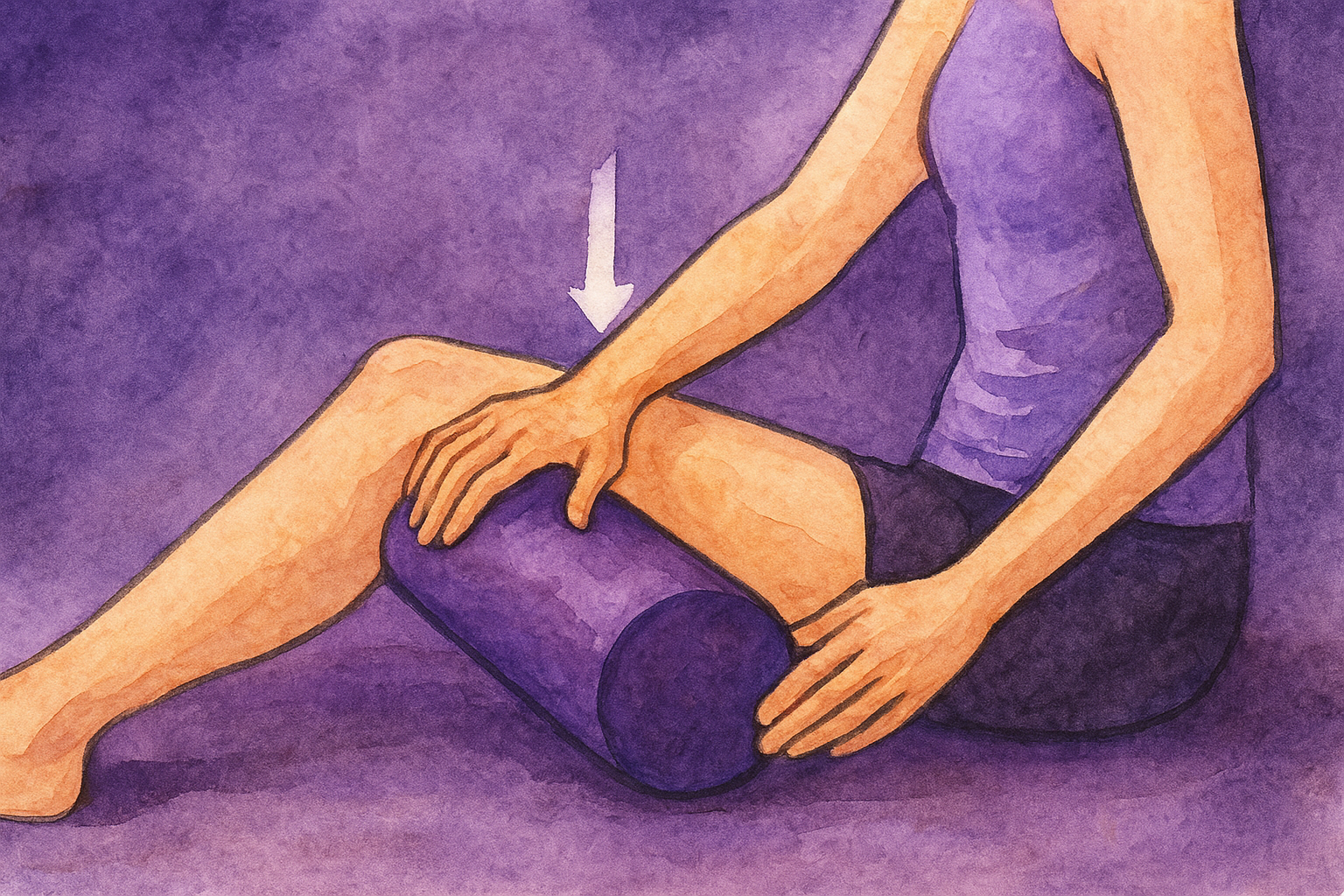
When you press a foam roller into a tense area and hold it, you’re triggering several physiological responses at the same time. You’re stimulating mechanoreceptors embedded in the tissue, which sends a signal to your nervous system to reduce motor tone in that region. You’re also raising local blood flow and tissue temperature, which improves the elasticity of the collagen fibers around the area. This is why sustained pressure feels like it "releases" something: your nervous system is genuinely lowering the tension signal to that spot.
Slow, sustained pressure held for 30 to 90 seconds produces a stronger nervous system response than fast rolling, because your mechanoreceptors need time to register the input and respond.
There’s also a fluid exchange component that matters for recovery. Fascia holds interstitial fluid, and compression followed by release acts like squeezing a sponge, flushing out metabolic waste and pulling in fresh fluid. This is part of why regular myofascial work builds cumulative flexibility gains over weeks, not just a temporary looseness during the session itself.
When to do it before your workout
Pre-workout myofascial release works best when your goal is improving range of motion and reducing stiffness before you start moving under load. If you know you’re about to squat, deadlift, or do any movement that demands full hip flexion, spending a few minutes on tight spots beforehand helps your joints access the depth they need without compensation patterns kicking in. It’s not about loosening everything. It’s about addressing specific areas that will restrict your movement in that session.
Keep pre-workout sessions short and targeted. Rolling for too long before training can temporarily reduce force output in the targeted muscle, which is the opposite of what you want heading into a lifting session.
Limit pre-workout myofascial release to 60 to 90 seconds per area to avoid reducing muscle activation before your sets.
What to target and for how long
When deciding on myofascial release before or after workout, target areas that are tight relative to the demands of your session. Before a lower body day, work the hip flexors, thoracic spine, and calves. Before an upper body session, focus on the pecs, lats, and forearms.
Area
Duration
Hip flexors
60 sec each side
Thoracic spine
60 to 90 sec total
Calves
45 to 60 sec each side
Pecs and lats
60 sec each side
Keep the pressure moderate, not aggressive. Aggressive, painful pressure before training spikes your nervous system’s threat response and causes the tissue to tighten further rather than release.
When to do it after your workout
Post-workout myofascial release is where most people get the most consistent benefit. Your muscles are warm, blood flow is elevated, and the tissue is more pliable than it was at the start of your session. This makes it easier to sink into restrictions without forcing the pressure, and your nervous system is already in a state where it’s more receptive to relaxation signals. When you’re weighing myofascial release before or after workout as your primary session, defaulting to post-workout gives you recovery benefits without the risk of reducing strength output before your sets.
Post-workout rolling works best when you hold pressure for 60 to 90 seconds per area rather than rushing through, because this is when the nervous system downregulation effect is strongest.
What makes post-workout the better default
After training, your muscles have accumulated metabolic byproducts like lactate and hydrogen ions, and your fascia has been repeatedly loaded and compressed. Applying myofascial release at this point supports fluid exchange in the tissue, helping move waste products out and pull in fresh, nutrient-rich fluid. This reduces the inflammatory response and the delayed onset soreness that typically peaks 24 to 48 hours after training.
What to target and for how long
Focus on the muscle groups you just trained, and spend slightly longer on each area than you would pre-workout.
Area
Duration
Quads and hamstrings
90 sec each side
Glutes and piriformis
60 to 90 sec each side
Upper back and lats
90 sec total
Calves
60 sec each side
Keep your breathing slow and deliberate throughout. Exhaling into tight spots accelerates the nervous system’s release response.
When to do it both before and after
Some training sessions justify myofascial release on both ends, and knowing when that’s worth the extra time saves you from overcomplicating your routine. High-volume days, long runs, heavy lower body sessions, or any workout where specific areas are both restricted going in and heavily loaded throughout are the clearest cases for a double session. The pre-workout work addresses mobility restrictions so you can move cleanly, and the post-workout work handles the recovery side once the damage is done.
Doing myofascial release both before and after a workout isn’t overkill if you keep each session short and targeted rather than trying to cover every muscle group twice.
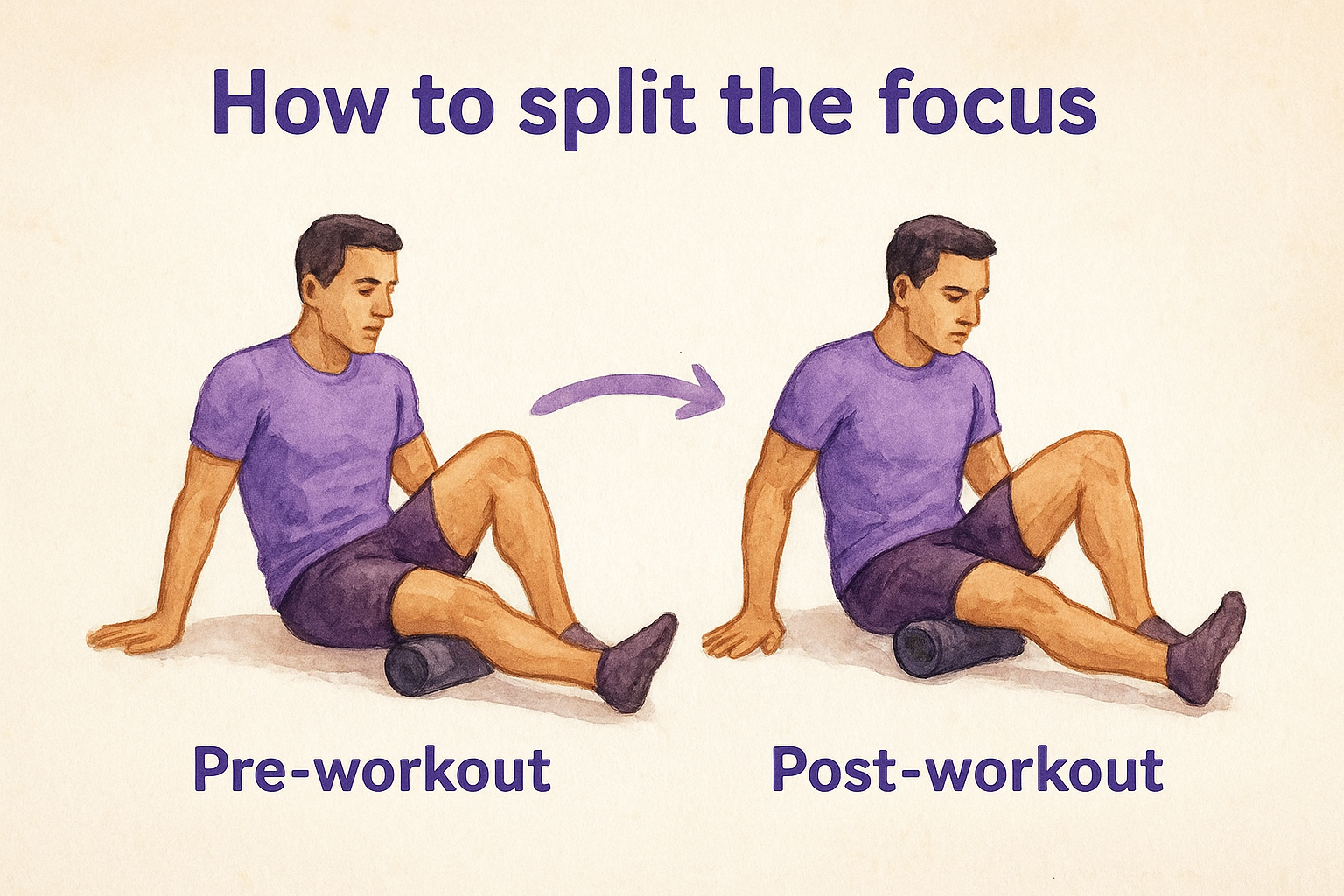
How to split the focus
When you decide that myofascial release before or after workout alone won’t cover what your body needs, split the focus rather than repeating the same work. Pre-workout, target the areas that will limit your movement in that session. Post-workout, shift attention to the muscles you just loaded most heavily, which often overlaps but isn’t always identical.
Timing
Focus
Pre-workout
Mobility restrictions specific to the session
Post-workout
Loaded muscles and connective tissue recovery
Keep your pre-workout pass to two or three areas and under two minutes total. Your post-workout pass can be longer and more thorough since you’re no longer worried about reducing force output before your sets. Splitting your attention this way turns what could feel like extra work into a structured system with a clear purpose at each end.
How to do it safely and effectively
Regardless of whether you choose myofascial release before or after workout, applying pressure correctly is the difference between productive tissue work and a session that leaves you more irritated than when you started. The most common mistake is rolling too fast and too hard, treating the foam roller like a massage gun rather than a tool that needs time to work.
Pressure and pain thresholds
Your pressure should sit at a 6 or 7 out of 10 discomfort, uncomfortable enough to feel productive but never sharp or shooting. If you feel nerve pain, numbness, or pain that intensifies rather than softens after 10 seconds, ease off immediately and shift position. Hold each spot until you feel the tissue begin to soften, then move to the next restriction.
Never roll directly on a joint, the lower back, or any area with acute inflammation, bruising, or swelling, as direct pressure on these areas causes harm rather than relief.
Technique and hydration
Use slow, deliberate movements and pause when you find a tender spot rather than rolling through it continuously. Breathe out into the pressure and give your nervous system time to process the input. Your tissue responds to patience, not force.
Drinking water before and after your session supports the fluid exchange that makes myofascial work effective. Fascia is largely water, and when you’re dehydrated, the tissue loses elasticity and becomes harder to release. Aim for at least 250 to 500ml of water around your rolling session to keep the tissue responsive and aid the flushing effect.
Quick recap
Deciding on myofascial release before or after workout comes down to your goal for that session. Pre-workout, keep it short, targeted, and focused on the specific areas that will limit your movement under load. Sixty to ninety seconds per spot is enough. Post-workout, you have more flexibility to go longer, cover the muscles you just trained, and let the tissue fully settle before you move on with your day.
If your session is particularly demanding, do both, but split the focus so you’re not repeating the same work twice. Pre-workout handles mobility, post-workout handles recovery. Breathe slowly, hold pressure long enough to feel the tissue respond, and stay hydrated so your fascia stays pliable throughout.
Physical recovery takes more than foam rolling. If you want structured support for muscle tension, fatigue, and full-body recovery, take a look at the Afterglow Recovery Protocol and see what a complete approach looks like.
Lukas Nelpela
writes on neuroscience, mental health, and mindful exploration. With a passion in research-driven wellness and years focused on set & setting, integration, and recovery, he turns complex ideas into clear, usable insight.
Sleep quality shapes how you think, feel, and recover, whether you’re bouncing back from a tough week or integrating a psychedelic experience. The Harvard sleep hygiene guidelines, developed by researchers at Harvard Medical School, remain some of the most cited and practical recommendations for improving rest. They’re not trendy hacks
If you’ve ever woken up after a psychedelic experience with a locked jaw, tight shoulders, or a neck that barely turns, you already know the toll that sustained muscle tension can take on your body. That tightness doesn’t just sit on the surface, it often lives deeper, in the connective
Your mitochondria produce roughly 90% of the energy your body runs on. Every thought, every heartbeat, every moment of focus or fatigue traces back to these tiny organelles inside your cells. When they’re thriving, you feel sharp, resilient, and recharged. When they’re not, you feel it, brain fog, sluggish recovery,
Stiff hips, locked-up shoulders, a jaw that still feels like a vice grip from last weekend, your body keeps a receipt for everything you put it through. Whether you’re recovering from a heavy festival, an intense psychedelic session, or just sitting at a desk for ten hours straight, mobility work
You already know the drill: you’re lying in bed after a long day (or a long night), scrolling your phone, and sleep feels miles away. Your brain won’t shut off, your eyes sting, and that melatonin you took 40 minutes ago hasn’t kicked in. One of the simplest fixes? Blue
We use various cookies on our website. Some are essential for the website to function properly, while others we may only use with your consent. You can find more information about cookies on our website here.
This website uses cookies to improve your experience while you navigate through the website. Out of these cookies, the cookies that are categorized as necessary are stored on your browser as they are essential for the working of basic functionalities of the website. We also use third-party cookies that help us analyze and understand how you use this website. These cookies will be stored on your browser only with your consent. You also have the option to opt-out of these cookies. However, opting out of some of these cookies may have an impact on your browsing experience.
Necessary cookies are absolutely essential for the website to function properly. These cookies anonymously ensure basic functionalities and security features of the website.
Cookie
Duration
Description
cookielawinfo-checkbox-advertisement
1 year
Set by the GDPR Cookie Consent plugin, this cookie records the user consent for the cookies in the "Advertisement" category.
cookielawinfo-checkbox-analytics
11 months
This cookie is set by GDPR Cookie Consent plugin. The cookie is used to store the user consent for the cookies in the category "Analytics".
cookielawinfo-checkbox-functional
11 months
The cookie is set by GDPR cookie consent to record the user consent for the cookies in the category "Functional".
cookielawinfo-checkbox-necessary
11 months
This cookie is set by GDPR Cookie Consent plugin. The cookies is used to store the user consent for the cookies in the category "Necessary".
cookielawinfo-checkbox-others
11 months
This cookie is set by GDPR Cookie Consent plugin. The cookie is used to store the user consent for the cookies in the category "Other.
cookielawinfo-checkbox-performance
11 months
This cookie is set by GDPR Cookie Consent plugin. The cookie is used to store the user consent for the cookies in the category "Performance".
CookieLawInfoConsent
1 year
CookieYes sets this cookie to record the default button state of the corresponding category and the status of CCPA. It works only in coordination with the primary cookie.
elementor
never
The website's WordPress theme uses this cookie. It allows the website owner to implement or change the website's content in real-time.
fb_event_id_atc
30 minutes
Used to match client and server events for Meta Conversion API deduplication. Contains only anonymous technical IDs; no personal data stored.
fb_event_id_ic
30 minutes
Used to match client and server events for Meta Conversion API deduplication. Contains only anonymous technical IDs; no personal data stored.
fb_event_id_pur
30 minutes
Used to match client and server events for Meta Conversion API deduplication. Contains only anonymous technical IDs; no personal data stored.
fb_event_id_vc
30 minutes
Used to match client and server events for Meta Conversion API deduplication. Contains only anonymous technical IDs; no personal data stored.
rc::a
never
This cookie is set by the Google recaptcha service to identify bots to protect the website against malicious spam attacks.
rc::c
session
This cookie is set by the Google recaptcha service to identify bots to protect the website against malicious spam attacks.
viewed_cookie_policy
11 months
The cookie is set by the GDPR Cookie Consent plugin and is used to store whether or not user has consented to the use of cookies. It does not store any personal data.
VISITOR_PRIVACY_METADATA
6 months
YouTube sets this cookie to store the user's cookie consent state for the current domain.
wpEmojiSettingsSupports
session
WordPress sets this cookie when a user interacts with emojis on a WordPress site. It helps determine if the user's browser can display emojis properly.
Functional cookies help to perform certain functions, such as sharing website content on social media platforms, collecting feedback, and other third-party functions.
Cookie
Duration
Description
sib_cuid
6 months
SendinBlue sets this cookie to store unique visits.
VISITOR_INFO1_LIVE
6 months
A cookie set by YouTube to measure bandwidth that determines whether the user gets the new or old player interface.
yt-remote-cast-available
session
The yt-remote-cast-available cookie is used to store the user's preferences regarding whether casting is available on their YouTube video player.
yt-remote-cast-installed
session
The yt-remote-cast-installed cookie is used to store the user's video player preferences using embedded YouTube video.
yt-remote-connected-devices
never
YouTube sets this cookie to store the user's video preferences using embedded YouTube videos.
yt-remote-device-id
never
YouTube sets this cookie to store the user's video preferences using embedded YouTube videos.
yt-remote-fast-check-period
session
The yt-remote-fast-check-period cookie is used by YouTube to store the user's video player preferences for embedded YouTube videos.
yt-remote-session-app
session
The yt-remote-session-app cookie is used by YouTube to store user preferences and information about the interface of the embedded YouTube video player.
yt-remote-session-name
session
The yt-remote-session-name cookie is used by YouTube to store the user's video player preferences using embedded YouTube video.
ytidb::LAST_RESULT_ENTRY_KEY
never
The cookie ytidb::LAST_RESULT_ENTRY_KEY is used by YouTube to store the last search result entry that was clicked by the user. This information is used to improve the user experience by providing more relevant search results in the future.
Performance cookies are used to understand and analyze key website performance indexes, which helps in providing a better user experience for visitors.
Cookie
Duration
Description
SRM_B
1 year 24 days
Used by Microsoft Advertising as a unique ID for visitors.
Analytical cookies are used to understand how visitors interact with the website. These cookies help provide information on metrics such as the number of visitors, bounce rate, traffic source, etc.
Cookie
Duration
Description
_clck
1 year
Microsoft Clarity sets this cookie to retain the browser's Clarity User ID and settings exclusive to that website. This guarantees that actions taken during subsequent visits to the same website will be linked to the same user ID.
_clsk
1 day
Microsoft Clarity sets this cookie to store and consolidate a user's pageviews into a single session recording.
_fbp
3 months
Facebook sets this cookie to display advertisements when either on Facebook or on a digital platform powered by Facebook advertising after visiting the website.
_ga
1 year 1 month 4 days
Google Analytics sets this cookie to calculate visitor, session and campaign data and track site usage for the site's analytics report. The cookie stores information anonymously and assigns a randomly generated number to recognise unique visitors.
_ga_*
1 year 1 month 4 days
Google Analytics sets this cookie to store and count page views.
_gcl_au
3 months
Google Tag Manager sets the cookie to experiment advertisement efficiency of websites using their services.
_hjSession_*
1 hour
Hotjar sets this cookie to ensure data from subsequent visits to the same site is attributed to the same user ID, which persists in the Hotjar User ID, which is unique to that site.
_hjSessionUser_*
1 year
Hotjar sets this cookie to ensure data from subsequent visits to the same site is attributed to the same user ID, which persists in the Hotjar User ID, which is unique to that site.
_hjTLDTest
session
To determine the most generic cookie path that has to be used instead of the page hostname, Hotjar sets the _hjTLDTest cookie to store different URL substring alternatives until it fails.
CLID
1 year
Microsoft Clarity set this cookie to store information about how visitors interact with the website. The cookie helps to provide an analysis report. The data collection includes the number of visitors, where they visit the website, and the pages visited.
MR
7 days
This cookie, set by Bing, is used to collect user information for analytics purposes.
sbjs_current
session
Sourcebuster sets this cookie to identify the source of a visit and stores user action information in cookies. This analytical and behavioural cookie is used to enhance the visitor experience on the website.
sbjs_current_add
session
Sourcebuster sets this cookie to identify the source of a visit and stores user action information in cookies. This analytical and behavioural cookie is used to enhance the visitor experience on the website.
sbjs_first
session
Sourcebuster sets this cookie to identify the source of a visit and stores user action information in cookies. This analytical and behavioural cookie is used to enhance the visitor experience on the website.
sbjs_first_add
session
Sourcebuster sets this cookie to identify the source of a visit and stores user action information in cookies. This analytical and behavioural cookie is used to enhance the visitor experience on the website.
sbjs_migrations
session
Sourcebuster sets this cookie to identify the source of a visit and stores user action information in cookies. This analytical and behavioural cookie is used to enhance the visitor experience on the website.
sbjs_session
1 hour
Sourcebuster sets this cookie to identify the source of a visit and stores user action information in cookies. This analytical and behavioural cookie is used to enhance the visitor experience on the website.
sbjs_udata
session
Sourcebuster sets this cookie to identify the source of a visit and stores user action information in cookies. This analytical and behavioural cookie is used to enhance the visitor experience on the website.
SM
session
Microsoft Clarity cookie set this cookie for synchronizing the MUID across Microsoft domains.
YSC
session
YSC cookie is set by Youtube and is used to track the views of embedded videos on Youtube pages.
Advertising cookies are used to deliver relevant advertisements and marketing campaigns to visitors. These cookies track visitors across websites and collect information to deliver tailored advertisements.
Cookie
Duration
Description
_rdt_uuid
3 months
Reddit sets this cookie to build a profile of your interests and show you relevant ads.
ANONCHK
10 minutes
The ANONCHK cookie, set by Bing, is used to store a user's session ID and verify ads' clicks on the Bing search engine. The cookie helps in reporting and personalization as well.
MUID
1 year 24 days
Bing sets this cookie to recognise unique web browsers visiting Microsoft sites. This cookie is used for advertising, site analytics, and other operations.
test_cookie
15 minutes
doubleclick.net sets this cookie to determine if the user's browser supports cookies.
yt.innertube::nextId
never
YouTube sets this cookie to register a unique ID to store data on what videos from YouTube the user has seen.
yt.innertube::requests
never
YouTube sets this cookie to register a unique ID to store data on what videos from YouTube the user has seen.