Yoga Nidra For Beginners: A Step-By-Step How-To Guide
12 min read
If you’ve ever finished a psychedelic journey feeling wired, restless, or unable to quiet your mind, you’re not alone. One of the most effective tools for easing back into balance isn’t a supplement or a substance, it’s a practice called yoga nidra for beginners, and it requires nothing more than lying down and listening.
Yoga nidra, often called "yogic sleep," is a guided meditation technique that walks you into the space between waking and sleeping. In that space, your nervous system downshifts hard. Tension loosens. Racing thoughts slow. It’s become a go-to practice for people working through post-experience integration, the sometimes rocky process of absorbing what a psychedelic session brought to the surface. At Afterglow Supplements, we built our recovery protocol around replenishing the body after intense experiences, but real recovery also means giving the mind room to settle. Yoga nidra does exactly that.
This guide breaks the practice down step by step so you can start today, even with zero meditation experience. You’ll learn what yoga nidra actually is (and isn’t), how it differs from regular meditation, what happens in your brain and body during a session, and how to follow a complete beginner-friendly script on your own. Whether you’re using it as part of your post-trip wind-down or simply looking for deeper rest, this is a practical starting point, no flexibility, no experience, no special equipment needed.
What yoga nidra is and why it helps
Yoga nidra is a guided meditation technique rooted in ancient Indian tradition and later systematized in the 20th century by Swami Satyananda Saraswati. The practice translates literally as "yogic sleep," but that label can be misleading. You stay conscious and aware throughout the entire session. What actually shifts is the layer of consciousness you inhabit, dropping from the ordinary waking state into the borderland just above deep sleep, a zone researchers associate with theta brainwave activity and profound physical relaxation.
How yoga nidra differs from regular meditation
Most meditation practices ask you to sit upright, focus on the breath, and return to that focus when the mind wanders. Yoga nidra asks almost nothing of you. You lie flat on your back, close your eyes, and follow verbal instructions. A teacher or recording guides your attention across different parts of the body, through pairs of opposite sensations, and sometimes toward a personal intention called a sankalpa. There’s no correct way to respond and no goal to chase. The practice does the work for you, which is exactly why it suits complete beginners.
This makes yoga nidra for beginners far more accessible than most meditation styles, because the effort required is close to zero.
The guided structure also removes the biggest barrier most beginners face: not knowing what to do with a wandering mind. Your only job is to keep listening, and even that you can do imperfectly.
What happens in your brain and body during a session
When you follow a yoga nidra session, your nervous system shifts from sympathetic to parasympathetic dominance, what most people call moving from "fight-or-flight" to "rest-and-digest." Heart rate drops. Muscle tension releases. Cortisol levels fall. Research indexed through the National Institutes of Health has linked regular practice to reduced anxiety, improved sleep quality, and lower perceived stress, particularly in people carrying high baseline tension.
At the brainwave level, a well-guided session walks you through alpha waves (relaxed wakefulness), theta waves (deep creativity and memory consolidation), and sometimes delta waves (deep sleep), all while you remain technically conscious. That combination is unusual. Ordinary rest doesn’t produce it. Sleep doesn’t let you stay aware. Yoga nidra lands in the gap between the two.
Why it supports recovery after intense experiences
After a psychedelic session, your nervous system has worked hard. Neurotransmitter activity spikes, sensory processing runs at an elevated load, and emotional material often surfaces that the mind needs time to absorb. Many people find the days following an experience marked by fatigue, emotional sensitivity, or difficulty sleeping, exactly the conditions yoga nidra is built to address.
Consistent practice gives your body a structured window of deep recovery without requiring you to process anything intellectually. You don’t have to journal, talk, or analyze. You lie down and let the guided rotation of awareness move through your system. That alone can break the cycle of post-experience restlessness. Paired with physical recovery tools like proper nutrition, electrolytes, and targeted supplementation, yoga nidra becomes a solid anchor in the integration process.
Set up for a first session
Getting your environment right takes less than five minutes and makes a significant difference in how deeply you settle. Yoga nidra for beginners works best when your physical setup removes the need to adjust anything mid-session. You want your body comfortable enough that it stops sending signals to your brain, so your awareness can actually move inward instead of staying stuck on an aching back or a cold draft.
Choose your space and position
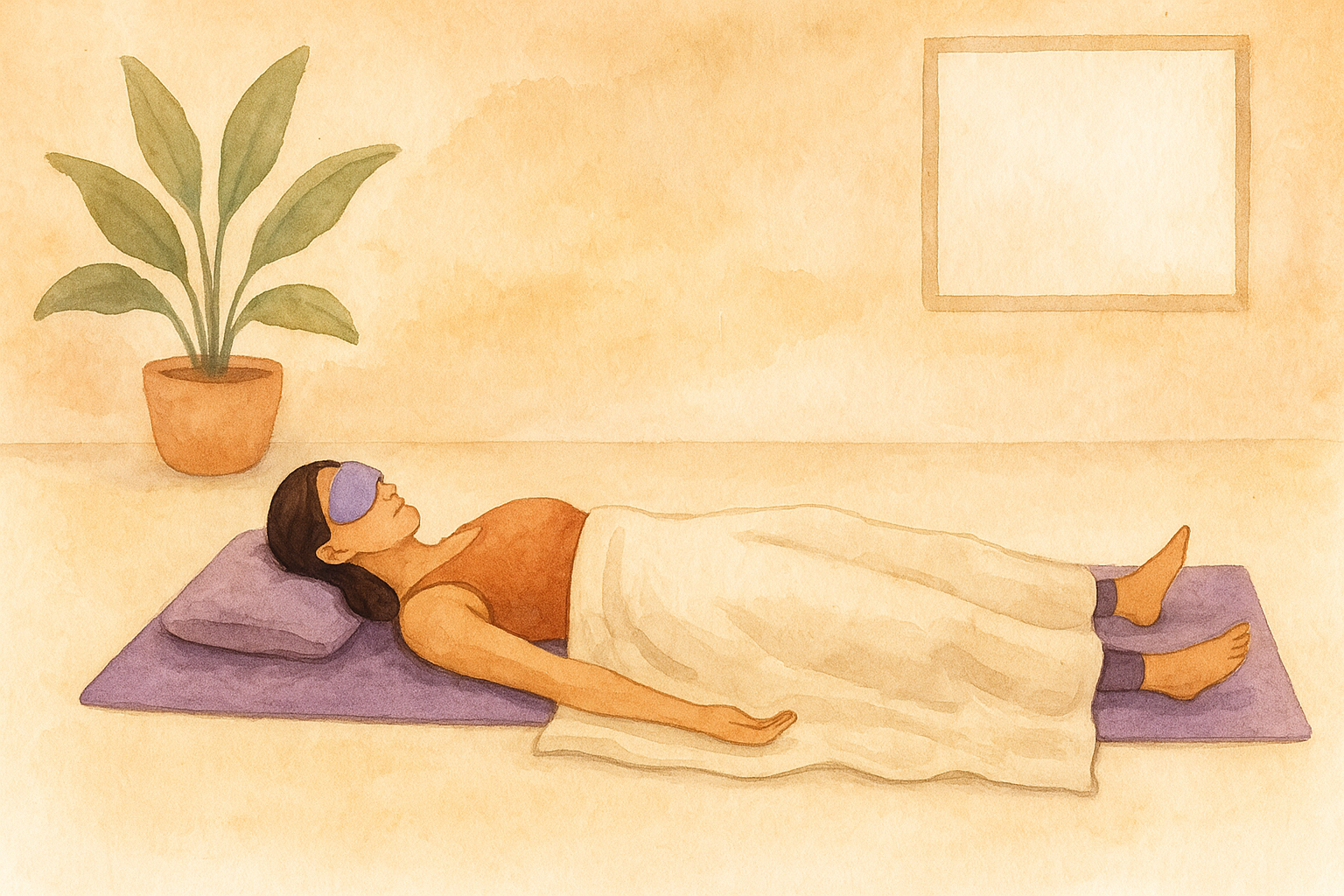
Pick a quiet room where you won’t be interrupted for at least 20 to 30 minutes. Lie flat on your back on a yoga mat, a rug, or a firm surface. Place a thin pillow under your head and, if your lower back feels strained, slide a rolled blanket under your knees. Cover yourself with a light blanket before you start, because your body temperature drops noticeably during deep relaxation and adjusting mid-session breaks the state you’re building.
The single most important setup rule is this: if you’re physically uncomfortable, your mind will stay busy. Get the body settled first.
Here’s a quick checklist of what to have ready before you begin:
Yoga mat or firm surface (avoid a mattress that’s too soft, which makes it harder to stay conscious)
Thin pillow for head support
Rolled blanket or bolster for under the knees
Light blanket to cover yourself
Eye mask or folded cloth to block light
Phone on silent with all notifications off
Choose your audio
You need a guided recording to lead your first session. A free recording from a certified yoga nidra teacher on YouTube works well. Look for sessions between 20 and 35 minutes with a calm, clear voice that doesn’t rush the body scan. Avoid anything layered with heavy background music, as it competes with the rotation of awareness that drives the practice.
Set your speaker volume before you lie down. Use a small speaker placed near your head or a pair of headphones. Once the session begins, reaching over to adjust the volume breaks concentration and pulls you back into ordinary waking awareness, which is exactly what the practice is working to move you out of. Thirty seconds of preparation protects the entire session.
Step-by-step yoga nidra for beginners
Once you’re lying down with your recording queued up, follow the steps below in sequence. This structure mirrors a standard yoga nidra session and gives you a clear mental map so you know what’s coming. You don’t need to memorize anything. Use this as a reference before you press play, then let the audio guide you through each stage.
Stage one: settle and state your intention
The session opens with a slow, deliberate body relaxation. Your guide will ask you to take a few deep breaths and let your body feel heavy. Don’t try to force relaxation. Simply notice each body part as the guide names it, and allow it to soften on its own. This initial phase typically lasts two to three minutes and transitions into the sankalpa, your personal intention. Keep this short: one clear sentence, something like "I am at peace" or "I recover fully." Repeat it mentally three times with genuine feeling, then let it go.
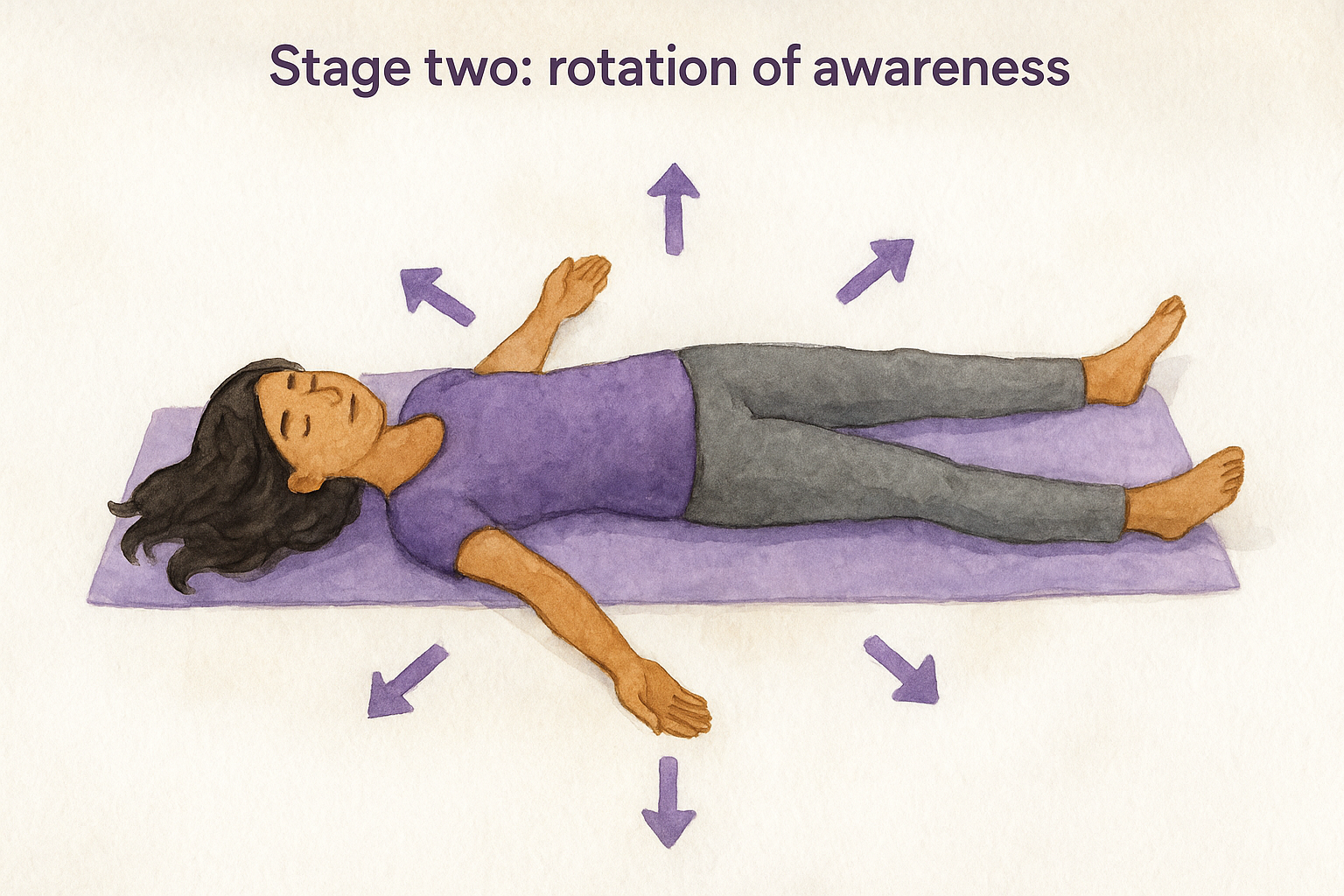
Stage two: rotation of awareness
This is the core of the practice. Your guide will move your attention systematically through the body, naming each part in a specific sequence, right thumb, index finger, middle finger, and so on across the hand, up the arm, across the face, down the torso, through the legs. Your only task is to hear each body part named and shift your inner attention there, briefly, without judgment and without moving the body physically.
The rotation works because it occupies the thinking mind just enough to keep it from generating chatter, while the body slips into deep rest underneath.
Move through each body part as fast or slow as the guide directs. If you miss one, continue from wherever the guide is now.
Stage three: pairs of opposites and close
After the rotation, your guide will introduce pairs of contrasting sensations: heaviness and lightness, warmth and cold, pain and pleasure. Let each one arise in your imagination rather than your muscles. You’re training the nervous system to shift between states quickly, which deepens relaxation. The session closes with a gentle return to waking awareness: the guide asks you to become conscious of the room, wiggle fingers and toes, and slowly open your eyes. Move slowly after this. Give yourself two minutes before standing.
Common obstacles and how to handle them
Most beginners hit at least one snag during their first few yoga nidra for beginners sessions, and that’s completely normal. Knowing what to expect ahead of time means you won’t interpret a rough start as failure and quit a practice that actually works.
Falling asleep before the session ends
Falling asleep is the most common obstacle in yoga nidra, and it’s also the least serious one. If you drift off, your body genuinely needed the rest. Over time, as your nervous system learns to tolerate deep relaxation without shutting down completely, you’ll stay conscious longer. To stay awake without forcing it, keep your arms slightly away from your body rather than resting them flat against your sides. That small physical cue signals the brain to stay alert. If you fall asleep every single session for two weeks straight, try practicing in the late morning rather than the evening, when sleep pressure is lower.
Falling asleep occasionally isn’t a failure; it’s information about what your body needs right now.
Constant mental chatter that won’t stop
Your mind will generate thoughts throughout the session. That’s not a problem to fix; it’s a normal feature of human neurology. The practice doesn’t require a quiet mind. It requires that you keep returning your attention to the guide’s voice each time you notice you’ve drifted. Think of it like this: every time you notice the drift and come back, you’re doing the practice correctly. You don’t need to suppress thoughts. Simply treat them the same way you treat distractions in any focused task, acknowledge and redirect.
Feeling restless or physically uncomfortable
Restlessness usually signals one of two things: your setup needs adjusting, or your nervous system is resisting the downshift because it’s used to staying on high alert. If the discomfort is physical, pause the recording, fix the issue, and restart. If it’s mental, tighten your sankalpa before the next session. A clear, specific intention gives your mind a direction to move toward, which reduces the ambient agitation that makes stillness feel threatening. Over the first week of practice, most people notice restlessness dropping noticeably as the nervous system starts to recognize the session as a safe context for rest.
Safety notes and when to pause
Yoga nidra for beginners is one of the gentlest practices available, but that doesn’t mean it’s without considerations. Most people can start immediately with no issues, and the practice carries far fewer risks than vigorous physical exercise or even most breathwork techniques. Still, a small number of situations call for extra caution, and knowing them upfront helps you practice with confidence rather than guesswork.
Who should check with a doctor first
If you’re currently managing a diagnosed mental health condition, it’s worth a brief conversation with your doctor or therapist before starting. This applies especially to conditions like schizophrenia, active psychosis, severe dissociative disorders, or PTSD with active symptoms. Yoga nidra deliberately blurs the line between waking and sleeping states. For most people, that’s deeply healing. For someone in a vulnerable mental health window, that threshold can occasionally feel disorienting rather than relaxing.
If you’re working with a therapist on trauma integration, let them know you’re adding yoga nidra to your routine. They may want to guide the timing.
The following groups should get a professional sign-off before starting a regular practice:
People currently taking prescription psychiatric medications that affect sleep architecture
Anyone with a recent history of psychotic episodes
Individuals recovering from acute trauma with active dissociation symptoms
People with epilepsy, since deep theta states may be a consideration
Signs to stop or pause a session
During a session, your body and mind will communicate clearly if something isn’t working. Most signals are mild and resolve on their own, but a few warrant stopping the recording and returning to normal waking activity.
Stop and sit up if you notice any of the following:
Strong emotional overwhelm that feels destabilizing rather than releasing
Sudden difficulty breathing or chest tightness
A sense of dissociation that doesn’t feel safe, such as feeling entirely unable to reconnect with your body on command
Disorienting visual phenomena combined with anxiety
Mild emotional release, including tears, warmth, or brief sadness, is normal and not a reason to stop. Your nervous system is processing, and that’s the point. The difference between healthy release and a reason to pause is your felt sense of whether you remain grounded. If you feel anchored enough to keep listening, continue. If you feel genuinely unsafe, sit up slowly, breathe naturally, and give yourself five minutes of quiet before moving on with your day.
Next steps for your practice
You now have everything you need to start yoga nidra for beginners tonight. The most important next step is the simplest one: press play on a recording and lie down. Don’t wait for the perfect moment or the ideal sleep schedule. One session will teach you more about the practice than reading about it ever could.
From there, build a lightweight routine. Practice three to four times per week rather than every day, especially if you’re using yoga nidra as part of post-experience recovery. Give your nervous system time to consolidate what each session offers before returning. Keep a short note after each session, one sentence on how you felt before and one on how you felt after. Patterns become visible fast.
Recovery works on multiple levels at once. If you’re also looking to support your body physically after an intense experience, explore the Afterglow recovery protocol for a structured supplement approach that pairs well with this practice.
Lukas Nelpela
writes on neuroscience, mental health, and mindful exploration. With a passion in research-driven wellness and years focused on set & setting, integration, and recovery, he turns complex ideas into clear, usable insight.
Sleep quality shapes how you think, feel, and recover, whether you’re bouncing back from a tough week or integrating a psychedelic experience. The Harvard sleep hygiene guidelines, developed by researchers at Harvard Medical School, remain some of the most cited and practical recommendations for improving rest. They’re not trendy hacks
If you’ve ever woken up after a psychedelic experience with a locked jaw, tight shoulders, or a neck that barely turns, you already know the toll that sustained muscle tension can take on your body. That tightness doesn’t just sit on the surface, it often lives deeper, in the connective
Your mitochondria produce roughly 90% of the energy your body runs on. Every thought, every heartbeat, every moment of focus or fatigue traces back to these tiny organelles inside your cells. When they’re thriving, you feel sharp, resilient, and recharged. When they’re not, you feel it, brain fog, sluggish recovery,
Stiff hips, locked-up shoulders, a jaw that still feels like a vice grip from last weekend, your body keeps a receipt for everything you put it through. Whether you’re recovering from a heavy festival, an intense psychedelic session, or just sitting at a desk for ten hours straight, mobility work
You already know the drill: you’re lying in bed after a long day (or a long night), scrolling your phone, and sleep feels miles away. Your brain won’t shut off, your eyes sting, and that melatonin you took 40 minutes ago hasn’t kicked in. One of the simplest fixes? Blue
We use various cookies on our website. Some are essential for the website to function properly, while others we may only use with your consent. You can find more information about cookies on our website here.
This website uses cookies to improve your experience while you navigate through the website. Out of these cookies, the cookies that are categorized as necessary are stored on your browser as they are essential for the working of basic functionalities of the website. We also use third-party cookies that help us analyze and understand how you use this website. These cookies will be stored on your browser only with your consent. You also have the option to opt-out of these cookies. However, opting out of some of these cookies may have an impact on your browsing experience.
Necessary cookies are absolutely essential for the website to function properly. These cookies anonymously ensure basic functionalities and security features of the website.
Cookie
Duration
Description
cookielawinfo-checkbox-advertisement
1 year
Set by the GDPR Cookie Consent plugin, this cookie records the user consent for the cookies in the "Advertisement" category.
cookielawinfo-checkbox-analytics
11 months
This cookie is set by GDPR Cookie Consent plugin. The cookie is used to store the user consent for the cookies in the category "Analytics".
cookielawinfo-checkbox-functional
11 months
The cookie is set by GDPR cookie consent to record the user consent for the cookies in the category "Functional".
cookielawinfo-checkbox-necessary
11 months
This cookie is set by GDPR Cookie Consent plugin. The cookies is used to store the user consent for the cookies in the category "Necessary".
cookielawinfo-checkbox-others
11 months
This cookie is set by GDPR Cookie Consent plugin. The cookie is used to store the user consent for the cookies in the category "Other.
cookielawinfo-checkbox-performance
11 months
This cookie is set by GDPR Cookie Consent plugin. The cookie is used to store the user consent for the cookies in the category "Performance".
CookieLawInfoConsent
1 year
CookieYes sets this cookie to record the default button state of the corresponding category and the status of CCPA. It works only in coordination with the primary cookie.
elementor
never
The website's WordPress theme uses this cookie. It allows the website owner to implement or change the website's content in real-time.
fb_event_id_atc
30 minutes
Used to match client and server events for Meta Conversion API deduplication. Contains only anonymous technical IDs; no personal data stored.
fb_event_id_ic
30 minutes
Used to match client and server events for Meta Conversion API deduplication. Contains only anonymous technical IDs; no personal data stored.
fb_event_id_pur
30 minutes
Used to match client and server events for Meta Conversion API deduplication. Contains only anonymous technical IDs; no personal data stored.
fb_event_id_vc
30 minutes
Used to match client and server events for Meta Conversion API deduplication. Contains only anonymous technical IDs; no personal data stored.
rc::a
never
This cookie is set by the Google recaptcha service to identify bots to protect the website against malicious spam attacks.
rc::c
session
This cookie is set by the Google recaptcha service to identify bots to protect the website against malicious spam attacks.
viewed_cookie_policy
11 months
The cookie is set by the GDPR Cookie Consent plugin and is used to store whether or not user has consented to the use of cookies. It does not store any personal data.
VISITOR_PRIVACY_METADATA
6 months
YouTube sets this cookie to store the user's cookie consent state for the current domain.
wpEmojiSettingsSupports
session
WordPress sets this cookie when a user interacts with emojis on a WordPress site. It helps determine if the user's browser can display emojis properly.
Functional cookies help to perform certain functions, such as sharing website content on social media platforms, collecting feedback, and other third-party functions.
Cookie
Duration
Description
sib_cuid
6 months
SendinBlue sets this cookie to store unique visits.
VISITOR_INFO1_LIVE
6 months
A cookie set by YouTube to measure bandwidth that determines whether the user gets the new or old player interface.
yt-remote-cast-available
session
The yt-remote-cast-available cookie is used to store the user's preferences regarding whether casting is available on their YouTube video player.
yt-remote-cast-installed
session
The yt-remote-cast-installed cookie is used to store the user's video player preferences using embedded YouTube video.
yt-remote-connected-devices
never
YouTube sets this cookie to store the user's video preferences using embedded YouTube videos.
yt-remote-device-id
never
YouTube sets this cookie to store the user's video preferences using embedded YouTube videos.
yt-remote-fast-check-period
session
The yt-remote-fast-check-period cookie is used by YouTube to store the user's video player preferences for embedded YouTube videos.
yt-remote-session-app
session
The yt-remote-session-app cookie is used by YouTube to store user preferences and information about the interface of the embedded YouTube video player.
yt-remote-session-name
session
The yt-remote-session-name cookie is used by YouTube to store the user's video player preferences using embedded YouTube video.
ytidb::LAST_RESULT_ENTRY_KEY
never
The cookie ytidb::LAST_RESULT_ENTRY_KEY is used by YouTube to store the last search result entry that was clicked by the user. This information is used to improve the user experience by providing more relevant search results in the future.
Performance cookies are used to understand and analyze key website performance indexes, which helps in providing a better user experience for visitors.
Cookie
Duration
Description
SRM_B
1 year 24 days
Used by Microsoft Advertising as a unique ID for visitors.
Analytical cookies are used to understand how visitors interact with the website. These cookies help provide information on metrics such as the number of visitors, bounce rate, traffic source, etc.
Cookie
Duration
Description
_clck
1 year
Microsoft Clarity sets this cookie to retain the browser's Clarity User ID and settings exclusive to that website. This guarantees that actions taken during subsequent visits to the same website will be linked to the same user ID.
_clsk
1 day
Microsoft Clarity sets this cookie to store and consolidate a user's pageviews into a single session recording.
_fbp
3 months
Facebook sets this cookie to display advertisements when either on Facebook or on a digital platform powered by Facebook advertising after visiting the website.
_ga
1 year 1 month 4 days
Google Analytics sets this cookie to calculate visitor, session and campaign data and track site usage for the site's analytics report. The cookie stores information anonymously and assigns a randomly generated number to recognise unique visitors.
_ga_*
1 year 1 month 4 days
Google Analytics sets this cookie to store and count page views.
_gcl_au
3 months
Google Tag Manager sets the cookie to experiment advertisement efficiency of websites using their services.
_hjSession_*
1 hour
Hotjar sets this cookie to ensure data from subsequent visits to the same site is attributed to the same user ID, which persists in the Hotjar User ID, which is unique to that site.
_hjSessionUser_*
1 year
Hotjar sets this cookie to ensure data from subsequent visits to the same site is attributed to the same user ID, which persists in the Hotjar User ID, which is unique to that site.
_hjTLDTest
session
To determine the most generic cookie path that has to be used instead of the page hostname, Hotjar sets the _hjTLDTest cookie to store different URL substring alternatives until it fails.
CLID
1 year
Microsoft Clarity set this cookie to store information about how visitors interact with the website. The cookie helps to provide an analysis report. The data collection includes the number of visitors, where they visit the website, and the pages visited.
MR
7 days
This cookie, set by Bing, is used to collect user information for analytics purposes.
sbjs_current
session
Sourcebuster sets this cookie to identify the source of a visit and stores user action information in cookies. This analytical and behavioural cookie is used to enhance the visitor experience on the website.
sbjs_current_add
session
Sourcebuster sets this cookie to identify the source of a visit and stores user action information in cookies. This analytical and behavioural cookie is used to enhance the visitor experience on the website.
sbjs_first
session
Sourcebuster sets this cookie to identify the source of a visit and stores user action information in cookies. This analytical and behavioural cookie is used to enhance the visitor experience on the website.
sbjs_first_add
session
Sourcebuster sets this cookie to identify the source of a visit and stores user action information in cookies. This analytical and behavioural cookie is used to enhance the visitor experience on the website.
sbjs_migrations
session
Sourcebuster sets this cookie to identify the source of a visit and stores user action information in cookies. This analytical and behavioural cookie is used to enhance the visitor experience on the website.
sbjs_session
1 hour
Sourcebuster sets this cookie to identify the source of a visit and stores user action information in cookies. This analytical and behavioural cookie is used to enhance the visitor experience on the website.
sbjs_udata
session
Sourcebuster sets this cookie to identify the source of a visit and stores user action information in cookies. This analytical and behavioural cookie is used to enhance the visitor experience on the website.
SM
session
Microsoft Clarity cookie set this cookie for synchronizing the MUID across Microsoft domains.
YSC
session
YSC cookie is set by Youtube and is used to track the views of embedded videos on Youtube pages.
Advertising cookies are used to deliver relevant advertisements and marketing campaigns to visitors. These cookies track visitors across websites and collect information to deliver tailored advertisements.
Cookie
Duration
Description
_rdt_uuid
3 months
Reddit sets this cookie to build a profile of your interests and show you relevant ads.
ANONCHK
10 minutes
The ANONCHK cookie, set by Bing, is used to store a user's session ID and verify ads' clicks on the Bing search engine. The cookie helps in reporting and personalization as well.
MUID
1 year 24 days
Bing sets this cookie to recognise unique web browsers visiting Microsoft sites. This cookie is used for advertising, site analytics, and other operations.
test_cookie
15 minutes
doubleclick.net sets this cookie to determine if the user's browser supports cookies.
yt.innertube::nextId
never
YouTube sets this cookie to register a unique ID to store data on what videos from YouTube the user has seen.
yt.innertube::requests
never
YouTube sets this cookie to register a unique ID to store data on what videos from YouTube the user has seen.