Yoga Nidra For Anxiety: Step-By-Step Practice To Calm Now
7 min read
Anxiety after a psychedelic experience can linger in ways that feel hard to shake, racing thoughts, a tight chest, difficulty settling back into your body. If you’ve been searching for yoga nidra for anxiety, you’re already on the right track. This guided meditation technique, sometimes called "yogic sleep," works directly with your nervous system to shift you out of fight-or-flight and into genuine calm, without requiring any flexibility, experience, or effort beyond lying down.
At Afterglow Supplements, we build recovery protocols that support your body’s chemistry after a psychedelic journey. But real recovery isn’t only biochemical, it’s also about giving your nervous system the tools to regulate itself again. Yoga nidra pairs naturally with physical supplementation because it targets the same goal from the other side: restoring balance after an intense experience.
This guide walks you through a complete yoga nidra practice you can start today. You’ll learn exactly how it works on anxiety at a neurological level, follow a step-by-step session from setup to finish, and pick up tips for making it a consistent part of your post-experience integration routine. No prerequisites, no woo, just a practical method backed by research.
What yoga nidra is and why it helps anxiety
Yoga nidra is a guided meditation practice rooted in Tantra and systematized in the 20th century by Swami Satyananda Saraswati. You lie still while a voice leads you through structured stages: a body scan, breath awareness, pairs of opposite sensations, and visualization. The whole session unfolds in a state between waking and sleep, which is exactly where your nervous system becomes most receptive to change.
How yoga nidra differs from regular meditation
Most meditation asks you to sit upright and maintain focus, which can actually amplify anxiety if your mind is already racing. Yoga nidra removes that demand entirely. You lie down, follow simple prompts, and let your awareness drift rather than grip. This passive structure makes yoga nidra for anxiety particularly accessible during high-stress or post-experience windows when focused attention feels impossible.
The key difference is that yoga nidra works with distraction rather than against it: your mind is guided, not controlled.
The neuroscience behind the calm
Research published in peer-reviewed journals shows that yoga nidra consistently reduces activity in the amygdala, the brain region that triggers the threat response. Studies also document significant drops in cortisol and increases in dopamine during practice. These are not subtle shifts. They are measurable physiological changes that explain why practitioners report feeling genuinely calmer after a single session.
Your brain operates in different frequency bands. During yoga nidra, you move from beta waves (active thinking) into alpha and then theta waves, the same range associated with deep emotional processing and integration. This is where anxiety loses its grip, not through suppression, but through genuine neurological downregulation that you can feel within minutes of starting a session.
Step 1. Prepare your body and space for safety
Preparation matters more than most people expect. When anxiety is running high, your nervous system is already on alert, and small environmental cues can either deepen that state or signal safety to your brain. Spending three to five minutes on setup dramatically improves how quickly you drop into calm during practice.
Create a low-stimulation environment
Your space doesn’t need to be perfect, but it does need to feel predictable and non-threatening. Here’s a quick checklist to run through before you lie down:
Use a blanket, even if you’re not cold, covering your body activates a felt sense of containment
Place a pillow under your knees to release lower back tension
Keep the room temperature slightly cool
A quiet, bounded space tells your amygdala there is no threat, which lets the practice work faster.
Position your body correctly
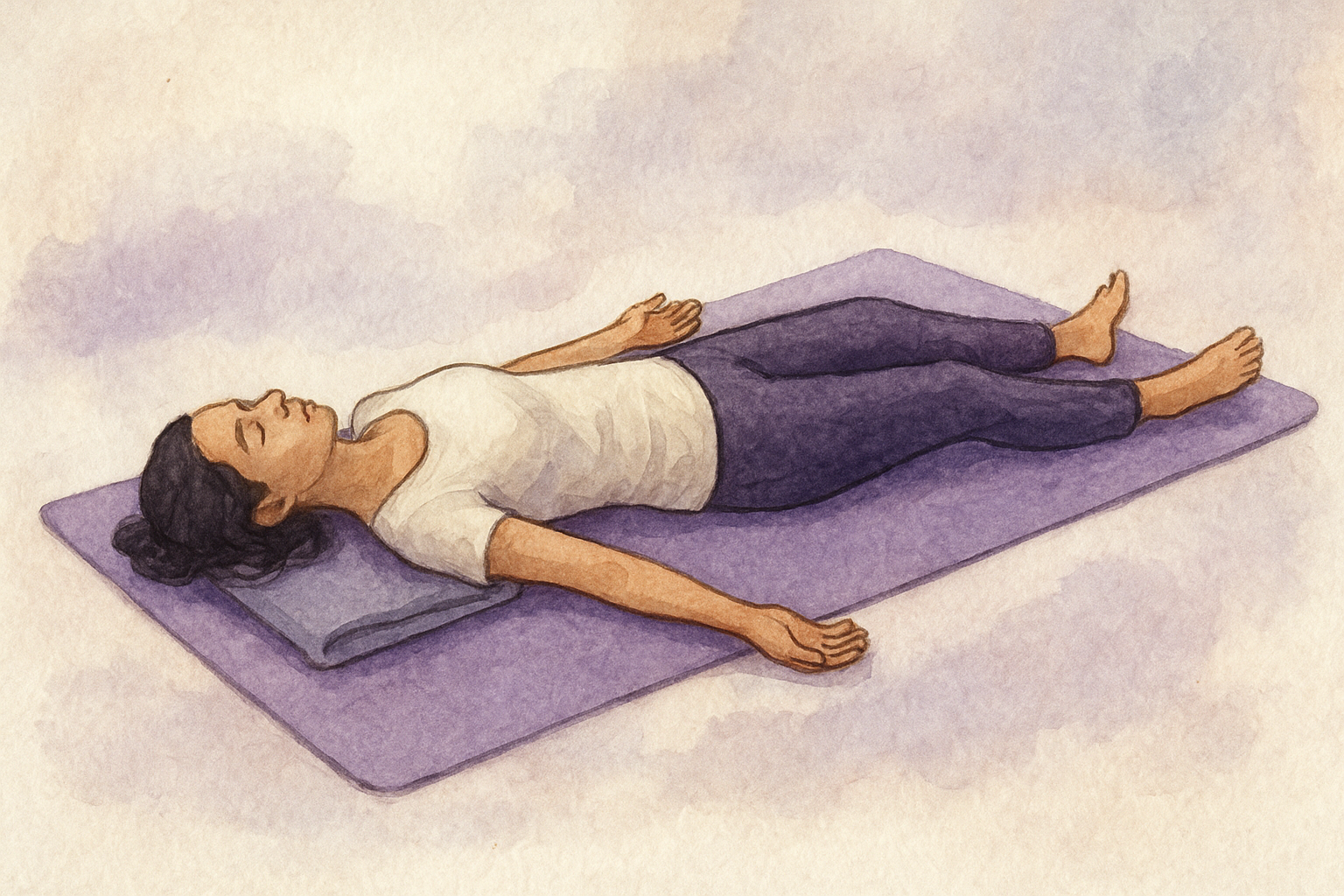
Lie flat on your back with your arms slightly away from your sides, palms facing up. This position, called Savasana, prevents muscular bracing. If flat feels uncomfortable after a psychedelic session, prop your knees with a folded blanket and soften your jaw before the guide begins.
Step 2. Follow a simple yoga nidra practice to calm now
This session takes 15 to 20 minutes and requires nothing beyond your prepared space. Run through it in order without skipping stages; each phase builds on the previous one to deepen your nervous system’s sense of safety.
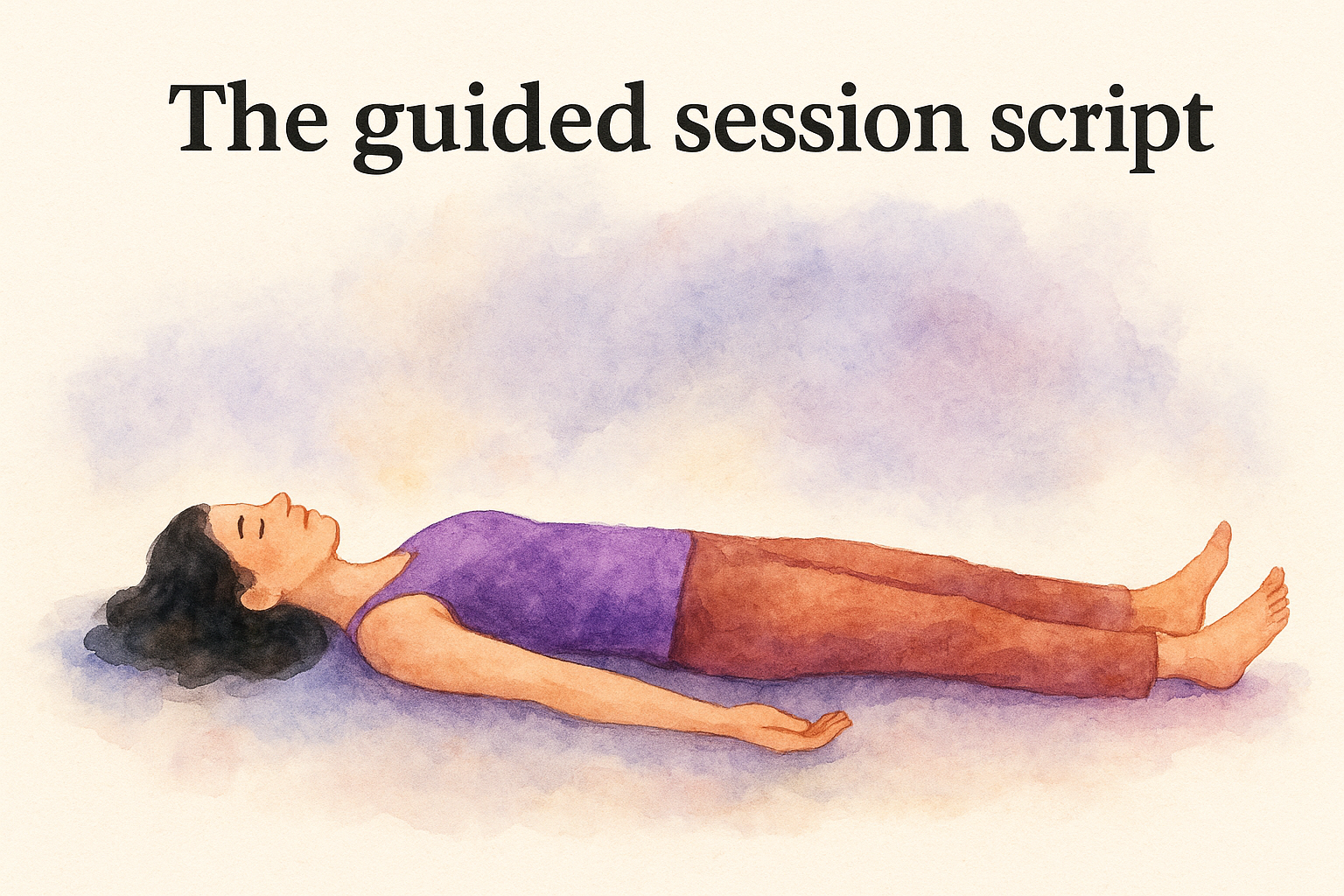
The guided session script
Use this script as your roadmap through the practice. Read it once before starting, or record yourself speaking it slowly so you can listen with your eyes closed.
Move through each stage at a pace that feels unhurried; rushing undermines the entire effect.
Stage
Duration
What to do
Sankalpa (intention)
1 min
Silently repeat: "I am safe, I am at rest."
Body scan
5 min
Move awareness from your right thumb to your toes, naming each body part mentally.
Breath awareness
3 min
Count each exhale from 27 down to 1. Start over if you lose your place.
Opposite sensations
3 min
Feel heaviness, then lightness. Feel warmth, then coolness.
Visualization
3 min
Picture a calm body of water. Watch it without forcing any outcome.
Return
1 min
Wiggle your fingers, deepen your breath, and slowly open your eyes.
This structure forms the core of yoga nidra for anxiety and mirrors the protocol used in published clinical studies on anxiety reduction.
Step 3. Adapt the script for panic, rumination, and sleep
The base script works well for general anxiety, but specific states require small adjustments to get the same effect. Knowing which version to reach for means you spend less time figuring it out and more time actually calming down.
When panic hits mid-session
Panic during practice usually means the body scan moves too fast or covers too large an area. Narrow your focus to just one hand. Feel your right palm, then each finger individually, then return to the palm. Repeat this loop until your breath slows naturally before continuing.
Shrinking your attention to a single body part is the fastest way to interrupt a panic spiral during yoga nidra for anxiety.
For rumination and racing thoughts
When your mind keeps replaying thoughts, switch the breath counting to shorter intervals: count only from 10 down to 1 and restart immediately. The tighter loop gives your mind less space to wander into anxious content while keeping you anchored in the practice.
When sleep is the goal
Skip the return stage entirely and soften the visualization to something slow and repetitive, like waves arriving on a shore. Let yourself drift without bringing awareness back. This version works best after physically demanding or emotionally intense psychedelic sessions when your body genuinely needs full rest over active integration.
Step 4. Make it a habit and avoid common mistakes
A single session of yoga nidra for anxiety can reduce acute stress, but the real gains come from consistent practice over time. Treat it the same way you treat physical recovery: one good session helps, but a weekly rhythm builds lasting change in your nervous system’s baseline state.
Build a consistent schedule
Timing matters more than frequency when you’re starting out. Pick one fixed slot in your week and protect it. Many practitioners find the 30-minute window right after waking or just before sleep most effective because cortisol and external demands are lower at those times.
Three sessions per week for four weeks is enough to notice measurable shifts in your resting anxiety level.
Mistakes that block progress
Knowing what to avoid early on saves you from quitting before the practice takes hold. Watch for these three common errors that new practitioners hit regularly:
Skipping the setup: rushing straight into the body scan without dimming lights or lying flat reduces effectiveness significantly
Practicing when distracted: notifications and background noise pull your nervous system back into alert mode
Expecting instant results: your nervous system adapts gradually, not in a single session
A calm next step
You now have a complete yoga nidra for anxiety practice you can use today. From setting up your space to adapting the session for panic, rumination, or sleep, every step in this guide gives your nervous system a concrete path back to calm. The hardest part is simply starting the first session rather than reading about it.
Consistency builds the real results. Return to the practice after intense experiences, not just when anxiety peaks, and you’ll notice your baseline stress level dropping over time. Your nervous system responds to repetition, and each session reinforces the pattern.
Physical recovery matters just as much as nervous system regulation. If you’re navigating the aftermath of a psychedelic journey, supporting your body’s chemistry alongside your mental state makes a measurable difference. Explore the Afterglow Recovery Protocol to see how targeted supplementation can work alongside practices like yoga nidra to get you back to yourself faster.
Lukas Nelpela
writes on neuroscience, mental health, and mindful exploration. With a passion in research-driven wellness and years focused on set & setting, integration, and recovery, he turns complex ideas into clear, usable insight.
Sleep quality shapes how you think, feel, and recover, whether you’re bouncing back from a tough week or integrating a psychedelic experience. The Harvard sleep hygiene guidelines, developed by researchers at Harvard Medical School, remain some of the most cited and practical recommendations for improving rest. They’re not trendy hacks
If you’ve ever woken up after a psychedelic experience with a locked jaw, tight shoulders, or a neck that barely turns, you already know the toll that sustained muscle tension can take on your body. That tightness doesn’t just sit on the surface, it often lives deeper, in the connective
Your mitochondria produce roughly 90% of the energy your body runs on. Every thought, every heartbeat, every moment of focus or fatigue traces back to these tiny organelles inside your cells. When they’re thriving, you feel sharp, resilient, and recharged. When they’re not, you feel it, brain fog, sluggish recovery,
Stiff hips, locked-up shoulders, a jaw that still feels like a vice grip from last weekend, your body keeps a receipt for everything you put it through. Whether you’re recovering from a heavy festival, an intense psychedelic session, or just sitting at a desk for ten hours straight, mobility work
You already know the drill: you’re lying in bed after a long day (or a long night), scrolling your phone, and sleep feels miles away. Your brain won’t shut off, your eyes sting, and that melatonin you took 40 minutes ago hasn’t kicked in. One of the simplest fixes? Blue
We use various cookies on our website. Some are essential for the website to function properly, while others we may only use with your consent. You can find more information about cookies on our website here.
This website uses cookies to improve your experience while you navigate through the website. Out of these cookies, the cookies that are categorized as necessary are stored on your browser as they are essential for the working of basic functionalities of the website. We also use third-party cookies that help us analyze and understand how you use this website. These cookies will be stored on your browser only with your consent. You also have the option to opt-out of these cookies. However, opting out of some of these cookies may have an impact on your browsing experience.
Necessary cookies are absolutely essential for the website to function properly. These cookies anonymously ensure basic functionalities and security features of the website.
Cookie
Duration
Description
cookielawinfo-checkbox-advertisement
1 year
Set by the GDPR Cookie Consent plugin, this cookie records the user consent for the cookies in the "Advertisement" category.
cookielawinfo-checkbox-analytics
11 months
This cookie is set by GDPR Cookie Consent plugin. The cookie is used to store the user consent for the cookies in the category "Analytics".
cookielawinfo-checkbox-functional
11 months
The cookie is set by GDPR cookie consent to record the user consent for the cookies in the category "Functional".
cookielawinfo-checkbox-necessary
11 months
This cookie is set by GDPR Cookie Consent plugin. The cookies is used to store the user consent for the cookies in the category "Necessary".
cookielawinfo-checkbox-others
11 months
This cookie is set by GDPR Cookie Consent plugin. The cookie is used to store the user consent for the cookies in the category "Other.
cookielawinfo-checkbox-performance
11 months
This cookie is set by GDPR Cookie Consent plugin. The cookie is used to store the user consent for the cookies in the category "Performance".
CookieLawInfoConsent
1 year
CookieYes sets this cookie to record the default button state of the corresponding category and the status of CCPA. It works only in coordination with the primary cookie.
elementor
never
The website's WordPress theme uses this cookie. It allows the website owner to implement or change the website's content in real-time.
fb_event_id_atc
30 minutes
Used to match client and server events for Meta Conversion API deduplication. Contains only anonymous technical IDs; no personal data stored.
fb_event_id_ic
30 minutes
Used to match client and server events for Meta Conversion API deduplication. Contains only anonymous technical IDs; no personal data stored.
fb_event_id_pur
30 minutes
Used to match client and server events for Meta Conversion API deduplication. Contains only anonymous technical IDs; no personal data stored.
fb_event_id_vc
30 minutes
Used to match client and server events for Meta Conversion API deduplication. Contains only anonymous technical IDs; no personal data stored.
rc::a
never
This cookie is set by the Google recaptcha service to identify bots to protect the website against malicious spam attacks.
rc::c
session
This cookie is set by the Google recaptcha service to identify bots to protect the website against malicious spam attacks.
viewed_cookie_policy
11 months
The cookie is set by the GDPR Cookie Consent plugin and is used to store whether or not user has consented to the use of cookies. It does not store any personal data.
VISITOR_PRIVACY_METADATA
6 months
YouTube sets this cookie to store the user's cookie consent state for the current domain.
wpEmojiSettingsSupports
session
WordPress sets this cookie when a user interacts with emojis on a WordPress site. It helps determine if the user's browser can display emojis properly.
Functional cookies help to perform certain functions, such as sharing website content on social media platforms, collecting feedback, and other third-party functions.
Cookie
Duration
Description
sib_cuid
6 months
SendinBlue sets this cookie to store unique visits.
VISITOR_INFO1_LIVE
6 months
A cookie set by YouTube to measure bandwidth that determines whether the user gets the new or old player interface.
yt-remote-cast-available
session
The yt-remote-cast-available cookie is used to store the user's preferences regarding whether casting is available on their YouTube video player.
yt-remote-cast-installed
session
The yt-remote-cast-installed cookie is used to store the user's video player preferences using embedded YouTube video.
yt-remote-connected-devices
never
YouTube sets this cookie to store the user's video preferences using embedded YouTube videos.
yt-remote-device-id
never
YouTube sets this cookie to store the user's video preferences using embedded YouTube videos.
yt-remote-fast-check-period
session
The yt-remote-fast-check-period cookie is used by YouTube to store the user's video player preferences for embedded YouTube videos.
yt-remote-session-app
session
The yt-remote-session-app cookie is used by YouTube to store user preferences and information about the interface of the embedded YouTube video player.
yt-remote-session-name
session
The yt-remote-session-name cookie is used by YouTube to store the user's video player preferences using embedded YouTube video.
ytidb::LAST_RESULT_ENTRY_KEY
never
The cookie ytidb::LAST_RESULT_ENTRY_KEY is used by YouTube to store the last search result entry that was clicked by the user. This information is used to improve the user experience by providing more relevant search results in the future.
Performance cookies are used to understand and analyze key website performance indexes, which helps in providing a better user experience for visitors.
Cookie
Duration
Description
SRM_B
1 year 24 days
Used by Microsoft Advertising as a unique ID for visitors.
Analytical cookies are used to understand how visitors interact with the website. These cookies help provide information on metrics such as the number of visitors, bounce rate, traffic source, etc.
Cookie
Duration
Description
_clck
1 year
Microsoft Clarity sets this cookie to retain the browser's Clarity User ID and settings exclusive to that website. This guarantees that actions taken during subsequent visits to the same website will be linked to the same user ID.
_clsk
1 day
Microsoft Clarity sets this cookie to store and consolidate a user's pageviews into a single session recording.
_fbp
3 months
Facebook sets this cookie to display advertisements when either on Facebook or on a digital platform powered by Facebook advertising after visiting the website.
_ga
1 year 1 month 4 days
Google Analytics sets this cookie to calculate visitor, session and campaign data and track site usage for the site's analytics report. The cookie stores information anonymously and assigns a randomly generated number to recognise unique visitors.
_ga_*
1 year 1 month 4 days
Google Analytics sets this cookie to store and count page views.
_gcl_au
3 months
Google Tag Manager sets the cookie to experiment advertisement efficiency of websites using their services.
_hjSession_*
1 hour
Hotjar sets this cookie to ensure data from subsequent visits to the same site is attributed to the same user ID, which persists in the Hotjar User ID, which is unique to that site.
_hjSessionUser_*
1 year
Hotjar sets this cookie to ensure data from subsequent visits to the same site is attributed to the same user ID, which persists in the Hotjar User ID, which is unique to that site.
_hjTLDTest
session
To determine the most generic cookie path that has to be used instead of the page hostname, Hotjar sets the _hjTLDTest cookie to store different URL substring alternatives until it fails.
CLID
1 year
Microsoft Clarity set this cookie to store information about how visitors interact with the website. The cookie helps to provide an analysis report. The data collection includes the number of visitors, where they visit the website, and the pages visited.
MR
7 days
This cookie, set by Bing, is used to collect user information for analytics purposes.
sbjs_current
session
Sourcebuster sets this cookie to identify the source of a visit and stores user action information in cookies. This analytical and behavioural cookie is used to enhance the visitor experience on the website.
sbjs_current_add
session
Sourcebuster sets this cookie to identify the source of a visit and stores user action information in cookies. This analytical and behavioural cookie is used to enhance the visitor experience on the website.
sbjs_first
session
Sourcebuster sets this cookie to identify the source of a visit and stores user action information in cookies. This analytical and behavioural cookie is used to enhance the visitor experience on the website.
sbjs_first_add
session
Sourcebuster sets this cookie to identify the source of a visit and stores user action information in cookies. This analytical and behavioural cookie is used to enhance the visitor experience on the website.
sbjs_migrations
session
Sourcebuster sets this cookie to identify the source of a visit and stores user action information in cookies. This analytical and behavioural cookie is used to enhance the visitor experience on the website.
sbjs_session
1 hour
Sourcebuster sets this cookie to identify the source of a visit and stores user action information in cookies. This analytical and behavioural cookie is used to enhance the visitor experience on the website.
sbjs_udata
session
Sourcebuster sets this cookie to identify the source of a visit and stores user action information in cookies. This analytical and behavioural cookie is used to enhance the visitor experience on the website.
SM
session
Microsoft Clarity cookie set this cookie for synchronizing the MUID across Microsoft domains.
YSC
session
YSC cookie is set by Youtube and is used to track the views of embedded videos on Youtube pages.
Advertising cookies are used to deliver relevant advertisements and marketing campaigns to visitors. These cookies track visitors across websites and collect information to deliver tailored advertisements.
Cookie
Duration
Description
_rdt_uuid
3 months
Reddit sets this cookie to build a profile of your interests and show you relevant ads.
ANONCHK
10 minutes
The ANONCHK cookie, set by Bing, is used to store a user's session ID and verify ads' clicks on the Bing search engine. The cookie helps in reporting and personalization as well.
MUID
1 year 24 days
Bing sets this cookie to recognise unique web browsers visiting Microsoft sites. This cookie is used for advertising, site analytics, and other operations.
test_cookie
15 minutes
doubleclick.net sets this cookie to determine if the user's browser supports cookies.
yt.innertube::nextId
never
YouTube sets this cookie to register a unique ID to store data on what videos from YouTube the user has seen.
yt.innertube::requests
never
YouTube sets this cookie to register a unique ID to store data on what videos from YouTube the user has seen.