If you’ve ever dealt with stubborn muscle knots, a locked-up jaw, or that full-body stiffness that lingers after an intense experience, you’ve felt your fascia calling for attention. Myofascial release benefits go far beyond a standard massage, this hands-on technique targets the connective tissue that wraps every muscle, bone, and organ in your body, addressing pain and restriction at its structural source.
For anyone who pushes their body hard, whether through physical activity, long festival weekends, or psychedelic journeys that leave your muscles clenched and your jaw sore, myofascial release offers real, measurable relief. It’s one of the most effective ways to restore range of motion, ease chronic tension patterns, and accelerate the physical side of recovery. At Afterglow Supplements, we focus on helping your body bounce back after intense experiences, and myofascial release fits right into that picture. While our supplements replenish what’s been depleted internally, bodywork like myofascial release handles the external tension your body holds onto.
This article breaks down exactly how myofascial release works, what the research says about its benefits for pain relief, mobility, and muscle recovery, and how to know if it’s the right fit for your body. Whether you’re dealing with post-experience jaw clenching, chronic back tightness, or just want to move better, you’ll walk away with a clear understanding of what this technique can, and can’t, do for you.
What myofascial release is and how it works
Myofascial release (MFR) is a manual therapy technique that applies sustained, low-load pressure to the body’s connective tissue, known as fascia, to reduce tension, restore mobility, and relieve pain. Unlike conventional massage that works primarily on muscle fibers, myofascial release targets the fascial system, a three-dimensional web of tissue that surrounds and connects every structure in your body. A trained therapist applies gentle, prolonged pressure at specific points where the fascia has become tight or restricted, holding each position long enough to allow the tissue to soften and release.
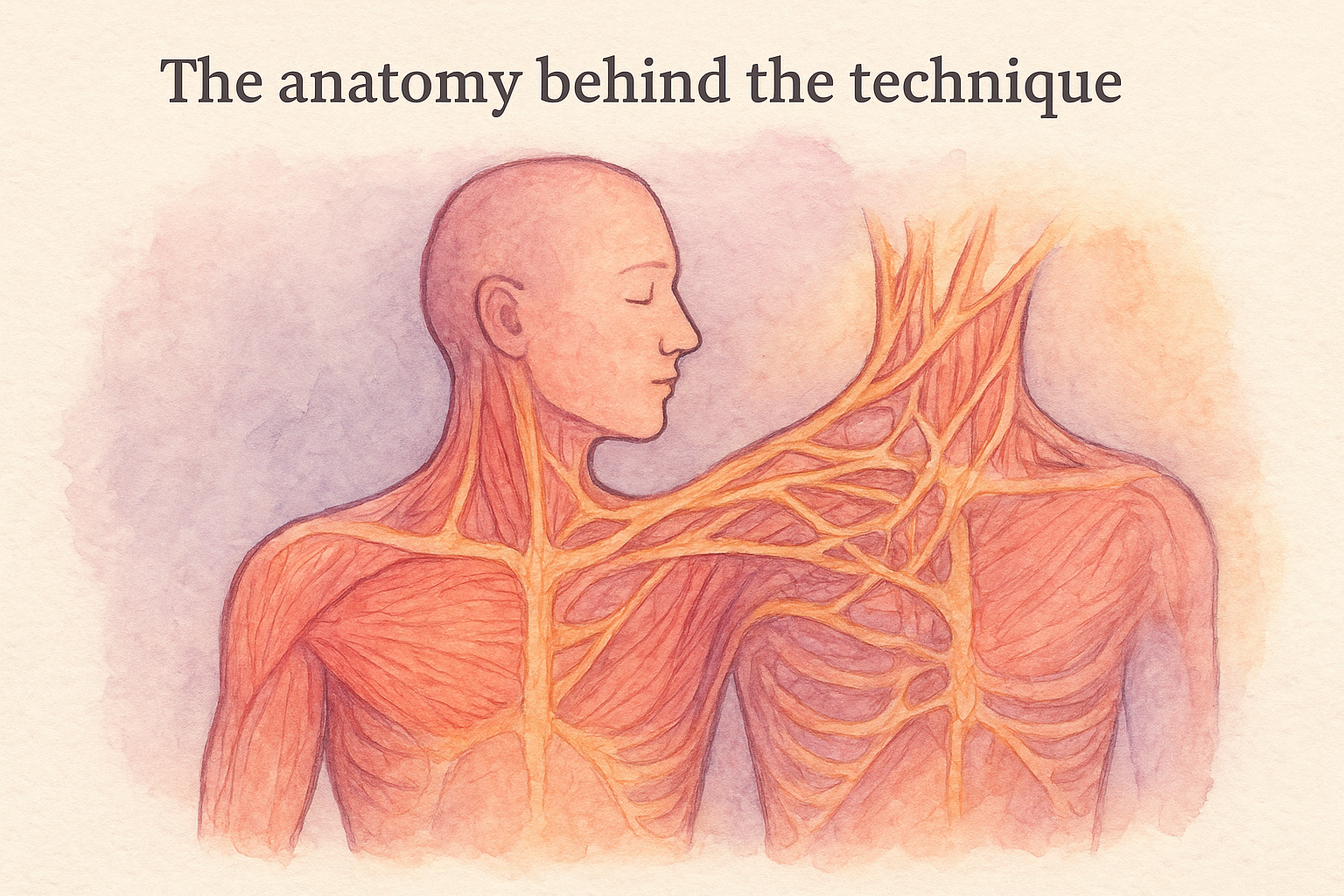
The anatomy behind the technique
Fascia is a densely woven, continuous sheet of connective tissue made mostly of collagen and elastin fibers suspended in a gel-like ground substance. It wraps around your muscles, bones, nerves, blood vessels, and organs without interruption, meaning a restriction in one area can create tension patterns that show up somewhere else entirely. When you clench your jaw for hours at a festival or sleep in an awkward position after a long night, fascial tissue in those areas can become dehydrated and bound, pulling on surrounding structures and triggering the kind of widespread ache that standard stretching alone won’t fully resolve.
Three distinct layers of fascia exist in your body:
Superficial fascia: sits just below the skin and contains fat, nerves, and blood vessels
Deep fascia: surrounds muscles, bones, and joints, the layer most directly involved in myofascial release treatment
Visceral fascia: wraps around organs and suspends them within body cavities
How the pressure actually works
The mechanism behind myofascial release benefits isn’t fully settled in research, but the leading explanation involves a property called thixotropy, where fascia behaves like a gel that becomes more fluid when sustained force is applied over time. When a therapist holds steady pressure on a restricted area for 90 seconds or more, the fascial tissue gradually shifts from a stiffer, bound state to a softer, more pliable consistency. This allows blood flow to return to the area, nerve receptors to reset, and the surrounding muscle tissue to let go of the holding pattern it has been locked into.
The key difference from standard massage is that myofascial release works with time, not force. That slow, sustained hold is what allows the tissue to change at a structural level rather than simply responding to surface pressure.
Researchers also point to mechanotransduction as a contributing factor, the process by which physical pressure on cells triggers biochemical changes inside them. Applying sustained load to fascial tissue signals cells called fibroblasts to remodel the collagen network, which can gradually improve the tissue’s flexibility and reduce its tendency to adhere to neighboring structures.
The difference between myofascial release and regular massage
Standard massage techniques like Swedish or deep tissue work rhythmically across muscle fibers using oil or lotion to reduce friction. Their goal is to stimulate circulation and relax muscle tone in the moment, which is genuinely useful, but it’s a different mechanism than what myofascial work accomplishes. Myofascial release uses no lubricant, because the therapist needs enough grip on the skin to feel and follow the subtle movement of fascial tissue as it releases beneath their hands. Sessions involve longer holds, slower contact, and a different quality of attention, with the practitioner tracking micro-movements in the tissue rather than applying a set stroke sequence from start to finish.
Why fascia matters for pain and movement
Most people focus on muscles, joints, or nerves when they try to explain chronic pain or restricted movement, but fascia is often the missing piece. Because it forms a continuous, uninterrupted network from your scalp to the soles of your feet, fascial health directly determines how freely you move, how efficiently your muscles fire, and how quickly your body recovers after physical or psychological stress. When fascia is healthy, it glides smoothly between structures, allowing full range of motion and efficient force transfer through your movement chain. When it’s not, the consequences show up as pain, stiffness, and fatigue in places you might never connect to their actual source.
When fascia becomes restricted
Fascia loses its pliability through a surprisingly wide range of triggers: repetitive strain, dehydration, poor posture, inflammation, surgery, and even prolonged psychological stress can cause the collagen fibers within fascial tissue to tighten and mat together. Once that happens, the affected tissue becomes less gel-like and more rigid, compressing the nerves and blood vessels that run through it. This compression is one reason why fascial restrictions often produce burning, aching, or tingling sensations rather than the sharp, localized pain most people associate with an obvious injury.
Dehydration is one of the fastest ways to compromise fascial tissue, because the ground substance that keeps collagen fibers sliding past each other depends on adequate water to maintain its fluid consistency.
Physical stress like jaw clenching during a long night out creates exactly this kind of restriction. The masseter and temporalis muscles tighten hard for hours, the fascia around them adapts to that contracted state, and by the following morning the tissue has shortened into a new resting length that your stretching routine won’t fully undo on its own.
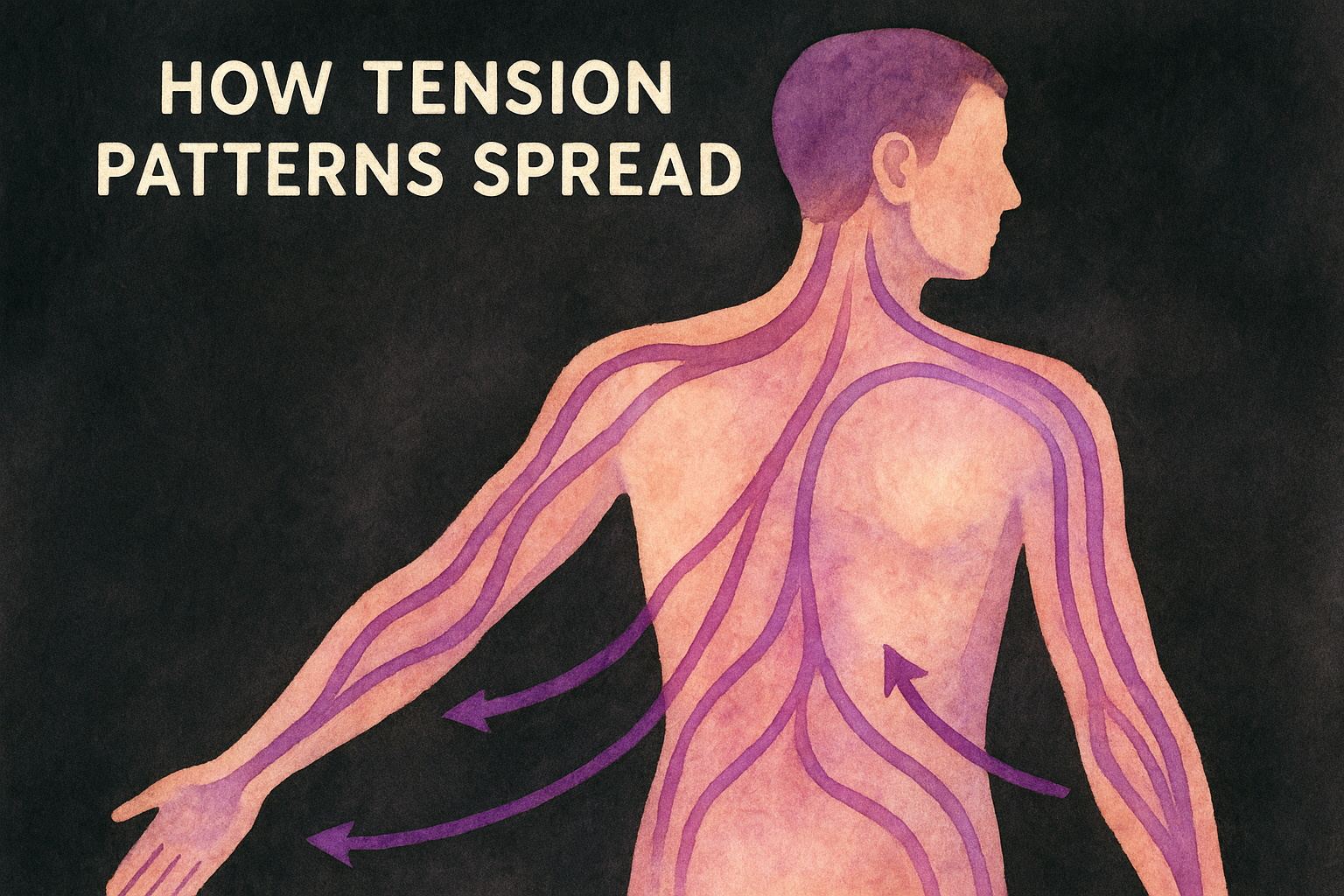
How tension patterns spread
Because fascia connects everything, a restriction in one region creates mechanical tension that travels along the fascial lines to remote areas. A chronic tightness in your hip flexors, for instance, can pull on the lumbar fascia and gradually contribute to lower back pain, even though nothing is structurally wrong with your spine. This interconnected behavior is exactly why understanding myofascial release benefits requires thinking in whole-body patterns rather than isolated muscle groups. Therapists trained in MFR are specifically looking for these compensatory chains, not just the area where you feel the most discomfort.
Key myofascial release benefits
The research on myofascial release benefits spans multiple areas of physical health, and the findings consistently point to three core outcomes: pain reduction, improved range of motion, and accelerated muscle recovery. Each of these builds on the same underlying mechanism, releasing fascial restrictions that compress nerves, limit joint movement, and lock your muscles into chronically shortened patterns.
Pain relief through decompression
When fascia tightens around nerves and blood vessels, it generates pressure on sensitive structures that your brain registers as persistent aching, burning, or referred pain. Sustained myofascial pressure reverses this compression by encouraging the tissue to soften and spread, which directly reduces the mechanical load on those nerves. Studies on individuals with chronic low back pain, fibromyalgia, and neck pain show consistent reductions in pain intensity following a course of myofascial release sessions, with effects that outlast the treatment itself because the tissue structure has physically changed rather than just temporarily relaxed.
This is why myofascial release often addresses pain that persists long after a physical injury has technically healed: the fascial restriction remains even after the damaged tissue repairs itself.
Improved range of motion and flexibility
Tight fascia acts like shrink-wrap around your joints, reducing how far you can move without generating discomfort. When the fascial tissue softens through sustained pressure, the movement envelope around your hips, shoulders, and spine opens up in ways that stretching alone rarely achieves. You gain length through the entire fascial line, not just at the muscle belly, which translates into more fluid, full-range movement during both exercise and everyday activity. For anyone dealing with jaw tightness or neck stiffness after an intense night, this benefit shows up quickly in how much easier it becomes to turn your head and open your mouth without that familiar grinding resistance.
Accelerated muscle recovery
Your muscles flush metabolic waste products more efficiently when the fascia surrounding them is pliable and well-hydrated. Fascial restrictions effectively act as a barrier to circulation, trapping inflammatory byproducts in the tissue and slowing the repair cycle. Myofascial release restores that circulation pathway, meaning your muscles receive fresh oxygen and nutrients sooner after physical stress. This is particularly relevant if your recovery window is short, because reducing fascial tension cuts down the time your body needs to move from the stiff, sore post-exertion phase back to baseline function.
Conditions and symptoms it may help
Myofascial release benefits a wide range of conditions because fascial restriction shows up across almost every tissue system in the body. Rather than treating a specific diagnosis, MFR works on the underlying tension patterns that contribute to dozens of different complaints, which is why the same technique can address something as varied as chronic neck pain and post-exertion jaw soreness within the same framework.
Chronic pain and musculoskeletal complaints
Research and clinical application consistently support myofascial release as a useful intervention for people dealing with long-standing pain that hasn’t responded well to rest or conventional treatment. Common conditions in this category include:
Fibromyalgia: Studies show measurable reductions in widespread pain and fatigue after a structured course of MFR sessions, likely because fibromyalgia involves heightened sensitivity at fascial mechanoreceptors.
Chronic low back pain: Fascial tightness along the thoracolumbar fascia is one of the most commonly identified contributors to persistent lower back pain, and sustained MFR pressure on those restrictions produces consistent pain relief.
Plantar fasciitis: The plantar fascia responds well to sustained release work, especially when combined with addressing tension patterns running up through the calf and hip.
Temporomandibular joint (TMJ) dysfunction: Restriction in the jaw fascia and surrounding musculature directly drives TMJ pain, clicking, and limited mouth opening.
If you’ve been grinding or clenching your jaw through a long night, TMJ dysfunction is one of the fastest places to feel the payoff from targeted myofascial work.
Post-exertion and stress-related symptoms
Beyond diagnosed conditions, myofascial release is particularly useful for acute and subacute symptoms that follow intense physical or psychological stress. If your body has been through something demanding, whether a hard training block, a long festival weekend, or a psychedelic experience that left you clenched and depleted, your fascia holds onto that stress in predictable ways. Jaw tightness, neck stiffness, shoulder tension, and generalized body aches are all signatures of fascial tissue that contracted hard and hasn’t fully released on its own.
Headaches driven by tension in the suboccipital region, where the base of your skull meets your neck, also respond well to myofascial techniques. Releasing the fascia in that area reduces the pulling force that radiates into your temples and behind your eyes, addressing the structural cause rather than masking the symptom with pain relief medication.
What to expect in a session
A myofascial release session looks and feels different from a standard massage appointment, so knowing what’s ahead helps you get more out of it. Your therapist will typically spend 30 to 90 minutes working with you, depending on your goals and the areas of restriction they need to address. The pace is slow and deliberate by design, because sustained pressure rather than speed is what produces the tissue changes responsible for the myofascial release benefits you’re after.
The intake and assessment process
Before any hands-on work begins, your therapist will ask about your history of pain, injury, surgery, and recent physical stress. This isn’t just routine paperwork. Understanding whether you’ve been clenching your jaw, dealing with recurring neck stiffness, or recovering from a physically demanding experience directly shapes where and how they apply pressure. Many therapists also do a brief postural assessment, watching how you stand and move to identify the compensatory patterns your body has built around fascial restrictions.
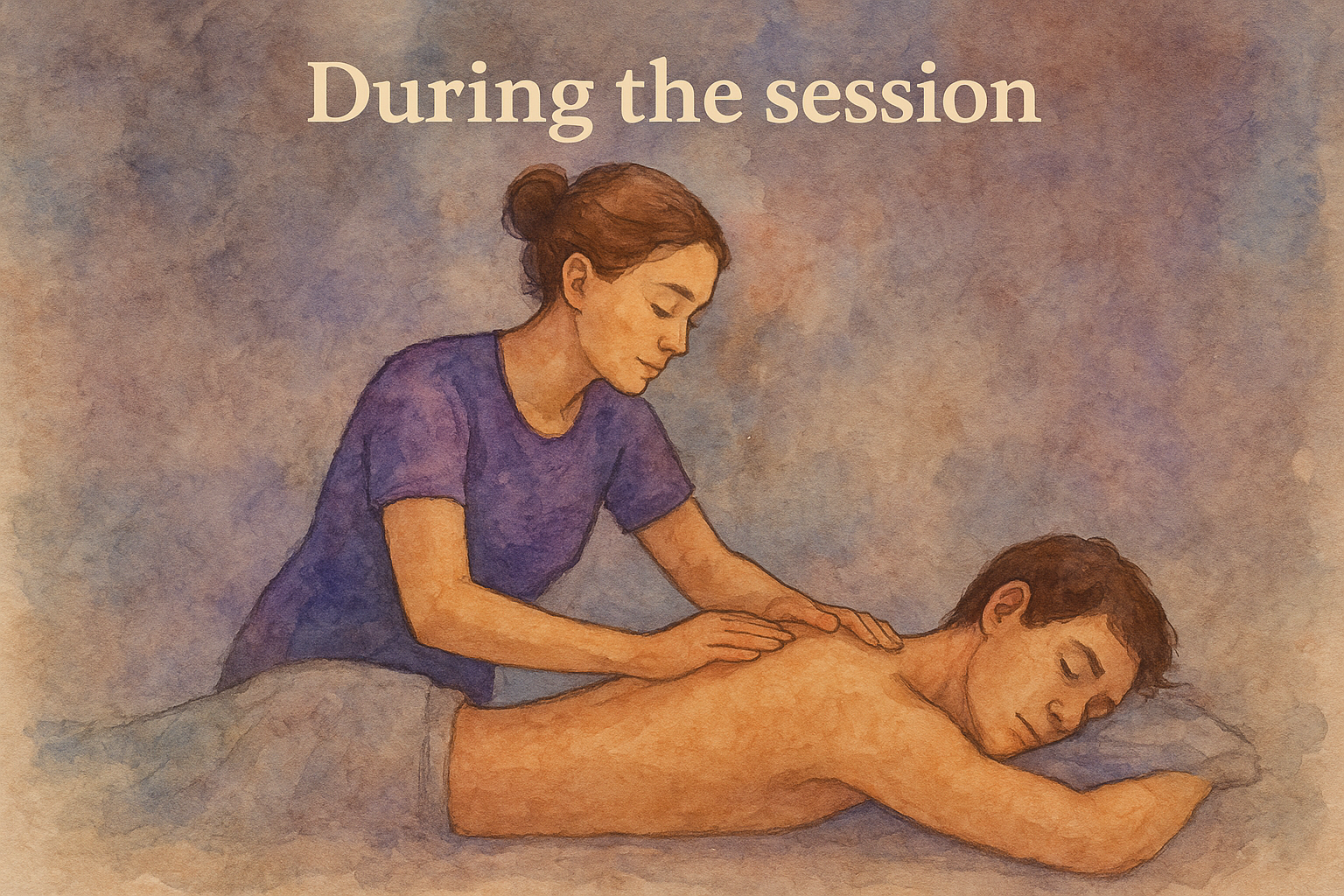
During the session
Your therapist applies slow, sustained contact to restricted areas using their hands, fingers, or forearm, holding each point for 90 seconds to several minutes without sliding across the skin. You’ll feel gentle but firm pressure that often produces a sensation of warmth, tingling, or a dull ache as the tissue begins to shift. These sensations are normal signals that the fascial tissue is softening and releasing beneath the pressure, not an indication that the work is too aggressive.
Communicate openly with your therapist throughout the session. If a hold produces sharp or electric pain rather than a dull release sensation, that’s feedback worth mentioning immediately.
Unlike deep tissue massage, you won’t experience intense mechanical force. The treatment is largely receptive, meaning your therapist follows where the tissue leads rather than imposing a fixed stroke sequence. Some people notice spontaneous twitching, deep breathing, or emotional release during holds, particularly in areas where the body has stored sustained stress.
How you’ll feel afterward
Most people leave a session feeling noticeably lighter and more mobile than when they arrived, but it’s common to experience mild soreness for 24 to 48 hours as your body adapts to the tissue changes. Staying well-hydrated after your appointment supports the rehydration of the fascial ground substance and helps flush out the metabolic byproducts that the release process mobilizes. Fatigue on the day of treatment is also typical and usually a sign that your nervous system is processing real structural change.
Self-myofascial release at home
You don’t need a therapist to access myofascial release benefits between professional sessions. With a few basic tools and the right approach to pressure and timing, you can address common fascial restrictions at home, particularly the jaw tension, neck stiffness, and shoulder tightness that accumulate after demanding physical or psychological experiences. Self-myofascial release won’t replace skilled hands-on work for deeper restrictions, but it keeps your fascial tissue more pliable between appointments and shortens the time it takes your body to return to baseline.
Tools that work
The most widely available self-release tools fall into a short list, and the shape and density of each tool determines which areas of your body it can realistically reach. Choosing the wrong tool for a specific area often means you apply pressure in the wrong plane or miss the fascial tissue entirely.
Here are the most practical options and their best uses:
Foam roller: Best for larger surface areas like the thoracic spine, IT band, and quadriceps. Use a medium-density roller rather than the firmest option available, because excess hardness compresses tissue too aggressively for fascial work.
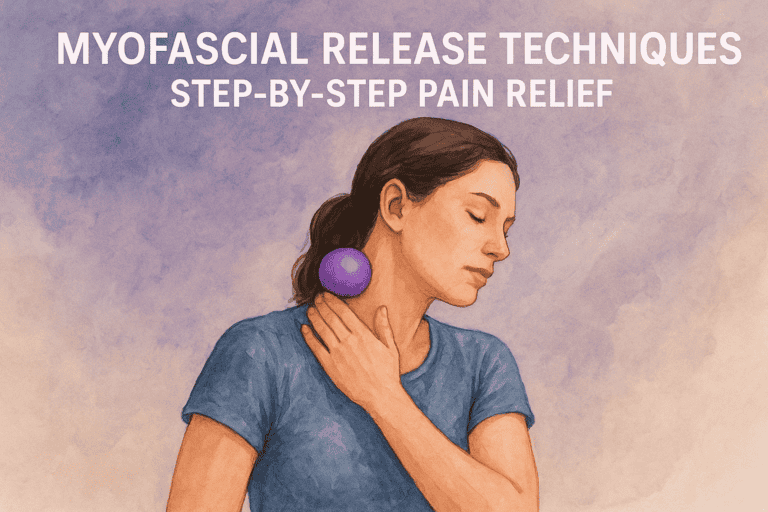
Lacrosse ball or massage ball: Ideal for the glutes, plantar fascia, and the suboccipital region at the base of your skull. Its smaller contact surface lets you get precise pressure into restricted areas that a foam roller can’t access.
Massage stick or handheld roller: Useful for calves and forearms when you want more control over angle and pressure than a floor-based roller provides.
How to apply pressure effectively
The most common mistake people make with self-release is moving too fast, rolling back and forth continuously across a tight area rather than pausing on the restriction and letting the tissue respond. Find a tender spot, stop there, and hold steady pressure for at least 90 seconds. You should notice the initial aching sensation gradually ease as the fascia softens beneath the tool.
Slow, sustained holds produce real tissue change. Rapid rolling mostly stimulates surface circulation without reaching the fascial layer where restrictions actually live.
Your breathing matters during each hold. Taking slow, deliberate exhales while you maintain contact encourages your nervous system to downregulate, which allows the surrounding musculature to release rather than guard against the pressure. Drink water before and after your self-release work to support the rehydration process your fascial tissue needs after the collagen fibers have been mobilized.
Myofascial release vs other bodywork
Understanding where myofascial release sits among other manual therapies helps you choose the right tool for your specific recovery needs. Most forms of bodywork address muscle tension in some way, but they differ significantly in the layer of tissue they target, the speed of application, and the kind of change they produce. Knowing these differences lets you make a more informed decision rather than defaulting to whatever is most familiar or most available.
How it compares to massage
Swedish massage and deep tissue work are rhythmic techniques that use gliding strokes and applied friction to stimulate circulation and temporarily reduce muscle tone. Both use oil or lotion to reduce friction between the therapist’s hands and your skin, which means they slide across the surface rather than gripping and tracking the fascial layer beneath. These approaches work well for relaxation and short-term muscle relief, but they don’t produce the structural tissue remodeling that makes myofascial release benefits distinct and longer-lasting. Sports massage similarly focuses on flushing metabolic waste from muscle fibers before or after exertion, useful for performance recovery, but not designed to address the underlying fascial patterns driving chronic tightness.
If your tension pattern returns within a few days of a standard massage, that’s a strong signal the restriction lives in the fascia rather than the muscle belly.
How it compares to stretching and trigger point therapy
Stretching targets muscle length by pulling tissue to its end range and holding or moving through it. It’s valuable for maintaining flexibility, but most stretching approaches work along a single plane of movement and miss the three-dimensional fascial web that wraps through and around your muscles. Fascial restrictions often run obliquely across multiple planes, which is why sustained pressure reaches them more effectively than a hamstring stretch or hip opener alone.
Trigger point therapy shares more overlap with myofascial release because it also uses sustained pressure on restricted tissue. The key distinction is that trigger point work targets discrete, hyperirritable spots in muscle fibers and aims to interrupt a localized pain referral pattern. Myofascial release follows the tissue response across entire fascial lines rather than focusing on isolated nodules. Both have their place, and many therapists combine them within the same session to address restrictions at multiple levels of the tissue system.
Safety, side effects, and who should avoid it
Myofascial release is a low-force technique that most healthy adults tolerate well, but it still carries a small set of side effects you should know before booking a session. Understanding both the normal responses and the genuine contraindications helps you approach treatment with realistic expectations rather than guessing at what’s acceptable. The myofascial release benefits covered throughout this article are accessible to most people, but a subset of conditions require you to modify or avoid treatment entirely.
Common side effects to expect
Mild soreness in the areas treated is the most frequently reported side effect, typically appearing within a few hours of the session and resolving within 24 to 48 hours. This response reflects the fact that your body is adapting to real tissue change rather than a surface-level intervention, and it differs from the deep bruising that aggressive deep tissue work sometimes produces.
Staying well-hydrated in the hours after treatment consistently reduces post-session soreness and supports your fascial tissue’s recovery from the mobilization work.
Beyond physical soreness, some people experience temporary emotional responses during or after a session, including unexpected tearfulness, a sudden sense of heaviness, or brief anxiety. These reactions are well-documented in body-centered therapy and reflect the release of tension your nervous system was holding rather than anything harmful. They typically resolve within a few hours without any specific intervention.
Who should avoid or modify treatment
Several conditions make myofascial release either unsafe or inappropriate until you’ve consulted a qualified medical provider. Your therapist should always complete a thorough intake before any hands-on work, and you should be upfront about your health history to protect yourself from unnecessary risk.
Avoid or postpone myofascial release treatment if any of the following apply to you:
Active infection, fever, or inflammation: Applying sustained pressure to inflamed tissue can worsen the local response rather than reduce it.
Open wounds, skin conditions, or recent surgery: Pressure over these areas risks disrupting healing tissue or introducing complications.
Active cancer: Fascial work near tumor sites requires physician clearance because of its effect on lymphatic and circulatory pathways.
Blood clotting disorders or anticoagulant use: Sustained pressure carries a risk of bruising or deeper tissue disruption in people with compromised clotting function.
Osteoporosis or bone fragility: Even low-force pressure can be excessive load on weakened bone structure without appropriate modification.
Acute fractures or joint instability: Work near unstable structures requires medical clearance before treatment begins.
How to choose a provider and plan care
Finding the right therapist matters as much as the technique itself. A skilled practitioner reads your tissue and adapts the session to what your body is doing in real time, while a poorly trained one applies generic pressure in ways that either miss the restriction entirely or push through discomfort that should signal them to ease off. Before booking your first session, spend a few minutes vetting whoever you’re considering rather than defaulting to the nearest name on a search results page.
What to look for in a qualified therapist
Start by asking about formal training in myofascial release specifically, not just general massage therapy. Licensed physical therapists, occupational therapists, and massage therapists can all legally practice MFR, but their training in fascial techniques varies significantly. Look for practitioners who have completed structured coursework in myofascial release, such as the curriculum developed by John Barnes, who is widely recognized as a foundational figure in the field. Ask directly how many years they’ve been applying these techniques and whether they work with the kinds of patterns you’re dealing with, such as jaw tension, post-exertion stiffness, or chronic neck restriction.
A therapist who listens carefully during your intake and asks follow-up questions about your history is a better sign than one who starts working without much assessment.
Reading reviews that mention specific symptoms and outcomes gives you more useful information than overall star ratings. Look for mentions of the same complaints you have and whether the writer noticed lasting change rather than just temporary relief.
Planning your care over time
Most people need between four and eight sessions to work through the primary fascial restrictions driving their symptoms, with sessions spaced one to two weeks apart to give your body time to integrate each round of change. Going more frequently early on can sometimes accelerate progress, but spacing allows your nervous system to settle into the new tissue state before the next session builds on it.
Between appointments, your self-release work at home directly influences how quickly you accumulate myofascial release benefits from professional sessions. Staying consistent with foam rolling, hydration, and targeted ball work keeps your tissue more responsive and reduces the amount of rework a therapist has to do on restrictions that have re-tightened since your last visit. Track which areas feel better and which persist across sessions so you can give your provider useful feedback and adjust the treatment plan accordingly.
Next steps
Myofascial release benefits are accessible regardless of where you’re starting from. Whether you’ve been dealing with chronic jaw tension, recurring neck stiffness, or the full-body fatigue that follows an intense physical or psychological experience, the steps forward are clear: find a qualified therapist, start your home practice with consistent pressure holds, and stay hydrated to support your fascial tissue between sessions.
Recovery doesn’t happen through any single intervention. Combining bodywork with the right internal support gives your body the best chance of bouncing back completely. When your fascia is releasing tension and your neurotransmitters and nutrients are being actively replenished, the recovery window shortens and the quality of how you feel afterward improves meaningfully. If you’re ready to address the internal side of recovery alongside the physical work, explore the Afterglow Recovery Protocol and see how a structured supplement approach fits into your overall plan.
Lukas Nelpela
writes on neuroscience, mental health, and mindful exploration. With a passion in research-driven wellness and years focused on set & setting, integration, and recovery, he turns complex ideas into clear, usable insight.
Sleep quality shapes how you think, feel, and recover, whether you’re bouncing back from a tough week or integrating a psychedelic experience. The Harvard sleep hygiene guidelines, developed by researchers at Harvard Medical School, remain some of the most cited and practical recommendations for improving rest. They’re not trendy hacks
If you’ve ever woken up after a psychedelic experience with a locked jaw, tight shoulders, or a neck that barely turns, you already know the toll that sustained muscle tension can take on your body. That tightness doesn’t just sit on the surface, it often lives deeper, in the connective
Your mitochondria produce roughly 90% of the energy your body runs on. Every thought, every heartbeat, every moment of focus or fatigue traces back to these tiny organelles inside your cells. When they’re thriving, you feel sharp, resilient, and recharged. When they’re not, you feel it, brain fog, sluggish recovery,
Stiff hips, locked-up shoulders, a jaw that still feels like a vice grip from last weekend, your body keeps a receipt for everything you put it through. Whether you’re recovering from a heavy festival, an intense psychedelic session, or just sitting at a desk for ten hours straight, mobility work
You already know the drill: you’re lying in bed after a long day (or a long night), scrolling your phone, and sleep feels miles away. Your brain won’t shut off, your eyes sting, and that melatonin you took 40 minutes ago hasn’t kicked in. One of the simplest fixes? Blue
We use various cookies on our website. Some are essential for the website to function properly, while others we may only use with your consent. You can find more information about cookies on our website here.
This website uses cookies to improve your experience while you navigate through the website. Out of these cookies, the cookies that are categorized as necessary are stored on your browser as they are essential for the working of basic functionalities of the website. We also use third-party cookies that help us analyze and understand how you use this website. These cookies will be stored on your browser only with your consent. You also have the option to opt-out of these cookies. However, opting out of some of these cookies may have an impact on your browsing experience.
Necessary cookies are absolutely essential for the website to function properly. These cookies anonymously ensure basic functionalities and security features of the website.
Cookie
Duration
Description
cookielawinfo-checkbox-advertisement
1 year
Set by the GDPR Cookie Consent plugin, this cookie records the user consent for the cookies in the "Advertisement" category.
cookielawinfo-checkbox-analytics
11 months
This cookie is set by GDPR Cookie Consent plugin. The cookie is used to store the user consent for the cookies in the category "Analytics".
cookielawinfo-checkbox-functional
11 months
The cookie is set by GDPR cookie consent to record the user consent for the cookies in the category "Functional".
cookielawinfo-checkbox-necessary
11 months
This cookie is set by GDPR Cookie Consent plugin. The cookies is used to store the user consent for the cookies in the category "Necessary".
cookielawinfo-checkbox-others
11 months
This cookie is set by GDPR Cookie Consent plugin. The cookie is used to store the user consent for the cookies in the category "Other.
cookielawinfo-checkbox-performance
11 months
This cookie is set by GDPR Cookie Consent plugin. The cookie is used to store the user consent for the cookies in the category "Performance".
CookieLawInfoConsent
1 year
CookieYes sets this cookie to record the default button state of the corresponding category and the status of CCPA. It works only in coordination with the primary cookie.
elementor
never
The website's WordPress theme uses this cookie. It allows the website owner to implement or change the website's content in real-time.
fb_event_id_atc
30 minutes
Used to match client and server events for Meta Conversion API deduplication. Contains only anonymous technical IDs; no personal data stored.
fb_event_id_ic
30 minutes
Used to match client and server events for Meta Conversion API deduplication. Contains only anonymous technical IDs; no personal data stored.
fb_event_id_pur
30 minutes
Used to match client and server events for Meta Conversion API deduplication. Contains only anonymous technical IDs; no personal data stored.
fb_event_id_vc
30 minutes
Used to match client and server events for Meta Conversion API deduplication. Contains only anonymous technical IDs; no personal data stored.
rc::a
never
This cookie is set by the Google recaptcha service to identify bots to protect the website against malicious spam attacks.
rc::c
session
This cookie is set by the Google recaptcha service to identify bots to protect the website against malicious spam attacks.
viewed_cookie_policy
11 months
The cookie is set by the GDPR Cookie Consent plugin and is used to store whether or not user has consented to the use of cookies. It does not store any personal data.
VISITOR_PRIVACY_METADATA
6 months
YouTube sets this cookie to store the user's cookie consent state for the current domain.
wpEmojiSettingsSupports
session
WordPress sets this cookie when a user interacts with emojis on a WordPress site. It helps determine if the user's browser can display emojis properly.
Functional cookies help to perform certain functions, such as sharing website content on social media platforms, collecting feedback, and other third-party functions.
Cookie
Duration
Description
sib_cuid
6 months
SendinBlue sets this cookie to store unique visits.
VISITOR_INFO1_LIVE
6 months
A cookie set by YouTube to measure bandwidth that determines whether the user gets the new or old player interface.
yt-remote-cast-available
session
The yt-remote-cast-available cookie is used to store the user's preferences regarding whether casting is available on their YouTube video player.
yt-remote-cast-installed
session
The yt-remote-cast-installed cookie is used to store the user's video player preferences using embedded YouTube video.
yt-remote-connected-devices
never
YouTube sets this cookie to store the user's video preferences using embedded YouTube videos.
yt-remote-device-id
never
YouTube sets this cookie to store the user's video preferences using embedded YouTube videos.
yt-remote-fast-check-period
session
The yt-remote-fast-check-period cookie is used by YouTube to store the user's video player preferences for embedded YouTube videos.
yt-remote-session-app
session
The yt-remote-session-app cookie is used by YouTube to store user preferences and information about the interface of the embedded YouTube video player.
yt-remote-session-name
session
The yt-remote-session-name cookie is used by YouTube to store the user's video player preferences using embedded YouTube video.
ytidb::LAST_RESULT_ENTRY_KEY
never
The cookie ytidb::LAST_RESULT_ENTRY_KEY is used by YouTube to store the last search result entry that was clicked by the user. This information is used to improve the user experience by providing more relevant search results in the future.
Performance cookies are used to understand and analyze key website performance indexes, which helps in providing a better user experience for visitors.
Cookie
Duration
Description
SRM_B
1 year 24 days
Used by Microsoft Advertising as a unique ID for visitors.
Analytical cookies are used to understand how visitors interact with the website. These cookies help provide information on metrics such as the number of visitors, bounce rate, traffic source, etc.
Cookie
Duration
Description
_clck
1 year
Microsoft Clarity sets this cookie to retain the browser's Clarity User ID and settings exclusive to that website. This guarantees that actions taken during subsequent visits to the same website will be linked to the same user ID.
_clsk
1 day
Microsoft Clarity sets this cookie to store and consolidate a user's pageviews into a single session recording.
_fbp
3 months
Facebook sets this cookie to display advertisements when either on Facebook or on a digital platform powered by Facebook advertising after visiting the website.
_ga
1 year 1 month 4 days
Google Analytics sets this cookie to calculate visitor, session and campaign data and track site usage for the site's analytics report. The cookie stores information anonymously and assigns a randomly generated number to recognise unique visitors.
_ga_*
1 year 1 month 4 days
Google Analytics sets this cookie to store and count page views.
_gcl_au
3 months
Google Tag Manager sets the cookie to experiment advertisement efficiency of websites using their services.
_hjSession_*
1 hour
Hotjar sets this cookie to ensure data from subsequent visits to the same site is attributed to the same user ID, which persists in the Hotjar User ID, which is unique to that site.
_hjSessionUser_*
1 year
Hotjar sets this cookie to ensure data from subsequent visits to the same site is attributed to the same user ID, which persists in the Hotjar User ID, which is unique to that site.
_hjTLDTest
session
To determine the most generic cookie path that has to be used instead of the page hostname, Hotjar sets the _hjTLDTest cookie to store different URL substring alternatives until it fails.
CLID
1 year
Microsoft Clarity set this cookie to store information about how visitors interact with the website. The cookie helps to provide an analysis report. The data collection includes the number of visitors, where they visit the website, and the pages visited.
MR
7 days
This cookie, set by Bing, is used to collect user information for analytics purposes.
sbjs_current
session
Sourcebuster sets this cookie to identify the source of a visit and stores user action information in cookies. This analytical and behavioural cookie is used to enhance the visitor experience on the website.
sbjs_current_add
session
Sourcebuster sets this cookie to identify the source of a visit and stores user action information in cookies. This analytical and behavioural cookie is used to enhance the visitor experience on the website.
sbjs_first
session
Sourcebuster sets this cookie to identify the source of a visit and stores user action information in cookies. This analytical and behavioural cookie is used to enhance the visitor experience on the website.
sbjs_first_add
session
Sourcebuster sets this cookie to identify the source of a visit and stores user action information in cookies. This analytical and behavioural cookie is used to enhance the visitor experience on the website.
sbjs_migrations
session
Sourcebuster sets this cookie to identify the source of a visit and stores user action information in cookies. This analytical and behavioural cookie is used to enhance the visitor experience on the website.
sbjs_session
1 hour
Sourcebuster sets this cookie to identify the source of a visit and stores user action information in cookies. This analytical and behavioural cookie is used to enhance the visitor experience on the website.
sbjs_udata
session
Sourcebuster sets this cookie to identify the source of a visit and stores user action information in cookies. This analytical and behavioural cookie is used to enhance the visitor experience on the website.
SM
session
Microsoft Clarity cookie set this cookie for synchronizing the MUID across Microsoft domains.
YSC
session
YSC cookie is set by Youtube and is used to track the views of embedded videos on Youtube pages.
Advertising cookies are used to deliver relevant advertisements and marketing campaigns to visitors. These cookies track visitors across websites and collect information to deliver tailored advertisements.
Cookie
Duration
Description
_rdt_uuid
3 months
Reddit sets this cookie to build a profile of your interests and show you relevant ads.
ANONCHK
10 minutes
The ANONCHK cookie, set by Bing, is used to store a user's session ID and verify ads' clicks on the Bing search engine. The cookie helps in reporting and personalization as well.
MUID
1 year 24 days
Bing sets this cookie to recognise unique web browsers visiting Microsoft sites. This cookie is used for advertising, site analytics, and other operations.
test_cookie
15 minutes
doubleclick.net sets this cookie to determine if the user's browser supports cookies.
yt.innertube::nextId
never
YouTube sets this cookie to register a unique ID to store data on what videos from YouTube the user has seen.
yt.innertube::requests
never
YouTube sets this cookie to register a unique ID to store data on what videos from YouTube the user has seen.