Sivananda Yoga Nidra: Benefits, Practice, And Guided Audio
7 min read
If you’ve ever struggled to fully rest your mind after an intense experience, psychedelic or otherwise, you’re not alone. Sivananda Yoga Nidra is a structured deep relaxation practice rooted in one of the world’s most respected yoga traditions, and it offers something rare: conscious rest that actually restores you. It’s not sleep, and it’s not standard meditation. It sits somewhere in between, guiding you into a state where genuine healing happens.
For those who use psychedelics intentionally, Yoga Nidra can be a powerful integration tool. It helps process what surfaced during a journey, eases post-experience anxiety, and supports the kind of deep neurological recovery that pairs well with proper supplementation. At Afterglow, we think of recovery as more than just nutrients, it’s also about giving your nervous system the space to reset.
This article breaks down what Sivananda Yoga Nidra actually is, how it connects to Swami Satyananda Saraswati’s teachings, what the science says about its benefits, and where to find guided audio sessions you can use right away. Whether you’re new to the practice or looking to deepen your post-journey recovery routine, you’ll walk away with something practical.
What Sivananda Yoga Nidra is
Sivananda Yoga Nidra is a guided deep relaxation technique rooted in the classical Sivananda lineage, a system of yoga codified by Swami Sivananda Saraswati of Rishikesh, India. The name "Yoga Nidra" translates roughly to "yogic sleep", but the practice keeps you in a state of conscious awareness while your body moves through progressively deeper levels of relaxation. You stay awake enough to follow instructions, yet relaxed enough that your brain shifts away from its usual busy, analytical mode.
The state it creates
During a session, your brain activity moves toward the theta wave range, the same zone associated with the moments just before you fall asleep. This is where your nervous system begins genuine repair work, and research linked through the National Institutes of Health connects this hypnagogic state to reduced cortisol, improved emotional processing, and enhanced neuroplasticity.
Yoga Nidra has been shown to produce rest equivalent to several hours of ordinary sleep, making it one of the most efficient recovery tools available.
The physiological effects show up quickly. Most people report a significant drop in physical tension within the first ten minutes, and a noticeable shift in mental clarity after a single session. These are not minor effects.
What makes this tradition distinct
The Sivananda approach emphasizes a specific, sequential structure: physical relaxation first, then breath awareness, guided visualization, and a conscious return to waking. This order is not arbitrary. It comes directly from classical texts and oral teachings passed through the lineage over generations.
Unlike loosely adapted mindfulness formats, sivananda yoga nidra follows a deliberate framework built around pratyahara, the withdrawal of the senses described in Patanjali’s Yoga Sutras. That foundation is what separates it from generic relaxation audio.
How Sivananda and Satyananda Yoga Nidra relate
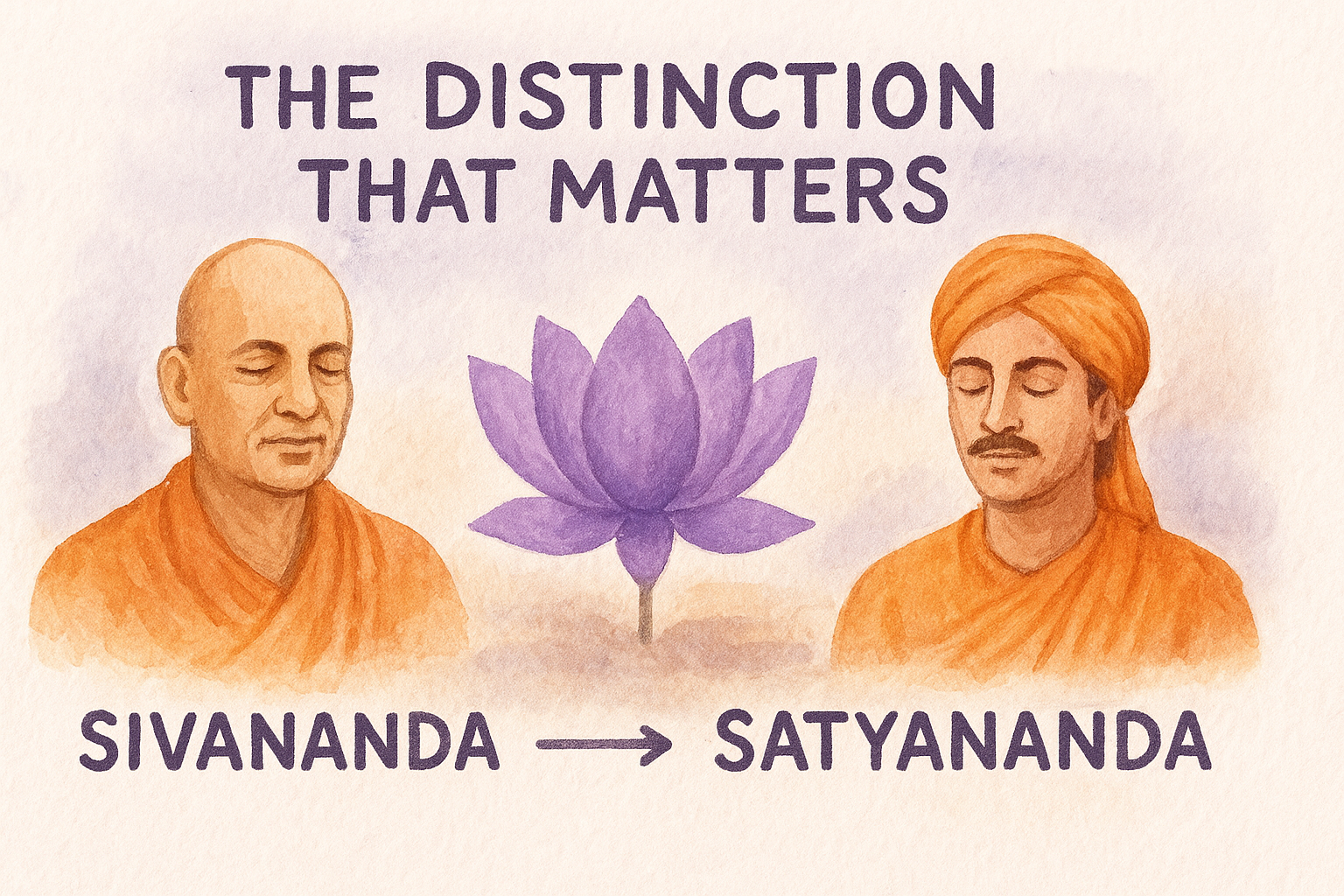
Swami Satyananda Saraswati was a direct disciple of Swami Sivananda, which is why you’ll often see the two names used interchangeably. He studied at Sivananda’s ashram in Rishikesh, absorbed the classical teachings deeply, and later systematized Yoga Nidra into the formal protocol most teachers use today. He founded the Bihar School of Yoga, where sivananda yoga nidra evolved from oral tradition into a documented, reproducible method that spread globally.
The lineage runs in a straight line: Sivananda’s philosophy, refined by Satyananda’s structuring, is what gives modern Yoga Nidra its depth and consistency.
The Distinction That Matters
Both names refer to the same root tradition, but they reflect different roles within it. Sivananda established the philosophical foundation, emphasizing rest, surrender, and integration as core spiritual practices. Satyananda then took those principles and built a step-by-step structure that any teacher could replicate and any student could follow.
When you encounter a class labeled under either name, you’re working from the same source. The core elements stay consistent: a body scan, breath awareness, guided visualization, and a sankalpa, or personal intention, set at the start to anchor the practice.
Why people practice Yoga Nidra in this tradition
People return to this practice because it delivers results that other relaxation methods don’t match. The structured sivananda yoga nidra protocol takes you through layers of tension release in a specific order, which means your body and mind don’t have to figure out how to let go on their own. You follow the guidance, and the system does the work for you.
The practice is particularly effective for anyone whose nervous system has been through something intense, whether that’s sustained stress, grief, or a powerful psychedelic experience.
What it addresses
The tradition targets both physical and psychological recovery in a single session. Practitioners use it to reduce chronic anxiety, improve sleep quality, and process difficult emotional material that surfaces during or after intense experiences. Cortisol levels drop measurably, muscle tension releases, and your mind moves into a state where real integration happens rather than just being thought about.
Consistent practice also builds a deeper capacity for self-awareness. Over time, you train your nervous system to access calm states more easily, which makes the practice useful far beyond recovery. You carry that regulation into daily life, not just during sessions.
How to practice Sivananda Yoga Nidra step by step
You don’t need any equipment or prior experience to begin sivananda yoga nidra. The practice requires only a quiet space, a flat surface, and about 20 to 30 minutes where you won’t be interrupted.
Setting up your space
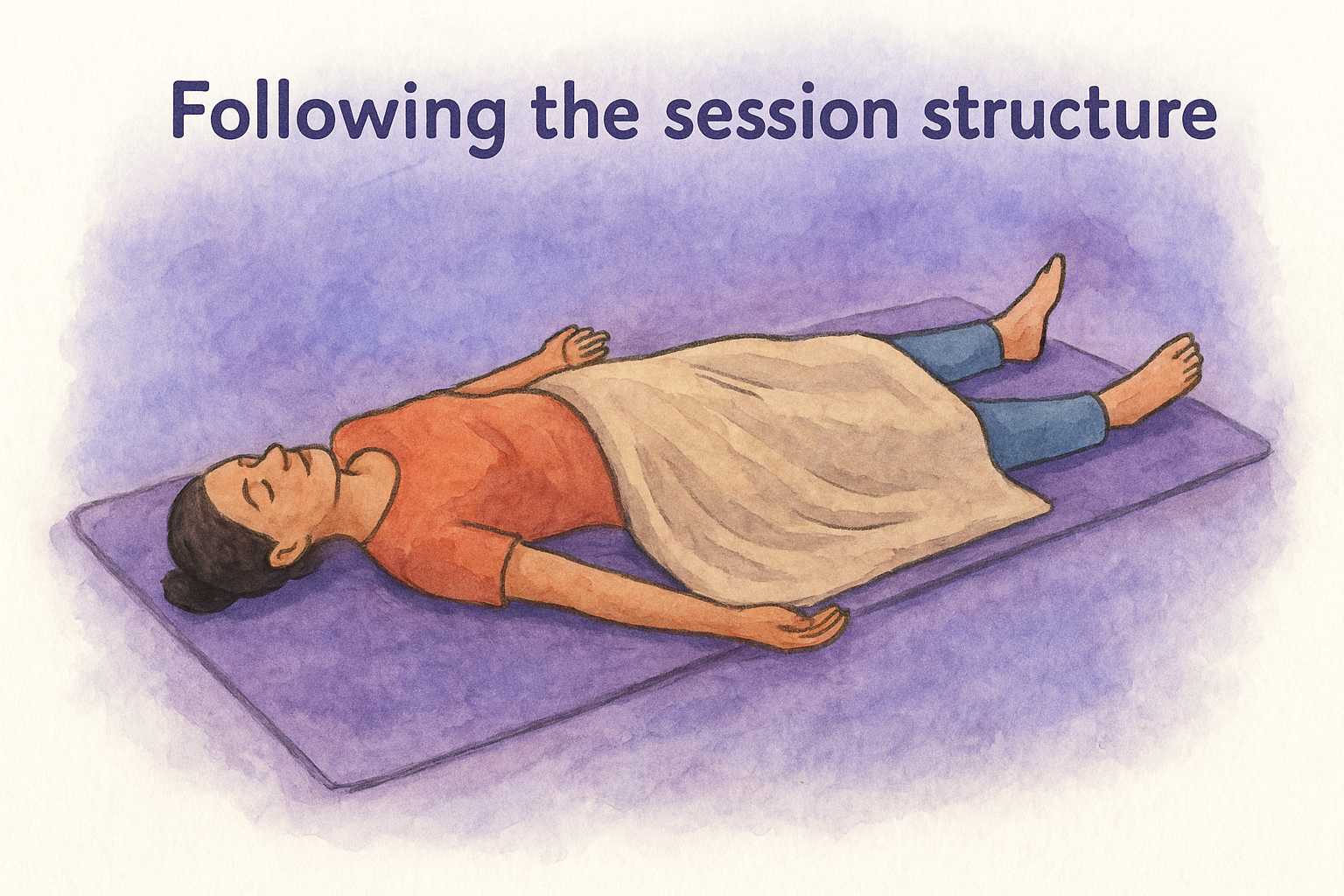
Lie flat on your back in savasana, arms slightly away from your body, palms facing up. Cover yourself with a blanket if the room is cool, since your body temperature drops as you relax deeply.
Basic setup checklist:
Flat surface (yoga mat or firm bed)
Blanket for warmth
Dimmed lights
Phone silenced
Following the session structure
A standard session moves through five distinct stages, each building directly on the last. Following them in order is what gives the practice its depth.
The sequence is non-negotiable in this tradition; skipping stages limits how far your nervous system can actually unwind.
Set your sankalpa – state a short personal intention at the start
Body rotation – mentally move attention through each body part in sequence
Breath awareness – observe your natural breathing without changing it
Visualization – follow guided imagery that deepens relaxation
Return – gradually bring your awareness back to the room
Staying with the full structure gives you meaningfully better results than a partial session, since each stage primes your nervous system for the next layer of release.
How to choose a guided Yoga Nidra audio or class
Not every recording labeled "Yoga Nidra" follows the same structure. For sivananda yoga nidra specifically, you want a guide who works from the classical lineage, meaning the session includes a sankalpa, body rotation, breath awareness, and visualization in that order. If those stages are missing or scrambled, the session won’t deliver the same depth of nervous system release.
What to look for in a teacher or recording
Your first filter is lineage and training. Look for teachers who trained at the Bihar School of Yoga, the Sivananda Vedanta Centers, or with instructors who trace their teaching directly to those institutions. Session length also matters: a minimum of 20 minutes gives your nervous system enough time to cycle through all five stages properly.
A recording that skips straight to visualization without a full body rotation is cutting the most important groundwork short.
Check whether the pacing is slow and deliberate, since rushed delivery prevents your brain from actually settling into theta. For classes, ask the teacher directly about their training background before committing to a full course.
Next steps
Sivananda Yoga Nidra gives you a structured, proven way to bring your nervous system back to baseline after intense experiences. You now have everything you need to start: the background, the five-stage sequence, and the criteria for finding a quality teacher or audio. The most effective next step is simply lying down and doing your first session, rather than researching further.
Recovery works best when you address it from multiple angles. Physical restoration, neurological reset, and proper nutrient support work together, not in isolation. Yoga Nidra handles the nervous system side of things, but your brain and body also need the right building blocks to replenish what a psychedelic experience depletes. If you want a complete recovery approach that covers the physiological piece, take a look at the Afterglow Recovery Protocol. It was built specifically to support the kind of deep recovery that practices like Yoga Nidra are designed to complement.
Lukas Nelpela
writes on neuroscience, mental health, and mindful exploration. With a passion in research-driven wellness and years focused on set & setting, integration, and recovery, he turns complex ideas into clear, usable insight.
Sleep quality shapes how you think, feel, and recover, whether you’re bouncing back from a tough week or integrating a psychedelic experience. The Harvard sleep hygiene guidelines, developed by researchers at Harvard Medical School, remain some of the most cited and practical recommendations for improving rest. They’re not trendy hacks
If you’ve ever woken up after a psychedelic experience with a locked jaw, tight shoulders, or a neck that barely turns, you already know the toll that sustained muscle tension can take on your body. That tightness doesn’t just sit on the surface, it often lives deeper, in the connective
Your mitochondria produce roughly 90% of the energy your body runs on. Every thought, every heartbeat, every moment of focus or fatigue traces back to these tiny organelles inside your cells. When they’re thriving, you feel sharp, resilient, and recharged. When they’re not, you feel it, brain fog, sluggish recovery,
Stiff hips, locked-up shoulders, a jaw that still feels like a vice grip from last weekend, your body keeps a receipt for everything you put it through. Whether you’re recovering from a heavy festival, an intense psychedelic session, or just sitting at a desk for ten hours straight, mobility work
You already know the drill: you’re lying in bed after a long day (or a long night), scrolling your phone, and sleep feels miles away. Your brain won’t shut off, your eyes sting, and that melatonin you took 40 minutes ago hasn’t kicked in. One of the simplest fixes? Blue
We use various cookies on our website. Some are essential for the website to function properly, while others we may only use with your consent. You can find more information about cookies on our website here.
This website uses cookies to improve your experience while you navigate through the website. Out of these cookies, the cookies that are categorized as necessary are stored on your browser as they are essential for the working of basic functionalities of the website. We also use third-party cookies that help us analyze and understand how you use this website. These cookies will be stored on your browser only with your consent. You also have the option to opt-out of these cookies. However, opting out of some of these cookies may have an impact on your browsing experience.
Necessary cookies are absolutely essential for the website to function properly. These cookies anonymously ensure basic functionalities and security features of the website.
Cookie
Duration
Description
cookielawinfo-checkbox-advertisement
1 year
Set by the GDPR Cookie Consent plugin, this cookie records the user consent for the cookies in the "Advertisement" category.
cookielawinfo-checkbox-analytics
11 months
This cookie is set by GDPR Cookie Consent plugin. The cookie is used to store the user consent for the cookies in the category "Analytics".
cookielawinfo-checkbox-functional
11 months
The cookie is set by GDPR cookie consent to record the user consent for the cookies in the category "Functional".
cookielawinfo-checkbox-necessary
11 months
This cookie is set by GDPR Cookie Consent plugin. The cookies is used to store the user consent for the cookies in the category "Necessary".
cookielawinfo-checkbox-others
11 months
This cookie is set by GDPR Cookie Consent plugin. The cookie is used to store the user consent for the cookies in the category "Other.
cookielawinfo-checkbox-performance
11 months
This cookie is set by GDPR Cookie Consent plugin. The cookie is used to store the user consent for the cookies in the category "Performance".
CookieLawInfoConsent
1 year
CookieYes sets this cookie to record the default button state of the corresponding category and the status of CCPA. It works only in coordination with the primary cookie.
elementor
never
The website's WordPress theme uses this cookie. It allows the website owner to implement or change the website's content in real-time.
fb_event_id_atc
30 minutes
Used to match client and server events for Meta Conversion API deduplication. Contains only anonymous technical IDs; no personal data stored.
fb_event_id_ic
30 minutes
Used to match client and server events for Meta Conversion API deduplication. Contains only anonymous technical IDs; no personal data stored.
fb_event_id_pur
30 minutes
Used to match client and server events for Meta Conversion API deduplication. Contains only anonymous technical IDs; no personal data stored.
fb_event_id_vc
30 minutes
Used to match client and server events for Meta Conversion API deduplication. Contains only anonymous technical IDs; no personal data stored.
rc::a
never
This cookie is set by the Google recaptcha service to identify bots to protect the website against malicious spam attacks.
rc::c
session
This cookie is set by the Google recaptcha service to identify bots to protect the website against malicious spam attacks.
viewed_cookie_policy
11 months
The cookie is set by the GDPR Cookie Consent plugin and is used to store whether or not user has consented to the use of cookies. It does not store any personal data.
VISITOR_PRIVACY_METADATA
6 months
YouTube sets this cookie to store the user's cookie consent state for the current domain.
wpEmojiSettingsSupports
session
WordPress sets this cookie when a user interacts with emojis on a WordPress site. It helps determine if the user's browser can display emojis properly.
Functional cookies help to perform certain functions, such as sharing website content on social media platforms, collecting feedback, and other third-party functions.
Cookie
Duration
Description
sib_cuid
6 months
SendinBlue sets this cookie to store unique visits.
VISITOR_INFO1_LIVE
6 months
A cookie set by YouTube to measure bandwidth that determines whether the user gets the new or old player interface.
yt-remote-cast-available
session
The yt-remote-cast-available cookie is used to store the user's preferences regarding whether casting is available on their YouTube video player.
yt-remote-cast-installed
session
The yt-remote-cast-installed cookie is used to store the user's video player preferences using embedded YouTube video.
yt-remote-connected-devices
never
YouTube sets this cookie to store the user's video preferences using embedded YouTube videos.
yt-remote-device-id
never
YouTube sets this cookie to store the user's video preferences using embedded YouTube videos.
yt-remote-fast-check-period
session
The yt-remote-fast-check-period cookie is used by YouTube to store the user's video player preferences for embedded YouTube videos.
yt-remote-session-app
session
The yt-remote-session-app cookie is used by YouTube to store user preferences and information about the interface of the embedded YouTube video player.
yt-remote-session-name
session
The yt-remote-session-name cookie is used by YouTube to store the user's video player preferences using embedded YouTube video.
ytidb::LAST_RESULT_ENTRY_KEY
never
The cookie ytidb::LAST_RESULT_ENTRY_KEY is used by YouTube to store the last search result entry that was clicked by the user. This information is used to improve the user experience by providing more relevant search results in the future.
Performance cookies are used to understand and analyze key website performance indexes, which helps in providing a better user experience for visitors.
Cookie
Duration
Description
SRM_B
1 year 24 days
Used by Microsoft Advertising as a unique ID for visitors.
Analytical cookies are used to understand how visitors interact with the website. These cookies help provide information on metrics such as the number of visitors, bounce rate, traffic source, etc.
Cookie
Duration
Description
_clck
1 year
Microsoft Clarity sets this cookie to retain the browser's Clarity User ID and settings exclusive to that website. This guarantees that actions taken during subsequent visits to the same website will be linked to the same user ID.
_clsk
1 day
Microsoft Clarity sets this cookie to store and consolidate a user's pageviews into a single session recording.
_fbp
3 months
Facebook sets this cookie to display advertisements when either on Facebook or on a digital platform powered by Facebook advertising after visiting the website.
_ga
1 year 1 month 4 days
Google Analytics sets this cookie to calculate visitor, session and campaign data and track site usage for the site's analytics report. The cookie stores information anonymously and assigns a randomly generated number to recognise unique visitors.
_ga_*
1 year 1 month 4 days
Google Analytics sets this cookie to store and count page views.
_gcl_au
3 months
Google Tag Manager sets the cookie to experiment advertisement efficiency of websites using their services.
_hjSession_*
1 hour
Hotjar sets this cookie to ensure data from subsequent visits to the same site is attributed to the same user ID, which persists in the Hotjar User ID, which is unique to that site.
_hjSessionUser_*
1 year
Hotjar sets this cookie to ensure data from subsequent visits to the same site is attributed to the same user ID, which persists in the Hotjar User ID, which is unique to that site.
_hjTLDTest
session
To determine the most generic cookie path that has to be used instead of the page hostname, Hotjar sets the _hjTLDTest cookie to store different URL substring alternatives until it fails.
CLID
1 year
Microsoft Clarity set this cookie to store information about how visitors interact with the website. The cookie helps to provide an analysis report. The data collection includes the number of visitors, where they visit the website, and the pages visited.
MR
7 days
This cookie, set by Bing, is used to collect user information for analytics purposes.
sbjs_current
session
Sourcebuster sets this cookie to identify the source of a visit and stores user action information in cookies. This analytical and behavioural cookie is used to enhance the visitor experience on the website.
sbjs_current_add
session
Sourcebuster sets this cookie to identify the source of a visit and stores user action information in cookies. This analytical and behavioural cookie is used to enhance the visitor experience on the website.
sbjs_first
session
Sourcebuster sets this cookie to identify the source of a visit and stores user action information in cookies. This analytical and behavioural cookie is used to enhance the visitor experience on the website.
sbjs_first_add
session
Sourcebuster sets this cookie to identify the source of a visit and stores user action information in cookies. This analytical and behavioural cookie is used to enhance the visitor experience on the website.
sbjs_migrations
session
Sourcebuster sets this cookie to identify the source of a visit and stores user action information in cookies. This analytical and behavioural cookie is used to enhance the visitor experience on the website.
sbjs_session
1 hour
Sourcebuster sets this cookie to identify the source of a visit and stores user action information in cookies. This analytical and behavioural cookie is used to enhance the visitor experience on the website.
sbjs_udata
session
Sourcebuster sets this cookie to identify the source of a visit and stores user action information in cookies. This analytical and behavioural cookie is used to enhance the visitor experience on the website.
SM
session
Microsoft Clarity cookie set this cookie for synchronizing the MUID across Microsoft domains.
YSC
session
YSC cookie is set by Youtube and is used to track the views of embedded videos on Youtube pages.
Advertising cookies are used to deliver relevant advertisements and marketing campaigns to visitors. These cookies track visitors across websites and collect information to deliver tailored advertisements.
Cookie
Duration
Description
_rdt_uuid
3 months
Reddit sets this cookie to build a profile of your interests and show you relevant ads.
ANONCHK
10 minutes
The ANONCHK cookie, set by Bing, is used to store a user's session ID and verify ads' clicks on the Bing search engine. The cookie helps in reporting and personalization as well.
MUID
1 year 24 days
Bing sets this cookie to recognise unique web browsers visiting Microsoft sites. This cookie is used for advertising, site analytics, and other operations.
test_cookie
15 minutes
doubleclick.net sets this cookie to determine if the user's browser supports cookies.
yt.innertube::nextId
never
YouTube sets this cookie to register a unique ID to store data on what videos from YouTube the user has seen.
yt.innertube::requests
never
YouTube sets this cookie to register a unique ID to store data on what videos from YouTube the user has seen.