11 Best Brain Fog Supplements for Focus and Mental Clarity
18 min read
You know the feeling, you sit down to work, read the same sentence three times, and still can’t process it. Your thoughts move through mud. Words don’t come easy. That mental haze has a name, and millions of people search for the best brain fog supplements every month hoping to cut through it. Whether your foggy head comes from poor sleep, stress, nutrient deficiencies, or the cognitive aftermath of intense experiences, the root causes often overlap: depleted neurotransmitters, inflammation, and oxidative stress in the brain.
The good news? Specific vitamins, minerals, and nootropic compounds can directly target those underlying mechanisms. Not with vague promises, but with real biochemical action, supporting serotonin synthesis, protecting neurons from oxidative damage, and restoring the building blocks your brain burns through under stress. Some of these compounds, like N-Acetylcysteine (NAC), L-Theanine, and Phosphatidylserine, are ones we know well at Afterglow Supplements because we use them in our own recovery formulations to help people bounce back from psychedelic experiences with full mental clarity.
This article breaks down 11 supplements with solid evidence behind them, what they do, how they work, and who they’re best suited for. No filler ingredients, no hype. Just a straight look at what actually helps clear the fog and sharpen your focus.
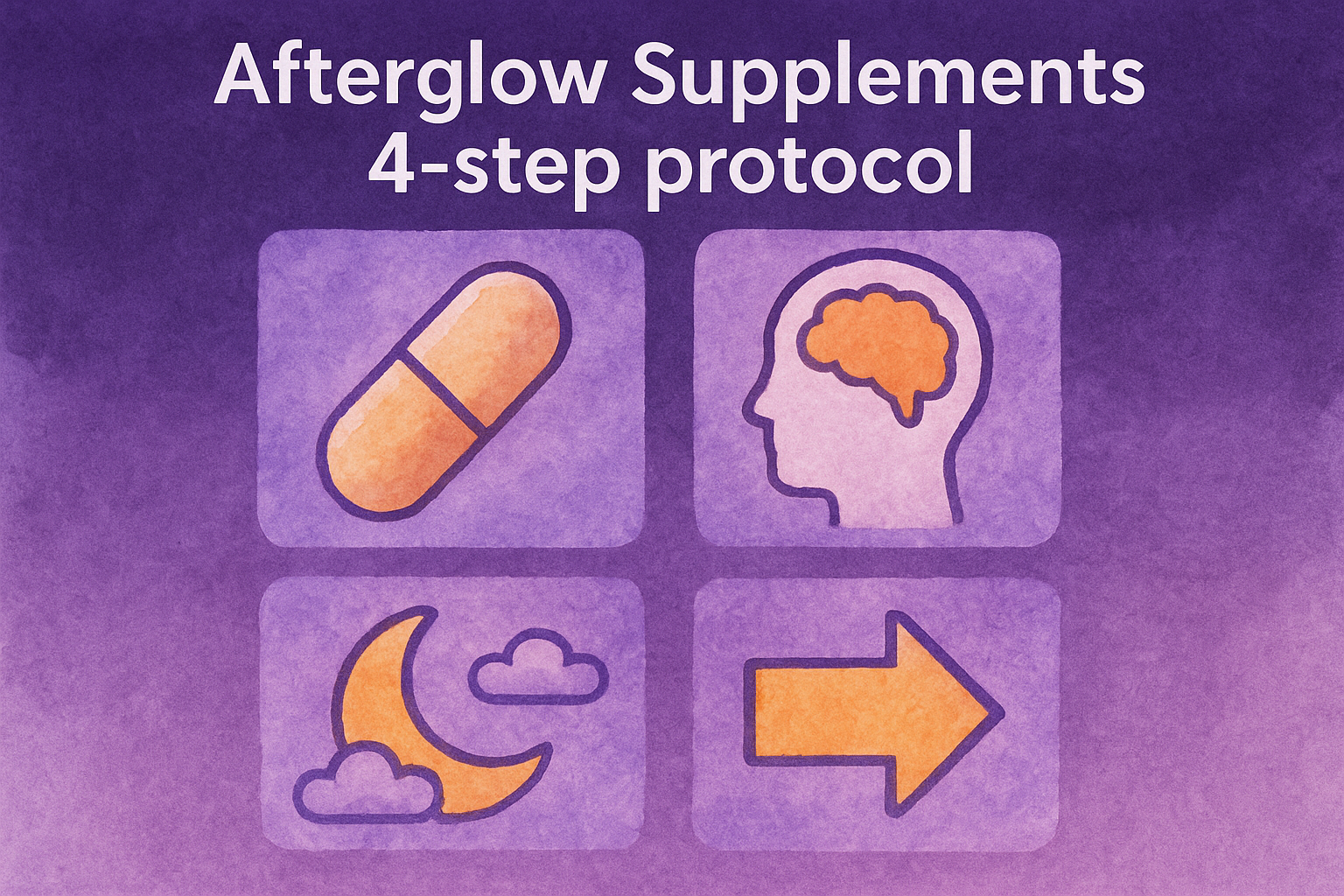
1. Afterglow Supplements 4-step protocol
If you’re looking for the best brain fog supplements bundled into a structured system rather than a pile of individual pills, the Afterglow 4-step protocol stands out. It was built specifically to address the neurological and physiological crash that follows intense psychedelic experiences, but the mechanisms it targets, serotonin depletion, oxidative stress, poor sleep, and muscle tension, are the same ones behind many common cases of brain fog.
What it may help with
The protocol covers four key phases: preparation, active support, sleep recovery, and next-day restoration. Ingredients like L-Tryptophan and Phosphatidylserine work to replenish neurotransmitter precursors and protect cell membranes, directly addressing the cognitive dullness that follows neurochemical depletion. NAC and Magnesium Bisglycinate add antioxidant defense and muscle relaxation, both of which support clearer thinking by reducing the oxidative and physical stress load on your system.
Targeting multiple recovery pathways at once is more effective than addressing them in isolation, which is what a phased protocol allows you to do.
What to look for in a formula
A solid recovery formula should include both upstream and downstream support: precursors that feed neurotransmitter synthesis and antioxidants that prevent cellular damage from clearing too slowly. Look for bioavailable forms like Magnesium Bisglycinate over cheaper oxides, and check that sleep-support ingredients such as Melatonin and L-Theanine are present in clinically relevant doses, not token amounts.
Typical use and timing
Afterglow is designed as a pre, during, sleep, and next-day regimen. You take specific components before the experience to load protective compounds, use electrolytes and supportive nutrients during, take the sleep formula at bedtime, and follow up the next day with the restoration blend. This timing matters because your brain clears waste and consolidates recovery during sleep, making the nighttime phase the most critical window for bouncing back cognitively.
Safety and interactions
The formula uses well-studied, generally recognized compounds at standard doses. That said, L-Tryptophan can interact with SSRIs and MAOIs by increasing serotonin activity, so you should avoid combining them. Always consult a doctor if you take any psychiatric medication or have a diagnosed mood disorder before adding any serotonin-influencing supplement.
Price range in Germany
Afterglow ships to Germany, with a full protocol kit typically ranging from €40 to €60 depending on the package. Single-use kits are available for occasional users, while bundles bring the per-use cost down for regular users.
2. Magnesium
Magnesium is one of the most overlooked entries on any list of the best brain fog supplements, and that’s a problem because roughly half of adults don’t get enough of it from food alone. Low magnesium directly impairs NMDA receptor function, a glutamate receptor essential for learning, memory, and cognitive processing, which makes the resulting fog feel thick and hard to shake.
Magnesium deficiency is one of the most common and most correctable causes of persistent brain fog.
What to look for in a product
Skip magnesium oxide, the cheapest form on shelves; it has poor bioavailability and mainly works as a laxative. Instead, look for Magnesium Bisglycinate or Magnesium Glycinate, which absorbs well and is gentler on the stomach.
Typical dose and timing
A standard dose runs 200 to 400 mg of elemental magnesium per day, ideally taken in the evening. Your body uses magnesium heavily during sleep for cellular repair and nervous system recovery, so nighttime dosing aligns with your natural needs.
Safety and interactions
Magnesium is generally safe at standard doses. Taking too much can cause loose stools, so start at 200 mg and adjust upward if needed. People with kidney disease should check with a doctor before supplementing, since the kidneys regulate magnesium excretion.
Price range in Germany
A quality Magnesium Bisglycinate product in Germany typically costs between €10 and €20 for a one to two month supply, making it one of the most cost-effective cognitive support options available.
3. Omega-3 fish oil
Omega-3 fatty acids, specifically EPA and DHA, are the structural backbone of your brain’s cell membranes. Without adequate levels, those membranes become rigid, and signal transmission between neurons slows down. That neurological drag shows up as difficulty concentrating, slow recall, and the kind of foggy thinking that makes you feel like you’re operating at half capacity. Omega-3s rank among the best brain fog supplements because they address the root structure problem, not just symptoms.
What it may help with
DHA makes up roughly 15 to 20% of your brain’s cerebral cortex, the region responsible for attention, decision-making, and working memory. EPA contributes by reducing neuroinflammation, a key driver of persistent brain fog. Together, they support clear signaling and help regulate mood stability, which often suffers alongside cognitive function.
Low omega-3 status is linked to faster cognitive decline and greater susceptibility to stress-induced brain fog.
What to look for in a product
Choose a product that lists combined EPA and DHA content separately, not just total fish oil weight. Look for at least 500 mg of combined EPA and DHA per serving, and choose a brand that third-party tests for heavy metals and oxidation levels.
Typical dose and timing
A common effective dose runs 1,000 to 2,000 mg of combined EPA and DHA daily, taken with a meal that contains fat to improve absorption. Consistent daily use over weeks produces the most noticeable cognitive benefits.
Safety and interactions
Omega-3s are well tolerated but can thin the blood at higher doses. If you take anticoagulants like warfarin, discuss supplementation with your doctor before starting.
Price range in Germany
A quality fish oil supplement in Germany typically costs €15 to €30 per month, depending on dose and brand purity standards.
4. Vitamin D3
Vitamin D3 sits at the intersection of immunity, mood regulation, and cognition, yet deficiency rates across Germany run high due to limited sunlight exposure for much of the year. When your levels drop below optimal, your brain pays the price with slower processing, low mood, and the kind of persistent mental heaviness that makes it one of the most relevant best brain fog supplements for people living in northern climates.
What it may help with
Vitamin D receptors exist throughout the brain, including in regions that control memory, attention, and mood. Research links low D3 levels to increased risk of depression and cognitive impairment. Correcting a deficiency can reduce inflammatory markers in the brain and restore normal dopamine and serotonin regulation, both of which directly influence how sharp and focused you feel day to day.
Vitamin D deficiency is particularly common in Germany between October and April, making supplementation during these months especially useful.
What to look for in a product
Choose D3 (cholecalciferol) over D2 (ergocalciferol), as D3 raises blood levels more effectively and maintains them longer. Pairing it with Vitamin K2 (MK-7) helps direct calcium properly and is a common combination in better-formulated products.
Typical dose and timing
A daily dose of 1,000 to 2,000 IU works well for general maintenance. Take it with your largest meal of the day since D3 absorbs better in the presence of dietary fat.
Safety and interactions
Vitamin D3 is fat-soluble, so excessive intake can accumulate. Doses up to 4,000 IU daily are considered safe for most adults, but get your blood levels tested before going higher.
Price range in Germany
A good D3/K2 combination product in Germany typically costs €10 to €20 per month, making it one of the most affordable cognitive health investments available.
5. B-complex vitamins
B vitamins don’t get enough credit as best brain fog supplements, yet your brain runs on them constantly. Every major step in neurotransmitter synthesis, from converting tryptophan to serotonin to building acetylcholine for memory, depends on B vitamins as cofactors. When your levels drop, those pathways slow, and the result is cognitive sluggishness that no amount of caffeine fully fixes.
What it may help with
B12 and B6 are the heavy hitters for brain function. B12 supports myelin production, the protective sheath around your nerve fibers that keeps signals fast and accurate. B6 is essential for synthesizing dopamine and serotonin, two neurotransmitters that directly control focus and mood stability. Folate (B9) rounds this out by supporting methylation, a chemical process your brain uses to regulate gene expression and clear metabolic waste.
Low B12 is one of the most reversible causes of serious cognitive decline, yet it often goes undetected for years.
What to look for in a product
Choose a B-complex that uses methylated forms: methylcobalamin over cyanocobalamin for B12, and methylfolate over folic acid for B9. These active forms bypass a conversion step that a significant portion of people can’t perform efficiently due to MTHFR gene variants.
Typical dose and timing
Take your B-complex in the morning with food to avoid nausea and to align with your body’s natural energy metabolism cycle. Most standard B-complex doses are effective without going into mega-dose territory.
Safety and interactions
B vitamins are water-soluble and largely safe, as your body excretes excess amounts. Very high doses of B6, above 50 mg daily for extended periods, can cause nerve sensitivity, so stick to standard supplement doses.
Price range in Germany
A quality methylated B-complex in Germany runs between €15 and €25 per month, with higher-quality methylated formulas sitting toward the upper end of that range.
6. Creatine monohydrate
Creatine is primarily known as a muscle supplement, but its role in brain energy metabolism makes it one of the more underrated best brain fog supplements on this list. Your brain is an energy-hungry organ, and it relies on a fast phosphocreatine system to regenerate ATP during high cognitive demand. When that system runs low, mental fatigue and processing delays follow quickly.
What it may help with
Creatine supports short-term energy availability in neurons, which translates to faster information processing, better working memory, and reduced mental fatigue during demanding tasks. Research shows consistent benefits for cognitive performance under conditions that deplete brain energy, including sleep deprivation and high mental load.
Creatine’s cognitive benefits are most noticeable when your brain is already under stress or energy strain.
What to look for in a product
Stick with creatine monohydrate, the most studied and cost-effective form. Avoid proprietary blends that obscure doses or add unnecessary fillers. A pure, micronized powder dissolves easily in water and gives you clean, predictable absorption without extra cost.
Typical dose and timing
A standard daily dose of 3 to 5 grams works well for most adults. You can skip the loading phase entirely since it offers no long-term advantage. Taking it consistently at any time of day, mixed into water or a shake, is all that matters.
Safety and interactions
Creatine monohydrate has an excellent long-term safety record at standard doses. It can slightly increase creatinine levels in blood tests, which looks abnormal but is harmless. People with pre-existing kidney conditions should consult a doctor before starting.
Price range in Germany
Pure creatine monohydrate is widely available in Germany for €10 to €20 per month, making it one of the most cost-effective cognitive support options you can add to your routine.
7. N-acetylcysteine
N-acetylcysteine (NAC) works as a precursor to glutathione, your body’s primary antioxidant. When oxidative stress accumulates in the brain, whether from illness, intense experiences, or chronic stress, neuronal function degrades and thinking slows. NAC directly replenishes the raw material your cells need to neutralize that damage.
What it may help with
NAC is one of the best brain fog supplements for cases where oxidative stress and neuroinflammation are the primary drivers. It also supports glutamate regulation, the brain’s main excitatory neurotransmitter, which when dysregulated contributes to anxiety, compulsive thinking, and poor focus.
Restoring glutathione levels through NAC can meaningfully reduce the oxidative load that keeps your brain running below its natural capacity.
What to look for in a product
Choose a product that lists pure NAC (N-acetyl-L-cysteine) without unnecessary fillers or proprietary blends. A third-party tested product ensures you’re getting what’s on the label, since NAC quality varies considerably across brands.
Typical dose and timing
A standard dose runs 600 to 1,200 mg daily, typically split into two doses taken with meals. Taking it with food helps minimize any nausea, which some people notice on an empty stomach.
Safety and interactions
NAC is well-tolerated at standard doses for most healthy adults. Avoid combining it with nitroglycerin or activated charcoal. People with asthma should note that inhaled NAC can trigger bronchospasm, though oral supplementation carries a much lower risk for most people.
Price range in Germany
Quality NAC supplements in Germany typically cost between €15 and €25 per month, with higher-dose formulas sitting at the upper end of that range.
8. L-theanine
L-theanine is an amino acid found naturally in green tea, and it’s one of the best brain fog supplements for people whose cognitive trouble stems from overstimulation rather than underactivation. It doesn’t sedate you; instead, it promotes calm, alert focus by increasing alpha brain wave activity, the same state your brain enters during relaxed, productive concentration.
What it may help with
L-theanine reduces the mental noise that makes focus feel impossible. It lowers activity in the default mode network, the part of your brain responsible for mind-wandering and rumination, while leaving alertness intact. Many people find it particularly useful for blunting the anxious edge that comes with caffeine, making the two a well-documented pairing for sharper, jitter-free cognition.
L-theanine is one of the few supplements that actively improves focus quality rather than just stimulating your system to feel more awake.
What to look for in a product
Look for pure L-theanine in capsule or powder form without unnecessary fillers. Doses should be clearly labeled, and a third-party tested product gives you more confidence in what you’re actually getting.
Typical dose and timing
A standard dose runs 100 to 200 mg per serving, taken in the morning or early afternoon. Pairing it with 100 mg of caffeine amplifies cognitive benefits for many users while reducing caffeine’s side effects.
Safety and interactions
L-theanine is well-tolerated and considered safe at standard doses for most healthy adults. No significant drug interactions have been established, though combining it with sedatives warrants caution.
Price range in Germany
Quality L-theanine supplements in Germany typically cost €10 to €20 per month, placing it among the more affordable cognitive support options available.
9. Rhodiola rosea
Rhodiola rosea is an adaptogenic herb that helps your body regulate the stress response more efficiently, which makes it one of the more practical best brain fog supplements for people whose cognitive trouble is stress-driven. When chronic stress keeps your cortisol elevated, your prefrontal cortex, the region responsible for focused thinking, takes a hit. Rhodiola works by modulating key stress pathways so that mental fatigue doesn’t accumulate as fast.
What it may help with
Rhodiola directly targets mental fatigue and burnout, two states that turn otherwise sharp thinkers into people who can’t hold a thought for more than a few minutes. Research shows it reduces perceived mental effort during demanding cognitive tasks and improves reaction time and attention accuracy in fatigued individuals. It also supports mood stability, which tends to suffer alongside cognitive clarity under sustained stress.
Rhodiola’s adaptogenic properties make it most effective when your brain fog is driven by exhaustion and stress rather than nutritional gaps.
What to look for in a product
Choose a product standardized to 3% rosavins and 1% salidroside, the active compounds responsible for its cognitive and adaptogenic effects. These ratios reflect the naturally occurring proportions in the root and represent the benchmark used in most clinical research on Rhodiola’s cognitive benefits.
Typical dose and timing
A standard dose runs 200 to 400 mg daily, taken in the morning or early afternoon on an empty stomach. Taking it too late in the day can occasionally interfere with sleep in sensitive individuals, so earlier dosing is the safer default.
Safety and interactions
Rhodiola is well-tolerated for most healthy adults at standard doses. Avoid combining it with stimulants or MAOIs. People with bipolar disorder should consult a doctor before using it, as its activating effects may be contraindicated.
Price range in Germany
A quality standardized Rhodiola rosea supplement in Germany typically costs between €15 and €25 per month, depending on dose and extract quality.
10. Lion’s mane mushroom
Lion’s mane (Hericium erinaceus) is a functional mushroom that stands apart from most entries on this list because it targets neurogenesis rather than just neurotransmitter balance. It stimulates the production of nerve growth factor (NGF), a protein that promotes the growth, maintenance, and survival of neurons, making it one of the more genuinely structural best brain fog supplements available.
What it may help with
Lion’s mane directly supports cognitive repair and long-term brain health by encouraging your neurons to grow and connect more efficiently. Research shows it can improve memory recall and focus in adults experiencing mild cognitive decline, and many users report clearer thinking and reduced mental fatigue with consistent use over several weeks.
Lion’s mane is one of the few natural compounds with credible evidence for supporting the brain’s own repair mechanisms rather than just masking fatigue.
What to look for in a product
Choose a product made from the fruiting body, not the mycelium, as the fruiting body contains significantly higher concentrations of the active hericenones and erinacines responsible for NGF stimulation. Look for products that list beta-glucan content as a quality marker, ideally above 25%.
Typical dose and timing
A standard dose runs 500 to 1,000 mg daily, taken in the morning with food. Benefits build gradually over four to eight weeks, so consistency matters more than timing precision.
Safety and interactions
Lion’s mane is well-tolerated by most healthy adults. Rare cases of allergic reaction have been reported in people sensitive to mushrooms. Avoid it if you have a known mushroom allergy.
Price range in Germany
A quality fruiting body lion’s mane supplement in Germany typically costs between €20 and €35 per month, with dual-extract formulas sitting toward the higher end.
11. Bacopa monnieri
Bacopa monnieri is an Ayurvedic herb with a research-backed track record as one of the best brain fog supplements for people dealing with slow information processing and poor working memory. Its active compounds, called bacosides, repair damaged neurons and enhance signal transmission between brain cells, translating to sharper recall and reduced cognitive fatigue with consistent use.
What it may help with
Bacopa works by increasing dendritic branching, the physical connections neurons form with each other, which strengthens memory consolidation and speeds up cognitive processing. Research shows consistent improvement in verbal learning, memory retention, and processing speed after eight to twelve weeks of use, making it particularly useful if your brain fog is chronic and persistent rather than tied to a single acute event.
Bacopa’s memory-enhancing effects are cumulative, meaning the longer you take it, the more pronounced your cognitive benefits become.
What to look for in a product
Choose a standardized extract containing at least 45% bacosides, the active compounds responsible for its cognitive effects. Products that don’t disclose their standardization level should be avoided, since bacoside content varies widely across raw herb powders and undisclosed formulas.
Typical dose and timing
A standard dose runs 300 to 600 mg daily, taken with a meal that contains fat since bacosides are fat-soluble and absorb better alongside dietary fat. Consistent daily use over at least six to eight weeks is necessary before you notice meaningful results.
Safety and interactions
Bacopa is generally well-tolerated, though some people notice mild digestive discomfort when taking it on an empty stomach. Avoid combining it with anticholinergic medications without consulting your doctor first.
Price range in Germany
A quality standardized Bacopa monnieri supplement in Germany typically costs between €15 and €25 per month, making it a practical long-term investment for cognitive support.
A clear path forward
Brain fog isn’t something you have to just push through. The best brain fog supplements on this list each target a specific biological mechanism, whether that’s oxidative stress, neurotransmitter depletion, or low cellular energy, and most of them work best when you stack them based on your actual situation rather than taking everything at once. Start with the compounds most likely to address your root cause, whether that’s magnesium and vitamin D3 for common deficiencies, or NAC and L-theanine if stress and oxidative load are the main drivers.
If your brain fog follows intense experiences and you want a structured, multi-stage approach that addresses several of these pathways at once, the Afterglow protocol was built for exactly that. It combines ingredients from this list into a timed, phased recovery system so nothing gets missed. Check out the Afterglow Recovery Protocol to see how it works and whether it fits what you need.
Lukas Nelpela
writes on neuroscience, mental health, and mindful exploration. With a passion in research-driven wellness and years focused on set & setting, integration, and recovery, he turns complex ideas into clear, usable insight.
You’re staring at your screen, reading the same sentence for the fourth time, and nothing sticks. Your thoughts feel like they’re wading through wet cement. So what is brain fog, exactly? It’s not a medical diagnosis, it’s a catch-all term for that frustrating state of mental cloudiness where focus, memory,
Every process in your body, thinking, moving, recovering, runs on energy produced inside your cells. That energy comes from mitochondria, and when they’re not functioning well, you feel it: brain fog, fatigue, slow recovery, and a general sense of running on empty. Mitochondrial support refers to the nutrients, habits, and
You sit down to focus, stare at your screen, and nothing clicks. Thoughts scatter, simple decisions feel impossible, and your mind moves like it’s stuck in wet concrete. If you’ve been looking up how to get rid of brain fog, you already know the frustration, that heavy, hazy state where
Working nights, rotating schedules, or pulling irregular hours throws your body’s internal clock into a constant state of confusion. Around 20% of the global workforce does some form of shift work, and the majority of those people report poor sleep as their number one complaint. Good sleep hygiene for shift
Stiff ankles affect more than just your squat depth. Limited ankle range of motion can mess with your knees, hips, and lower back, and if you spend long hours on your feet at festivals, retreats, or anywhere that keeps you moving, you’ll feel it. A solid ankle mobility routine takes
We use various cookies on our website. Some are essential for the website to function properly, while others we may only use with your consent. You can find more information about cookies on our website here.
This website uses cookies to improve your experience while you navigate through the website. Out of these cookies, the cookies that are categorized as necessary are stored on your browser as they are essential for the working of basic functionalities of the website. We also use third-party cookies that help us analyze and understand how you use this website. These cookies will be stored on your browser only with your consent. You also have the option to opt-out of these cookies. However, opting out of some of these cookies may have an impact on your browsing experience.
Necessary cookies are absolutely essential for the website to function properly. These cookies anonymously ensure basic functionalities and security features of the website.
Cookie
Duration
Description
cookielawinfo-checkbox-advertisement
1 year
Set by the GDPR Cookie Consent plugin, this cookie records the user consent for the cookies in the "Advertisement" category.
cookielawinfo-checkbox-analytics
11 months
This cookie is set by GDPR Cookie Consent plugin. The cookie is used to store the user consent for the cookies in the category "Analytics".
cookielawinfo-checkbox-functional
11 months
The cookie is set by GDPR cookie consent to record the user consent for the cookies in the category "Functional".
cookielawinfo-checkbox-necessary
11 months
This cookie is set by GDPR Cookie Consent plugin. The cookies is used to store the user consent for the cookies in the category "Necessary".
cookielawinfo-checkbox-others
11 months
This cookie is set by GDPR Cookie Consent plugin. The cookie is used to store the user consent for the cookies in the category "Other.
cookielawinfo-checkbox-performance
11 months
This cookie is set by GDPR Cookie Consent plugin. The cookie is used to store the user consent for the cookies in the category "Performance".
CookieLawInfoConsent
1 year
CookieYes sets this cookie to record the default button state of the corresponding category and the status of CCPA. It works only in coordination with the primary cookie.
elementor
never
The website's WordPress theme uses this cookie. It allows the website owner to implement or change the website's content in real-time.
fb_event_id_atc
30 minutes
Used to match client and server events for Meta Conversion API deduplication. Contains only anonymous technical IDs; no personal data stored.
fb_event_id_ic
30 minutes
Used to match client and server events for Meta Conversion API deduplication. Contains only anonymous technical IDs; no personal data stored.
fb_event_id_pur
30 minutes
Used to match client and server events for Meta Conversion API deduplication. Contains only anonymous technical IDs; no personal data stored.
fb_event_id_vc
30 minutes
Used to match client and server events for Meta Conversion API deduplication. Contains only anonymous technical IDs; no personal data stored.
rc::a
never
This cookie is set by the Google recaptcha service to identify bots to protect the website against malicious spam attacks.
rc::c
session
This cookie is set by the Google recaptcha service to identify bots to protect the website against malicious spam attacks.
viewed_cookie_policy
11 months
The cookie is set by the GDPR Cookie Consent plugin and is used to store whether or not user has consented to the use of cookies. It does not store any personal data.
VISITOR_PRIVACY_METADATA
6 months
YouTube sets this cookie to store the user's cookie consent state for the current domain.
wpEmojiSettingsSupports
session
WordPress sets this cookie when a user interacts with emojis on a WordPress site. It helps determine if the user's browser can display emojis properly.
Functional cookies help to perform certain functions, such as sharing website content on social media platforms, collecting feedback, and other third-party functions.
Cookie
Duration
Description
sib_cuid
6 months
SendinBlue sets this cookie to store unique visits.
VISITOR_INFO1_LIVE
6 months
A cookie set by YouTube to measure bandwidth that determines whether the user gets the new or old player interface.
yt-remote-cast-available
session
The yt-remote-cast-available cookie is used to store the user's preferences regarding whether casting is available on their YouTube video player.
yt-remote-cast-installed
session
The yt-remote-cast-installed cookie is used to store the user's video player preferences using embedded YouTube video.
yt-remote-connected-devices
never
YouTube sets this cookie to store the user's video preferences using embedded YouTube videos.
yt-remote-device-id
never
YouTube sets this cookie to store the user's video preferences using embedded YouTube videos.
yt-remote-fast-check-period
session
The yt-remote-fast-check-period cookie is used by YouTube to store the user's video player preferences for embedded YouTube videos.
yt-remote-session-app
session
The yt-remote-session-app cookie is used by YouTube to store user preferences and information about the interface of the embedded YouTube video player.
yt-remote-session-name
session
The yt-remote-session-name cookie is used by YouTube to store the user's video player preferences using embedded YouTube video.
ytidb::LAST_RESULT_ENTRY_KEY
never
The cookie ytidb::LAST_RESULT_ENTRY_KEY is used by YouTube to store the last search result entry that was clicked by the user. This information is used to improve the user experience by providing more relevant search results in the future.
Performance cookies are used to understand and analyze key website performance indexes, which helps in providing a better user experience for visitors.
Cookie
Duration
Description
SRM_B
1 year 24 days
Used by Microsoft Advertising as a unique ID for visitors.
Analytical cookies are used to understand how visitors interact with the website. These cookies help provide information on metrics such as the number of visitors, bounce rate, traffic source, etc.
Cookie
Duration
Description
_clck
1 year
Microsoft Clarity sets this cookie to retain the browser's Clarity User ID and settings exclusive to that website. This guarantees that actions taken during subsequent visits to the same website will be linked to the same user ID.
_clsk
1 day
Microsoft Clarity sets this cookie to store and consolidate a user's pageviews into a single session recording.
_fbp
3 months
Facebook sets this cookie to display advertisements when either on Facebook or on a digital platform powered by Facebook advertising after visiting the website.
_ga
1 year 1 month 4 days
Google Analytics sets this cookie to calculate visitor, session and campaign data and track site usage for the site's analytics report. The cookie stores information anonymously and assigns a randomly generated number to recognise unique visitors.
_ga_*
1 year 1 month 4 days
Google Analytics sets this cookie to store and count page views.
_gcl_au
3 months
Google Tag Manager sets the cookie to experiment advertisement efficiency of websites using their services.
_hjSession_*
1 hour
Hotjar sets this cookie to ensure data from subsequent visits to the same site is attributed to the same user ID, which persists in the Hotjar User ID, which is unique to that site.
_hjSessionUser_*
1 year
Hotjar sets this cookie to ensure data from subsequent visits to the same site is attributed to the same user ID, which persists in the Hotjar User ID, which is unique to that site.
_hjTLDTest
session
To determine the most generic cookie path that has to be used instead of the page hostname, Hotjar sets the _hjTLDTest cookie to store different URL substring alternatives until it fails.
CLID
1 year
Microsoft Clarity set this cookie to store information about how visitors interact with the website. The cookie helps to provide an analysis report. The data collection includes the number of visitors, where they visit the website, and the pages visited.
MR
7 days
This cookie, set by Bing, is used to collect user information for analytics purposes.
sbjs_current
session
Sourcebuster sets this cookie to identify the source of a visit and stores user action information in cookies. This analytical and behavioural cookie is used to enhance the visitor experience on the website.
sbjs_current_add
session
Sourcebuster sets this cookie to identify the source of a visit and stores user action information in cookies. This analytical and behavioural cookie is used to enhance the visitor experience on the website.
sbjs_first
session
Sourcebuster sets this cookie to identify the source of a visit and stores user action information in cookies. This analytical and behavioural cookie is used to enhance the visitor experience on the website.
sbjs_first_add
session
Sourcebuster sets this cookie to identify the source of a visit and stores user action information in cookies. This analytical and behavioural cookie is used to enhance the visitor experience on the website.
sbjs_migrations
session
Sourcebuster sets this cookie to identify the source of a visit and stores user action information in cookies. This analytical and behavioural cookie is used to enhance the visitor experience on the website.
sbjs_session
1 hour
Sourcebuster sets this cookie to identify the source of a visit and stores user action information in cookies. This analytical and behavioural cookie is used to enhance the visitor experience on the website.
sbjs_udata
session
Sourcebuster sets this cookie to identify the source of a visit and stores user action information in cookies. This analytical and behavioural cookie is used to enhance the visitor experience on the website.
SM
session
Microsoft Clarity cookie set this cookie for synchronizing the MUID across Microsoft domains.
YSC
session
YSC cookie is set by Youtube and is used to track the views of embedded videos on Youtube pages.
Advertising cookies are used to deliver relevant advertisements and marketing campaigns to visitors. These cookies track visitors across websites and collect information to deliver tailored advertisements.
Cookie
Duration
Description
_rdt_uuid
3 months
Reddit sets this cookie to build a profile of your interests and show you relevant ads.
ANONCHK
10 minutes
The ANONCHK cookie, set by Bing, is used to store a user's session ID and verify ads' clicks on the Bing search engine. The cookie helps in reporting and personalization as well.
MUID
1 year 24 days
Bing sets this cookie to recognise unique web browsers visiting Microsoft sites. This cookie is used for advertising, site analytics, and other operations.
test_cookie
15 minutes
doubleclick.net sets this cookie to determine if the user's browser supports cookies.
yt.innertube::nextId
never
YouTube sets this cookie to register a unique ID to store data on what videos from YouTube the user has seen.
yt.innertube::requests
never
YouTube sets this cookie to register a unique ID to store data on what videos from YouTube the user has seen.