Mitochondrial Support: What It Is And What Helps Your Cells
7 min read
Every process in your body, thinking, moving, recovering, runs on energy produced inside your cells. That energy comes from mitochondria, and when they’re not functioning well, you feel it: brain fog, fatigue, slow recovery, and a general sense of running on empty. Mitochondrial support refers to the nutrients, habits, and compounds that keep these organelles healthy and efficient. It’s a topic that matters to anyone who wants to feel sharper and bounce back faster, whether from daily stress or more intense experiences.
At Afterglow Supplements, we formulate recovery products for people who put their minds and bodies through demanding psychedelic experiences. Ingredients like N-Acetylcysteine (NAC) and Magnesium Bisglycinate, both part of our protocol, don’t just aid neurotransmitter recovery. They also play direct roles in protecting and fueling mitochondria. Understanding how your cells produce energy helps you make smarter choices about supplementation and recovery in general.
This article breaks down what mitochondria actually do, what causes them to underperform, and which specific nutrients and strategies help them work better. Whether you’re optimizing daily energy or supporting your body after a psychedelic journey, the fundamentals of cellular health apply. Let’s get into what the science says, and what you can actually do about it.
What mitochondrial support means
Mitochondrial support is a straightforward concept once you break it down. Mitochondria are tiny organelles inside your cells that convert food and oxygen into adenosine triphosphate (ATP), the molecule your body uses as fuel for nearly every biological function. When people talk about mitochondrial support, they mean the deliberate actions, nutrients, and compounds you use to keep those organelles working efficiently and protect them from damage over time.
What can go wrong inside your cells
Mitochondria are sensitive to oxidative stress, nutrient depletion, and chronic inflammation. When any of these factors build up, your mitochondria produce less ATP, generate more cellular waste, and struggle to repair themselves. You feel the result directly: slower thinking, reduced physical stamina, mood instability, and difficulty recovering from strenuous activity or intense psychological experiences.
Oxidative stress is one of the most common triggers of mitochondrial dysfunction, and it can accumulate quickly from sources like poor sleep, alcohol, or acute psychological strain.
What "support" actually involves
Supporting your mitochondria means giving them what they need to produce energy cleanly and consistently. This includes specific micronutrients like Magnesium, CoQ10, and B vitamins that feed directly into the ATP production cycle, as well as antioxidant compounds like NAC that neutralize the free radicals mitochondria generate as a byproduct of normal energy metabolism. Left unchecked, those free radicals damage the mitochondria themselves, reducing their output over time.
Lifestyle factors matter just as much as supplementation. Sleep quality, regular movement, and stress management all influence how well your mitochondria function on a day-to-day basis. Mitochondrial support, done properly, addresses both what your cells need to run and the accumulated damage that slows them down.
Why mitochondria matter for energy and recovery
Your mitochondria don’t just power your muscles. They fuel every energy-dependent process in your body, from firing neurons to regulating your mood and immune response. When mitochondrial output drops, the effects ripple across systems you might not immediately connect to cellular energy. That’s why optimizing mitochondrial function is foundational, not optional, for anyone serious about recovery and performance.
The direct link between ATP and how you feel
ATP is the currency your body runs on. Your brain alone consumes roughly 20% of your total energy output, which means even a modest drop in ATP production hits your cognitive function hard and fast. You notice it as mental fog, slowed reaction time, and difficulty holding focus. Physical recovery also stalls because muscle repair and cellular cleanup require ATP to proceed at full speed.
Why recovery after intense experiences is cellular
After psychedelic experiences or other high-demand events, your nervous system and metabolic pathways need time and resources to recalibrate. Mitochondria are central to that process because neurotransmitter synthesis, oxidative repair, and cellular waste clearance all depend on adequate energy supply.
Supporting your mitochondria directly after an intense experience shortens the gap between depletion and full recovery.
What helps your mitochondria
Several nutrients and habits form the core of effective mitochondrial support. Each one addresses a specific part of how your cells produce energy, handle oxidative stress, or repair damage. The right combination gives your mitochondria what they need to run efficiently and recover faster.
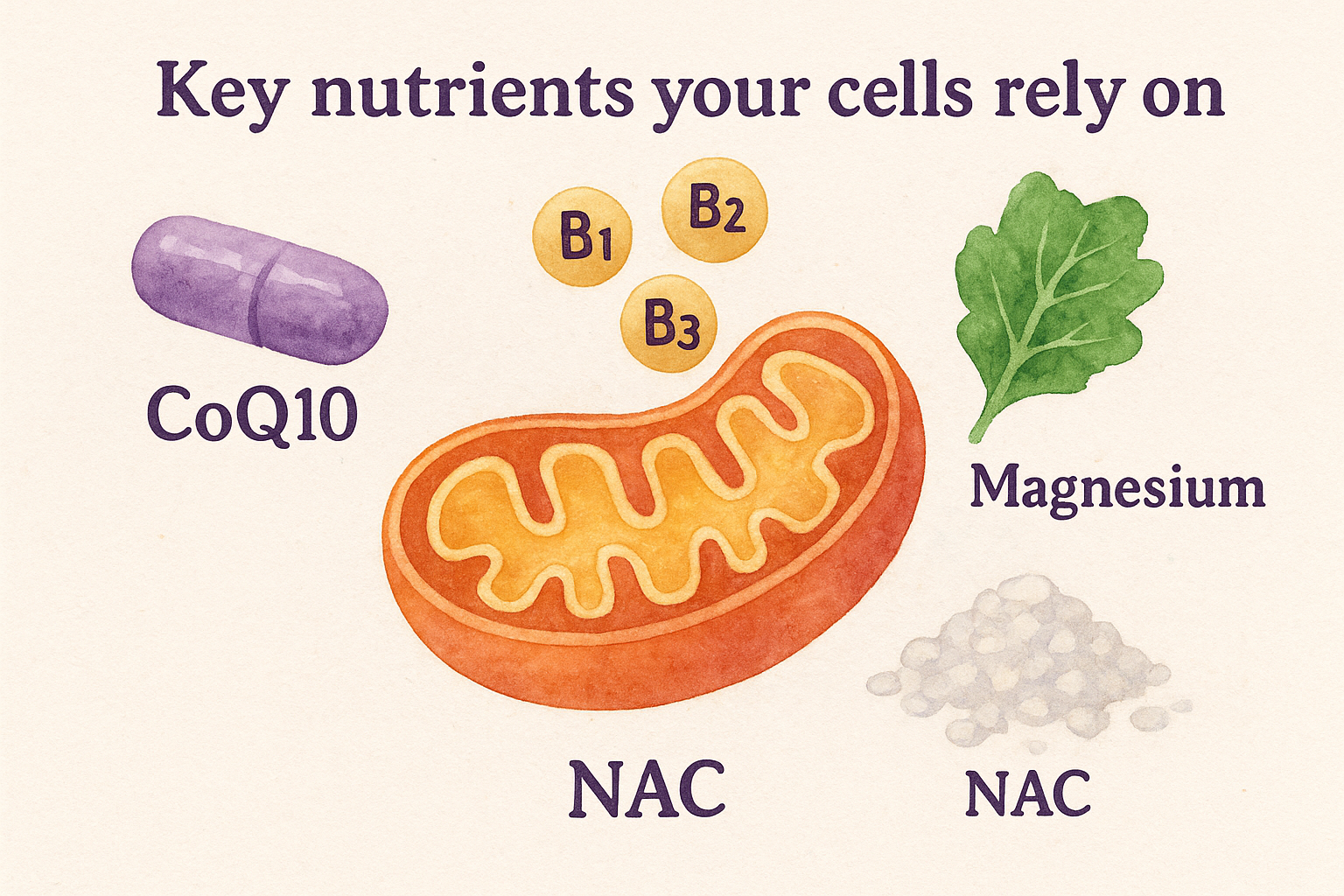
Key nutrients your cells rely on
Your mitochondria depend on specific compounds to keep ATP production running. CoQ10 acts as a direct electron carrier in the mitochondrial membrane, and B vitamins (B1, B2, B3) feed into the enzymatic reactions that generate ATP. Magnesium activates those same enzymes, while NAC boosts glutathione, your cell’s primary antioxidant defense.
NAC is one of the most studied compounds for reducing oxidative stress, a leading driver of mitochondrial decline.
CoQ10: supports electron transport and ATP output
NAC: raises glutathione and neutralizes free radicals
Magnesium: activates the enzymes that produce ATP
Lifestyle inputs that matter
Regular aerobic movement signals your cells to build more mitochondria through a process called biogenesis. Even moderate daily walking produces this effect, and quality sleep is equally critical because mitochondrial repair happens primarily at rest.
Chronic stress and poor diet both impair mitochondrial output directly. Managing those inputs alongside targeted supplementation gives your cells the best conditions to maintain consistent energy production.
How to build a mitochondrial support plan
Building an effective plan doesn’t require overhauling your entire lifestyle. Start by identifying your biggest gaps, whether that’s sleep quality, nutrient intake, or chronic stress, and tackle those first. A targeted mitochondrial support plan works better than trying to address everything at once.
Build your baseline habits first
Sleep and regular aerobic movement are your two highest-leverage inputs, and both cost nothing. Aim for seven to nine hours of sleep and at least 30 minutes of moderate activity most days. These habits signal your cells to maintain and grow new mitochondria over time.
Sleep: 7 to 9 hours consistently each night
Movement: 30+ minutes of aerobic activity daily
Stress reduction: even brief daily practices lower your overall oxidative burden
Layer in supplements around demand
Once your habits are solid, targeted supplementation fills the gaps your diet leaves open. CoQ10, Magnesium Bisglycinate, and NAC are the most practical starting points, each supporting a different part of the energy cycle. Front-load recovery nutrientsin the hours after a demanding experience to give your cells what they need when depletion is highest.
Combining NAC with Magnesium covers both antioxidant defense and enzymatic ATP production in a single step.
Safety notes and when to get help
Mitochondrial support supplements are generally safe for healthy adults when taken at standard doses, but more is not always better. Nutrients like NAC and CoQ10 are well-studied, yet stacking high doses of multiple antioxidants can actually interfere with normal cellular signaling rather than improve it. Always check labels, stick to recommended dosages, and introduce new supplements one at a time so you can spot any reactions clearly.
Taking too many antioxidant compounds at once can blunt the beneficial stress signals your cells use to trigger mitochondrial biogenesis.
Watch for warning signs
Some people experience mild digestive discomfort when starting NAC or high-dose Magnesium. This usually resolves within a few days. If you notice persistent nausea, unusual fatigue, or new symptoms after introducing a supplement, stop taking it and reassess before continuing.
When to get professional guidance
If your fatigue or brain fog is chronic and doesn’t respond to improved sleep, movement, and basic supplementation, see a doctor. Persistent mitochondrial dysfunction can signal underlying conditions like thyroid disorders, nutrient malabsorption, or metabolic issues that require proper diagnosis. Self-directed supplementation works well for optimization, but it doesn’t replace medical evaluation when something deeper is driving your symptoms.
Final takeaways
Your mitochondria sit at the center of every energy-dependent process in your body, from cognitive function to physical recovery. When they run well, you think clearly, bounce back faster, and handle stress without crashing. When they don’t, you feel it across the board. Mitochondrial support works best as a combination of consistent sleep, regular movement, and targeted nutrients like NAC, CoQ10, and Magnesium.
Start with your habits, then layer in supplements where your diet falls short. Stick to standard doses, introduce one supplement at a time, and pay attention to how your body responds. If your symptoms persist despite your best efforts, get medical guidance rather than adding more supplements on your own.
For those recovering from psychedelic experiences, cellular health is directly tied to how well and how quickly you bounce back. The Afterglow Recovery Protocol is built around the same science covered here. Explore the full recovery protocol and give your cells what they need to recover properly.
Lukas Nelpela
writes on neuroscience, mental health, and mindful exploration. With a passion in research-driven wellness and years focused on set & setting, integration, and recovery, he turns complex ideas into clear, usable insight.
You’re staring at your screen, reading the same sentence for the fourth time, and nothing sticks. Your thoughts feel like they’re wading through wet cement. So what is brain fog, exactly? It’s not a medical diagnosis, it’s a catch-all term for that frustrating state of mental cloudiness where focus, memory,
You sit down to focus, stare at your screen, and nothing clicks. Thoughts scatter, simple decisions feel impossible, and your mind moves like it’s stuck in wet concrete. If you’ve been looking up how to get rid of brain fog, you already know the frustration, that heavy, hazy state where
Working nights, rotating schedules, or pulling irregular hours throws your body’s internal clock into a constant state of confusion. Around 20% of the global workforce does some form of shift work, and the majority of those people report poor sleep as their number one complaint. Good sleep hygiene for shift
Stiff ankles affect more than just your squat depth. Limited ankle range of motion can mess with your knees, hips, and lower back, and if you spend long hours on your feet at festivals, retreats, or anywhere that keeps you moving, you’ll feel it. A solid ankle mobility routine takes
Sleep quality shapes how you think, feel, and recover, whether you’re bouncing back from a tough week or integrating a psychedelic experience. The Harvard sleep hygiene guidelines, developed by researchers at Harvard Medical School, remain some of the most cited and practical recommendations for improving rest. They’re not trendy hacks
We use various cookies on our website. Some are essential for the website to function properly, while others we may only use with your consent. You can find more information about cookies on our website here.
This website uses cookies to improve your experience while you navigate through the website. Out of these cookies, the cookies that are categorized as necessary are stored on your browser as they are essential for the working of basic functionalities of the website. We also use third-party cookies that help us analyze and understand how you use this website. These cookies will be stored on your browser only with your consent. You also have the option to opt-out of these cookies. However, opting out of some of these cookies may have an impact on your browsing experience.
Necessary cookies are absolutely essential for the website to function properly. These cookies anonymously ensure basic functionalities and security features of the website.
Cookie
Duration
Description
cookielawinfo-checkbox-advertisement
1 year
Set by the GDPR Cookie Consent plugin, this cookie records the user consent for the cookies in the "Advertisement" category.
cookielawinfo-checkbox-analytics
11 months
This cookie is set by GDPR Cookie Consent plugin. The cookie is used to store the user consent for the cookies in the category "Analytics".
cookielawinfo-checkbox-functional
11 months
The cookie is set by GDPR cookie consent to record the user consent for the cookies in the category "Functional".
cookielawinfo-checkbox-necessary
11 months
This cookie is set by GDPR Cookie Consent plugin. The cookies is used to store the user consent for the cookies in the category "Necessary".
cookielawinfo-checkbox-others
11 months
This cookie is set by GDPR Cookie Consent plugin. The cookie is used to store the user consent for the cookies in the category "Other.
cookielawinfo-checkbox-performance
11 months
This cookie is set by GDPR Cookie Consent plugin. The cookie is used to store the user consent for the cookies in the category "Performance".
CookieLawInfoConsent
1 year
CookieYes sets this cookie to record the default button state of the corresponding category and the status of CCPA. It works only in coordination with the primary cookie.
elementor
never
The website's WordPress theme uses this cookie. It allows the website owner to implement or change the website's content in real-time.
fb_event_id_atc
30 minutes
Used to match client and server events for Meta Conversion API deduplication. Contains only anonymous technical IDs; no personal data stored.
fb_event_id_ic
30 minutes
Used to match client and server events for Meta Conversion API deduplication. Contains only anonymous technical IDs; no personal data stored.
fb_event_id_pur
30 minutes
Used to match client and server events for Meta Conversion API deduplication. Contains only anonymous technical IDs; no personal data stored.
fb_event_id_vc
30 minutes
Used to match client and server events for Meta Conversion API deduplication. Contains only anonymous technical IDs; no personal data stored.
rc::a
never
This cookie is set by the Google recaptcha service to identify bots to protect the website against malicious spam attacks.
rc::c
session
This cookie is set by the Google recaptcha service to identify bots to protect the website against malicious spam attacks.
viewed_cookie_policy
11 months
The cookie is set by the GDPR Cookie Consent plugin and is used to store whether or not user has consented to the use of cookies. It does not store any personal data.
VISITOR_PRIVACY_METADATA
6 months
YouTube sets this cookie to store the user's cookie consent state for the current domain.
wpEmojiSettingsSupports
session
WordPress sets this cookie when a user interacts with emojis on a WordPress site. It helps determine if the user's browser can display emojis properly.
Functional cookies help to perform certain functions, such as sharing website content on social media platforms, collecting feedback, and other third-party functions.
Cookie
Duration
Description
sib_cuid
6 months
SendinBlue sets this cookie to store unique visits.
VISITOR_INFO1_LIVE
6 months
A cookie set by YouTube to measure bandwidth that determines whether the user gets the new or old player interface.
yt-remote-cast-available
session
The yt-remote-cast-available cookie is used to store the user's preferences regarding whether casting is available on their YouTube video player.
yt-remote-cast-installed
session
The yt-remote-cast-installed cookie is used to store the user's video player preferences using embedded YouTube video.
yt-remote-connected-devices
never
YouTube sets this cookie to store the user's video preferences using embedded YouTube videos.
yt-remote-device-id
never
YouTube sets this cookie to store the user's video preferences using embedded YouTube videos.
yt-remote-fast-check-period
session
The yt-remote-fast-check-period cookie is used by YouTube to store the user's video player preferences for embedded YouTube videos.
yt-remote-session-app
session
The yt-remote-session-app cookie is used by YouTube to store user preferences and information about the interface of the embedded YouTube video player.
yt-remote-session-name
session
The yt-remote-session-name cookie is used by YouTube to store the user's video player preferences using embedded YouTube video.
ytidb::LAST_RESULT_ENTRY_KEY
never
The cookie ytidb::LAST_RESULT_ENTRY_KEY is used by YouTube to store the last search result entry that was clicked by the user. This information is used to improve the user experience by providing more relevant search results in the future.
Performance cookies are used to understand and analyze key website performance indexes, which helps in providing a better user experience for visitors.
Cookie
Duration
Description
SRM_B
1 year 24 days
Used by Microsoft Advertising as a unique ID for visitors.
Analytical cookies are used to understand how visitors interact with the website. These cookies help provide information on metrics such as the number of visitors, bounce rate, traffic source, etc.
Cookie
Duration
Description
_clck
1 year
Microsoft Clarity sets this cookie to retain the browser's Clarity User ID and settings exclusive to that website. This guarantees that actions taken during subsequent visits to the same website will be linked to the same user ID.
_clsk
1 day
Microsoft Clarity sets this cookie to store and consolidate a user's pageviews into a single session recording.
_fbp
3 months
Facebook sets this cookie to display advertisements when either on Facebook or on a digital platform powered by Facebook advertising after visiting the website.
_ga
1 year 1 month 4 days
Google Analytics sets this cookie to calculate visitor, session and campaign data and track site usage for the site's analytics report. The cookie stores information anonymously and assigns a randomly generated number to recognise unique visitors.
_ga_*
1 year 1 month 4 days
Google Analytics sets this cookie to store and count page views.
_gcl_au
3 months
Google Tag Manager sets the cookie to experiment advertisement efficiency of websites using their services.
_hjSession_*
1 hour
Hotjar sets this cookie to ensure data from subsequent visits to the same site is attributed to the same user ID, which persists in the Hotjar User ID, which is unique to that site.
_hjSessionUser_*
1 year
Hotjar sets this cookie to ensure data from subsequent visits to the same site is attributed to the same user ID, which persists in the Hotjar User ID, which is unique to that site.
_hjTLDTest
session
To determine the most generic cookie path that has to be used instead of the page hostname, Hotjar sets the _hjTLDTest cookie to store different URL substring alternatives until it fails.
CLID
1 year
Microsoft Clarity set this cookie to store information about how visitors interact with the website. The cookie helps to provide an analysis report. The data collection includes the number of visitors, where they visit the website, and the pages visited.
MR
7 days
This cookie, set by Bing, is used to collect user information for analytics purposes.
sbjs_current
session
Sourcebuster sets this cookie to identify the source of a visit and stores user action information in cookies. This analytical and behavioural cookie is used to enhance the visitor experience on the website.
sbjs_current_add
session
Sourcebuster sets this cookie to identify the source of a visit and stores user action information in cookies. This analytical and behavioural cookie is used to enhance the visitor experience on the website.
sbjs_first
session
Sourcebuster sets this cookie to identify the source of a visit and stores user action information in cookies. This analytical and behavioural cookie is used to enhance the visitor experience on the website.
sbjs_first_add
session
Sourcebuster sets this cookie to identify the source of a visit and stores user action information in cookies. This analytical and behavioural cookie is used to enhance the visitor experience on the website.
sbjs_migrations
session
Sourcebuster sets this cookie to identify the source of a visit and stores user action information in cookies. This analytical and behavioural cookie is used to enhance the visitor experience on the website.
sbjs_session
1 hour
Sourcebuster sets this cookie to identify the source of a visit and stores user action information in cookies. This analytical and behavioural cookie is used to enhance the visitor experience on the website.
sbjs_udata
session
Sourcebuster sets this cookie to identify the source of a visit and stores user action information in cookies. This analytical and behavioural cookie is used to enhance the visitor experience on the website.
SM
session
Microsoft Clarity cookie set this cookie for synchronizing the MUID across Microsoft domains.
YSC
session
YSC cookie is set by Youtube and is used to track the views of embedded videos on Youtube pages.
Advertising cookies are used to deliver relevant advertisements and marketing campaigns to visitors. These cookies track visitors across websites and collect information to deliver tailored advertisements.
Cookie
Duration
Description
_rdt_uuid
3 months
Reddit sets this cookie to build a profile of your interests and show you relevant ads.
ANONCHK
10 minutes
The ANONCHK cookie, set by Bing, is used to store a user's session ID and verify ads' clicks on the Bing search engine. The cookie helps in reporting and personalization as well.
MUID
1 year 24 days
Bing sets this cookie to recognise unique web browsers visiting Microsoft sites. This cookie is used for advertising, site analytics, and other operations.
test_cookie
15 minutes
doubleclick.net sets this cookie to determine if the user's browser supports cookies.
yt.innertube::nextId
never
YouTube sets this cookie to register a unique ID to store data on what videos from YouTube the user has seen.
yt.innertube::requests
never
YouTube sets this cookie to register a unique ID to store data on what videos from YouTube the user has seen.