8 Sleep Hygiene Tips for Shift Workers That Actually Help
13 min read
Working nights, rotating schedules, or pulling irregular hours throws your body’s internal clock into a constant state of confusion. Around 20% of the global workforce does some form of shift work, and the majority of those people report poor sleep as their number one complaint. Good sleep hygiene for shift workers isn’t just a nice-to-have, it’s the difference between functioning and falling apart.
The usual "go to bed at the same time every night" advice doesn’t cut it when your schedule flips every few days. Shift workers deal with a unique set of obstacles: daylight flooding the bedroom at 8 a.m., cortisol spiking when you’re supposed to wind down, and a social world that operates on the exact opposite rhythm. Generic sleep tips were written for 9-to-5 lives, and that’s not yours.
At Afterglow Supplements, we spend a lot of time thinking about recovery and what happens after intense experiences, whether that’s a psychedelic journey, a weekend festival, or a grueling night shift. Ingredients like magnesium bisglycinate, L-theanine, and melatonin are part of our recovery protocol because quality sleep is the foundation everything else is built on. We know the science, and we know it matters.
Below are eight tips built specifically for people who work against the clock, practical, evidence-based strategies you can start using tonight (or this morning, depending on your shift). No filler, no recycled advice that ignores your reality.
1. Build a sleep schedule you can repeat
Your body runs on a 24-hour internal clock called the circadian rhythm, and it craves predictability. Even when your work schedule rotates, you can anchor your sleep by keeping your wake time as consistent as possible across your days on and off. Pick a target wake time for each shift type and protect it like any other commitment.
What to do
Set a fixed wake time for each shift pattern you work. If you’re on nights this week, wake at 6 p.m. every day whether you feel rested or not. Resist the urge to sleep in on days off, because that single habit is often what breaks the entire rhythm. Consistency on your days off matters just as much as consistency during your work week.
Why it works
The suprachiasmatic nucleus (SCN), the brain’s master clock, responds to repeated patterns in light exposure, activity, and sleep timing. When you anchor a regular wake time, your body starts releasing cortisol and melatonin at predictable intervals, making it easier to fall asleep and stay asleep. Irregular sleep timing suppresses melatonin and keeps stress hormones elevated at the wrong times.
A consistent wake time is the single most powerful anchor you have for regulating your circadian rhythm.
Social obligations and family schedules will occasionally break your rhythm. When that happens, anchor the next wake time immediately rather than trying to compensate with extra sleep. One disrupted cycle is recoverable. A week of inconsistent wake times rebuilds the problem from scratch. Treating good sleep hygiene for shift workers as a standing policy, rather than a perfect streak, keeps you from spiraling after one bad day.
2. Use light to move your body clock on purpose
Light is the most powerful signal your circadian system responds to. Controlling when you get bright light and when you block it is one of the most effective pieces of sleep hygiene for shift workers you can apply without spending much money.
What to do
Get bright light exposure immediately after waking, regardless of whether that’s noon or midnight. On night shifts, use a light therapy lamp (10,000 lux) at the start of your shift to signal alertness. Block light aggressively in the two hours before your sleep window using blackout curtains, sunglasses, or blue-light-blocking glasses if daylight is unavoidable on your commute home.
Why it works
Your SCN reads light as a direct cue to suppress melatonin and raise cortisol. Exposing yourself to bright light at the right time shifts your rhythm forward or backward by up to two hours per day, which is the fastest non-pharmacological way to realign your sleep window with your work schedule.
Blocking light in the final hour before bed is as important as getting light at the right time.
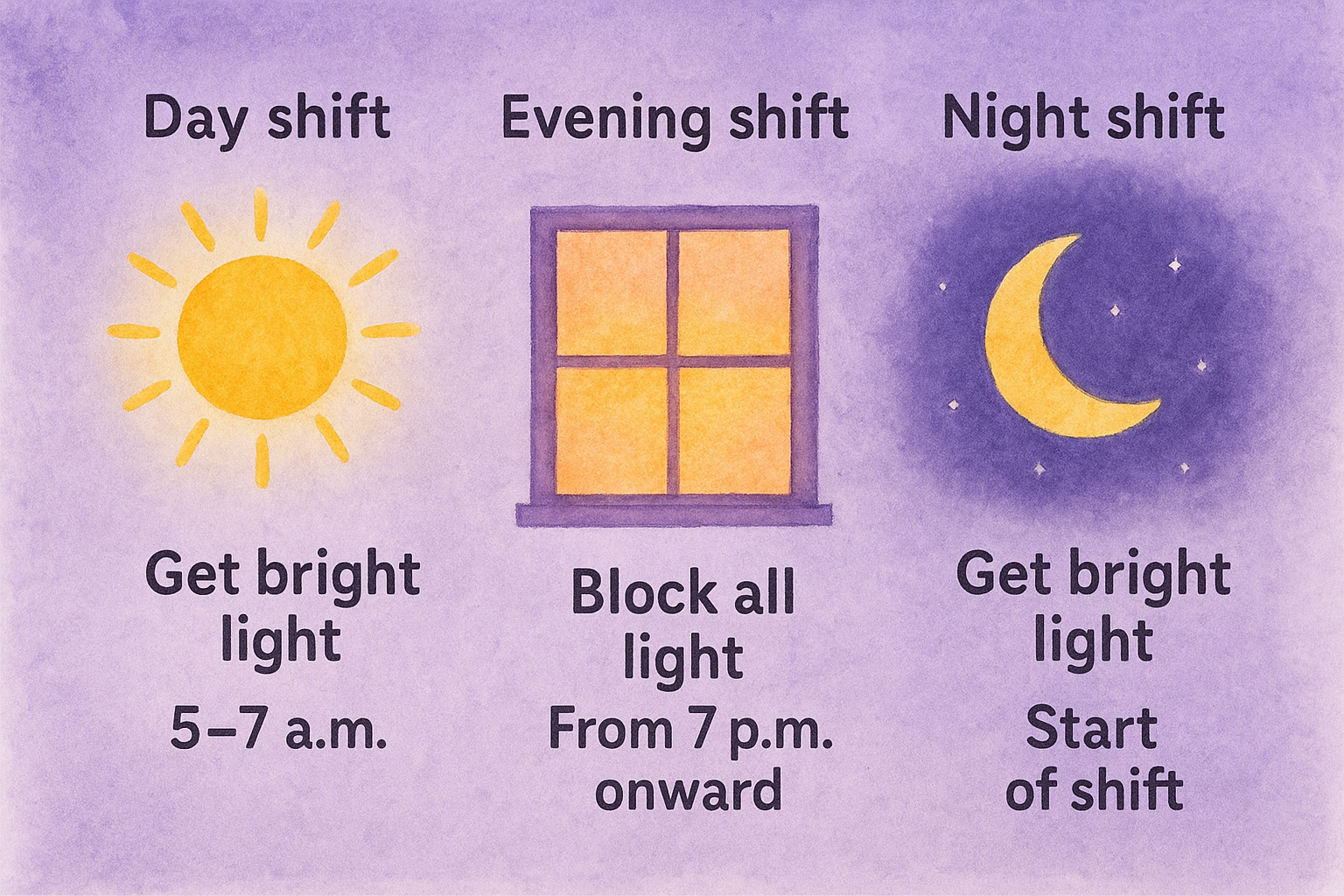
Quick timing guide for day, evening, and night shifts
Shift type
Get bright light
Block all light
Day shift
5–7 a.m.
From 7 p.m. onward
Evening shift
Noon–2 p.m.
From 10 p.m. onward
Night shift
Start of shift
Last hour of commute home
Common mistakes that keep you wired
The biggest error is checking your phone on the commute home after a night shift. Even brief screen exposure at sunrise tells your brain it’s time to wake up, not sleep. Wearing wraparound blue-light-blocking glasses from the moment your shift ends until you’re in bed removes that trigger entirely.
3. Turn your bedroom into a reliable sleep zone
Your bedroom needs to send one clear signal: sleep happens here. When you’re fighting daylight and neighborhood noise after a night shift, your environment either helps your body shut down or works against it. This is one of the most controllable pieces of sleep hygiene for shift workers, and small changes make a real difference.
What to do
Treat your bedroom as a dedicated sleep space, not a multi-use room. Remove screens, keep the temperature between 60-67°F (15-19°C), and block every light source before your sleep window begins. These aren’t comfort upgrades; they’re functional requirements for daytime sleep.
Why it works
Your brain forms strong associations between environments and behaviors. A cool, dark, quiet room consistently reinforces the sleep association, reducing the time it takes to fall asleep and cutting down on wake-ups caused by thermal or sensory disruption.
The more consistently your bedroom signals sleep, the less mental effort the transition requires.
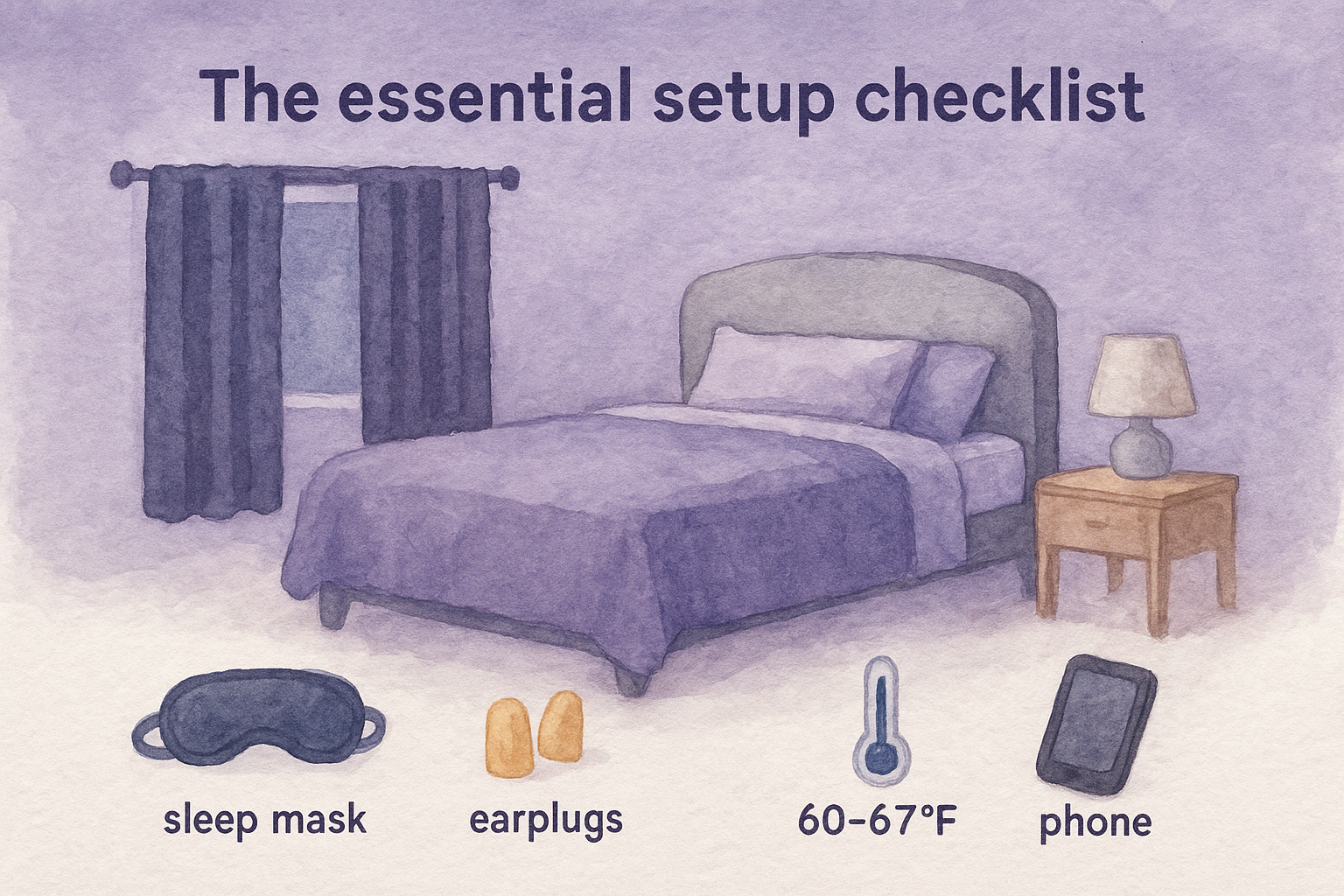
The essential setup checklist
Start here before your next sleep window:
Blackout curtains or a sleep mask rated for full light blocking
Earplugs or a white noise machine to mask street and household sounds
Thermostat or fan set to 60-67°F (15-19°C)
Phone on airplane mode or moved to another room
Fixes for noise, light leaks, and temperature
Light leaks around curtain edges are the most common problem. Fix them with curtain clips or black tape along the frame. For noise, a box fan or white noise device creates a steady audio mask that covers traffic and household sounds without needing complete silence.
4. Nap strategically to boost alertness without wrecking sleep
A well-timed nap is one of the most underused tools in sleep hygiene for shift workers. Used correctly, a short nap sharpens your focus and extends your safe working window. Used poorly, it leaves you groggy and cuts into your main sleep block at exactly the wrong moment.
What to do
Keep naps short and purposeful. A 10-20 minute nap before a night shift or during a scheduled break boosts alertness without triggering deep sleep. Place your nap at least 6 hours before your main sleep window to avoid competing with the sleep pressure you need to fall asleep later.
Why it works
Sleep pressure is driven by a chemical called adenosine that builds the longer you stay awake. A short nap clears just enough adenosine to restore alertness without fully depleting the drive you need for your main block. Napping into deep sleep (stages 3-4) is what causes that heavy, disoriented feeling on waking.
A 20-minute nap before a night shift can reduce reaction time errors as effectively as a full night of recovery sleep for short-duration tasks.
Best nap lengths and when to use them
Goal
Nap length
Best timing
Quick alertness boost
10-20 minutes
Pre-shift or mid-shift break
Memory consolidation
90 minutes
After main sleep if cut short
How to reduce sleep inertia after a nap
Sleep inertia is the groggy, slow feeling that follows waking from a longer nap. Set a firm alarm and step into bright light immediately after waking to clear it faster. Splashing cold water on your face and moving your body for two minutes cuts the fog more reliably than sitting still and waiting it out.
5. Time caffeine and nicotine so they help instead of hurt
Caffeine and nicotine are stimulants, and most shift workers rely on them to push through fatigue. Used at the right time, they extend your alert window. Used too late, they block sleep for hours after you feel like the effects have worn off, which is one of the most overlooked problems in sleep hygiene for shift workers.
What to do
Stop all caffeine intake at least six hours before your intended sleep time. Nicotine has a shorter half-life but still elevates heart rate and delays sleep onset, so cut it 90 minutes before bed. Front-load your stimulants to the first half of your shift, not the last.
Why it works
Caffeine works by blocking adenosine receptors, the same system that builds sleep pressure the longer you stay awake. Even after you stop feeling alert, caffeine remains active in your system and prevents adenosine from accumulating properly, which means you fall asleep slower and sleep lighter than you realize.
Half of the caffeine from a cup of coffee is still circulating in your bloodstream five to six hours later.
A cutoff rule you can follow on any shift
Take your planned sleep time, count back six hours, and that’s your caffeine cutoff. Night shift ending at 8 a.m. with a sleep target of 9 a.m.? Your last coffee is at 3 a.m.
What to do when you still feel sleepy at work
Cold water, brief movement, and bright light all stimulate alertness without delaying your sleep window later. A brisk two-minute walk beats a late coffee every time.
6. Stop using alcohol and heavy food as sleep tools
Alcohol and large meals are two of the most common self-medication habits among shift workers. Both feel like they help you wind down, but both actively damage sleep quality in ways that compound over time and leave you more depleted than before.
What to do
Avoid alcohol entirely within four hours of your sleep window, and keep meals light in the two hours before bed. A heavy, high-fat meal triggers digestion that raises your core body temperature at exactly the point your body needs to cool down.
No alcohol within four hours of sleep
No large meals within two hours of sleep
No high-sugar snacks right before bed
Why it works
Alcohol sedates you initially but fragments sleep architecture by suppressing REM sleep, the stage responsible for emotional processing and memory consolidation. You fall asleep faster but wake up more often and feel worse despite the hours logged. This is one of the most overlooked traps in sleep hygiene for shift workers.
Alcohol reduces REM sleep by up to 24% even in moderate amounts, according to research published in JMIR Mental Health.
What to eat on nights and before bed
Choose light, protein-rich options like eggs, Greek yogurt, or a small handful of nuts. These digest easily, support serotonin production, and avoid the blood sugar spike-and-crash pattern that pulls you awake mid-sleep.
Hydration timing that reduces sleep interruptions
Drink the majority of your fluids early in your waking period. Tapering hydration in the two hours before bed cuts bathroom trips that fragment your sleep without leaving you dehydrated during your shift.
7. Build a wind-down routine that works in daylight
Your nervous system does not switch off the moment you get home. After an intense shift, cortisol and adrenaline stay elevated for 30 to 60 minutes, which means climbing straight into bed often results in lying awake. A consistent pre-sleep routine signals your brain that sleep is next, not more activity.
What to do
Start your wind-down 20 minutes before your target sleep time. Keep the steps identical each day so your brain builds a reliable association between those actions and sleep. Dim lights, reduce noise, and move away from screens toward something passive like reading or light stretching.
Why it works
Repeated routines create conditioned responses in your nervous system. When you perform the same sequence consistently, your body begins releasing melatonin earlier in the process, cutting the time it takes to fall asleep. This makes wind-down routines one of the most practical tools in sleep hygiene for shift workers because they work regardless of what time the clock reads.
A consistent pre-sleep sequence can reduce sleep onset time by 10 to 15 minutes within two weeks of regular practice.
A 20-minute pre-sleep routine you can copy
Minutes 1-5: Change clothes and lower room temperature
Minutes 6-12: Light stretching or slow breathing exercises
Minutes 13-18: Read a physical book in dim light
Minutes 19-20: Set your alarm and move your phone out of the room
What to do when you cannot fall asleep
Leave the bed after 20 minutes of lying awake. Move to a dim, quiet space and do something low-stimulation until drowsiness arrives, then return. Staying in bed while awake trains your brain to link that environment with wakefulness, which deepens the problem over time.
8. Protect your safety and know when to get help
Fatigue from poor sleep hygiene for shift workers is not just uncomfortable; it creates real physical risk. Drowsy driving, slowed reaction times, and impaired judgment after a long night shift are as dangerous as working while intoxicated. Knowing your limits and recognizing when the problem has moved beyond lifestyle fixes protects both you and the people around you.
What to do
Never drive home if you have been awake for more than 17 to 19 hours. Arrange a carpool, take public transit, or sleep at work before commuting. Keep a small safety kit in your car with an emergency blanket so you can pull over and rest if needed.
Why it works
Sleep deprivation at the 17-hour mark produces cognitive impairment equivalent to a blood alcohol level of 0.05%, according to research reviewed by the National Institutes of Health. Your body does not alert you accurately when you reach that threshold, which makes the risk invisible until something goes wrong.
You cannot feel exactly how impaired you are when fatigued, which is precisely what makes it so dangerous.
Red flags for shift work sleep disorder
Watch for these signs that your situation needs professional attention:
Persistent inability to sleep during your scheduled window for more than a month
Falling asleep uncontrollably during your shift
Mood changes, memory gaps, or depression that do not improve with rest
Safer commute and post-shift recovery steps
After your shift ends, give yourself a 10 to 15 minute buffer before getting behind the wheel. Walk, hydrate, and check in honestly with how alert you feel before making any safety-critical decision.
A simple plan you can stick to
Good sleep hygiene for shift workers does not require a perfect life or a perfect schedule. It requires picking two or three of these tips and applying them consistently until they become automatic. Start with your sleep window and your light exposure, because those two levers move your circadian rhythm faster than anything else on this list.
From there, layer in your bedroom setup, your caffeine cutoff, and your wind-down routine. Each habit you lock in makes the next one easier to hold. Small, repeatable actions compound over weeks in ways that one heroic effort never does.
Recovery is not just about sleep, either. Your body also needs the right nutritional support to replenish what demanding schedules deplete. If you want to understand the science behind targeted recovery ingredients like magnesium bisglycinate, L-theanine, and melatonin, check out the Afterglow science-backed recovery protocol and see what a structured approach to recovery actually looks like.
Lukas Nelpela
writes on neuroscience, mental health, and mindful exploration. With a passion in research-driven wellness and years focused on set & setting, integration, and recovery, he turns complex ideas into clear, usable insight.
You’re staring at your screen, reading the same sentence for the fourth time, and nothing sticks. Your thoughts feel like they’re wading through wet cement. So what is brain fog, exactly? It’s not a medical diagnosis, it’s a catch-all term for that frustrating state of mental cloudiness where focus, memory,
Every process in your body, thinking, moving, recovering, runs on energy produced inside your cells. That energy comes from mitochondria, and when they’re not functioning well, you feel it: brain fog, fatigue, slow recovery, and a general sense of running on empty. Mitochondrial support refers to the nutrients, habits, and
You sit down to focus, stare at your screen, and nothing clicks. Thoughts scatter, simple decisions feel impossible, and your mind moves like it’s stuck in wet concrete. If you’ve been looking up how to get rid of brain fog, you already know the frustration, that heavy, hazy state where
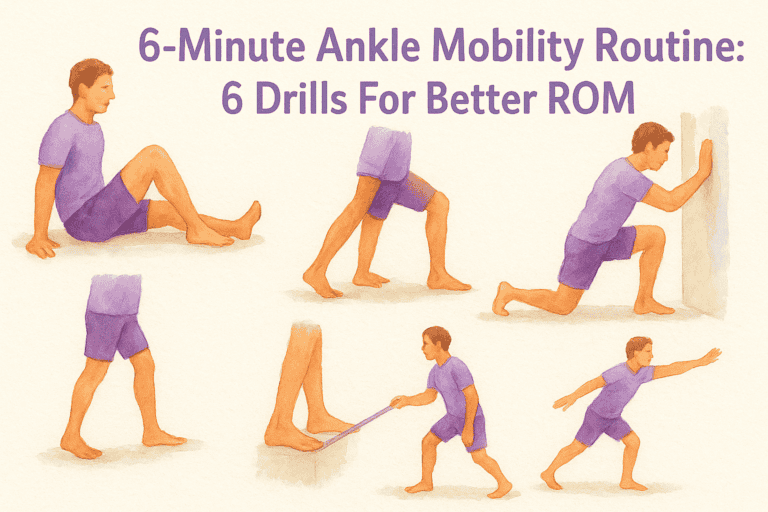
Stiff ankles affect more than just your squat depth. Limited ankle range of motion can mess with your knees, hips, and lower back, and if you spend long hours on your feet at festivals, retreats, or anywhere that keeps you moving, you’ll feel it. A solid ankle mobility routine takes
Sleep quality shapes how you think, feel, and recover, whether you’re bouncing back from a tough week or integrating a psychedelic experience. The Harvard sleep hygiene guidelines, developed by researchers at Harvard Medical School, remain some of the most cited and practical recommendations for improving rest. They’re not trendy hacks
We use various cookies on our website. Some are essential for the website to function properly, while others we may only use with your consent. You can find more information about cookies on our website here.
This website uses cookies to improve your experience while you navigate through the website. Out of these cookies, the cookies that are categorized as necessary are stored on your browser as they are essential for the working of basic functionalities of the website. We also use third-party cookies that help us analyze and understand how you use this website. These cookies will be stored on your browser only with your consent. You also have the option to opt-out of these cookies. However, opting out of some of these cookies may have an impact on your browsing experience.
Necessary cookies are absolutely essential for the website to function properly. These cookies anonymously ensure basic functionalities and security features of the website.
Cookie
Duration
Description
cookielawinfo-checkbox-advertisement
1 year
Set by the GDPR Cookie Consent plugin, this cookie records the user consent for the cookies in the "Advertisement" category.
cookielawinfo-checkbox-analytics
11 months
This cookie is set by GDPR Cookie Consent plugin. The cookie is used to store the user consent for the cookies in the category "Analytics".
cookielawinfo-checkbox-functional
11 months
The cookie is set by GDPR cookie consent to record the user consent for the cookies in the category "Functional".
cookielawinfo-checkbox-necessary
11 months
This cookie is set by GDPR Cookie Consent plugin. The cookies is used to store the user consent for the cookies in the category "Necessary".
cookielawinfo-checkbox-others
11 months
This cookie is set by GDPR Cookie Consent plugin. The cookie is used to store the user consent for the cookies in the category "Other.
cookielawinfo-checkbox-performance
11 months
This cookie is set by GDPR Cookie Consent plugin. The cookie is used to store the user consent for the cookies in the category "Performance".
CookieLawInfoConsent
1 year
CookieYes sets this cookie to record the default button state of the corresponding category and the status of CCPA. It works only in coordination with the primary cookie.
elementor
never
The website's WordPress theme uses this cookie. It allows the website owner to implement or change the website's content in real-time.
fb_event_id_atc
30 minutes
Used to match client and server events for Meta Conversion API deduplication. Contains only anonymous technical IDs; no personal data stored.
fb_event_id_ic
30 minutes
Used to match client and server events for Meta Conversion API deduplication. Contains only anonymous technical IDs; no personal data stored.
fb_event_id_pur
30 minutes
Used to match client and server events for Meta Conversion API deduplication. Contains only anonymous technical IDs; no personal data stored.
fb_event_id_vc
30 minutes
Used to match client and server events for Meta Conversion API deduplication. Contains only anonymous technical IDs; no personal data stored.
rc::a
never
This cookie is set by the Google recaptcha service to identify bots to protect the website against malicious spam attacks.
rc::c
session
This cookie is set by the Google recaptcha service to identify bots to protect the website against malicious spam attacks.
viewed_cookie_policy
11 months
The cookie is set by the GDPR Cookie Consent plugin and is used to store whether or not user has consented to the use of cookies. It does not store any personal data.
VISITOR_PRIVACY_METADATA
6 months
YouTube sets this cookie to store the user's cookie consent state for the current domain.
wpEmojiSettingsSupports
session
WordPress sets this cookie when a user interacts with emojis on a WordPress site. It helps determine if the user's browser can display emojis properly.
Functional cookies help to perform certain functions, such as sharing website content on social media platforms, collecting feedback, and other third-party functions.
Cookie
Duration
Description
sib_cuid
6 months
SendinBlue sets this cookie to store unique visits.
VISITOR_INFO1_LIVE
6 months
A cookie set by YouTube to measure bandwidth that determines whether the user gets the new or old player interface.
yt-remote-cast-available
session
The yt-remote-cast-available cookie is used to store the user's preferences regarding whether casting is available on their YouTube video player.
yt-remote-cast-installed
session
The yt-remote-cast-installed cookie is used to store the user's video player preferences using embedded YouTube video.
yt-remote-connected-devices
never
YouTube sets this cookie to store the user's video preferences using embedded YouTube videos.
yt-remote-device-id
never
YouTube sets this cookie to store the user's video preferences using embedded YouTube videos.
yt-remote-fast-check-period
session
The yt-remote-fast-check-period cookie is used by YouTube to store the user's video player preferences for embedded YouTube videos.
yt-remote-session-app
session
The yt-remote-session-app cookie is used by YouTube to store user preferences and information about the interface of the embedded YouTube video player.
yt-remote-session-name
session
The yt-remote-session-name cookie is used by YouTube to store the user's video player preferences using embedded YouTube video.
ytidb::LAST_RESULT_ENTRY_KEY
never
The cookie ytidb::LAST_RESULT_ENTRY_KEY is used by YouTube to store the last search result entry that was clicked by the user. This information is used to improve the user experience by providing more relevant search results in the future.
Performance cookies are used to understand and analyze key website performance indexes, which helps in providing a better user experience for visitors.
Cookie
Duration
Description
SRM_B
1 year 24 days
Used by Microsoft Advertising as a unique ID for visitors.
Analytical cookies are used to understand how visitors interact with the website. These cookies help provide information on metrics such as the number of visitors, bounce rate, traffic source, etc.
Cookie
Duration
Description
_clck
1 year
Microsoft Clarity sets this cookie to retain the browser's Clarity User ID and settings exclusive to that website. This guarantees that actions taken during subsequent visits to the same website will be linked to the same user ID.
_clsk
1 day
Microsoft Clarity sets this cookie to store and consolidate a user's pageviews into a single session recording.
_fbp
3 months
Facebook sets this cookie to display advertisements when either on Facebook or on a digital platform powered by Facebook advertising after visiting the website.
_ga
1 year 1 month 4 days
Google Analytics sets this cookie to calculate visitor, session and campaign data and track site usage for the site's analytics report. The cookie stores information anonymously and assigns a randomly generated number to recognise unique visitors.
_ga_*
1 year 1 month 4 days
Google Analytics sets this cookie to store and count page views.
_gcl_au
3 months
Google Tag Manager sets the cookie to experiment advertisement efficiency of websites using their services.
_hjSession_*
1 hour
Hotjar sets this cookie to ensure data from subsequent visits to the same site is attributed to the same user ID, which persists in the Hotjar User ID, which is unique to that site.
_hjSessionUser_*
1 year
Hotjar sets this cookie to ensure data from subsequent visits to the same site is attributed to the same user ID, which persists in the Hotjar User ID, which is unique to that site.
_hjTLDTest
session
To determine the most generic cookie path that has to be used instead of the page hostname, Hotjar sets the _hjTLDTest cookie to store different URL substring alternatives until it fails.
CLID
1 year
Microsoft Clarity set this cookie to store information about how visitors interact with the website. The cookie helps to provide an analysis report. The data collection includes the number of visitors, where they visit the website, and the pages visited.
MR
7 days
This cookie, set by Bing, is used to collect user information for analytics purposes.
sbjs_current
session
Sourcebuster sets this cookie to identify the source of a visit and stores user action information in cookies. This analytical and behavioural cookie is used to enhance the visitor experience on the website.
sbjs_current_add
session
Sourcebuster sets this cookie to identify the source of a visit and stores user action information in cookies. This analytical and behavioural cookie is used to enhance the visitor experience on the website.
sbjs_first
session
Sourcebuster sets this cookie to identify the source of a visit and stores user action information in cookies. This analytical and behavioural cookie is used to enhance the visitor experience on the website.
sbjs_first_add
session
Sourcebuster sets this cookie to identify the source of a visit and stores user action information in cookies. This analytical and behavioural cookie is used to enhance the visitor experience on the website.
sbjs_migrations
session
Sourcebuster sets this cookie to identify the source of a visit and stores user action information in cookies. This analytical and behavioural cookie is used to enhance the visitor experience on the website.
sbjs_session
1 hour
Sourcebuster sets this cookie to identify the source of a visit and stores user action information in cookies. This analytical and behavioural cookie is used to enhance the visitor experience on the website.
sbjs_udata
session
Sourcebuster sets this cookie to identify the source of a visit and stores user action information in cookies. This analytical and behavioural cookie is used to enhance the visitor experience on the website.
SM
session
Microsoft Clarity cookie set this cookie for synchronizing the MUID across Microsoft domains.
YSC
session
YSC cookie is set by Youtube and is used to track the views of embedded videos on Youtube pages.
Advertising cookies are used to deliver relevant advertisements and marketing campaigns to visitors. These cookies track visitors across websites and collect information to deliver tailored advertisements.
Cookie
Duration
Description
_rdt_uuid
3 months
Reddit sets this cookie to build a profile of your interests and show you relevant ads.
ANONCHK
10 minutes
The ANONCHK cookie, set by Bing, is used to store a user's session ID and verify ads' clicks on the Bing search engine. The cookie helps in reporting and personalization as well.
MUID
1 year 24 days
Bing sets this cookie to recognise unique web browsers visiting Microsoft sites. This cookie is used for advertising, site analytics, and other operations.
test_cookie
15 minutes
doubleclick.net sets this cookie to determine if the user's browser supports cookies.
yt.innertube::nextId
never
YouTube sets this cookie to register a unique ID to store data on what videos from YouTube the user has seen.
yt.innertube::requests
never
YouTube sets this cookie to register a unique ID to store data on what videos from YouTube the user has seen.