Platinum LED Therapy Lights: Models, Specs, And Buying Tips
10 min read
If you’ve spent any time researching recovery tools, whether after psychedelic experiences, intense training, or just the grind of daily life, you’ve probably come across PlatinumLED Therapy Lights. They’re one of the most talked-about brands in the red and near-infrared light therapy space, and for good reason. Their devices are built around wavelengths clinically studied for benefits like reduced inflammation, improved mood, faster cellular repair, and better sleep.
At Afterglow Supplements, we’re focused on helping people recover smarter after psychedelic experiences, and light therapy fits right into that picture. Red and near-infrared light can support neurological recovery and help regulate the same systems our supplement protocol targets: mood, sleep, and cognitive function. It’s a complementary tool worth understanding, especially if you’re serious about optimizing how your body and brain bounce back.
This article breaks down PlatinumLED’s full product lineup, compares specs across models, and gives you practical buying tips so you can pick the right device for your needs and budget. Whether you’re eyeing your first panel or upgrading to something more powerful, you’ll walk away with the details that actually matter.
Why PlatinumLED therapy lights get so much attention
PlatinumLED has built a strong reputation in the light therapy market by focusing on two things: output power and wavelength precision. Most brands in this space produce consumer-grade panels that look impressive on the outside but underdeliver on the metrics that actually drive results. PlatinumLED panels are consistently measured by third-party testers as delivering high irradiance levels across the full treatment area, which matters because the intensity of light reaching your tissue determines how much your cells actually respond. That’s not a marketing claim; it’s a measurable difference.
The science behind red and near-infrared light
Red light therapy works by targeting mitochondria in your cells, specifically a protein called cytochrome c oxidase. When mitochondria absorb red (around 630-660nm) and near-infrared (around 810-850nm) wavelengths, they produce more adenosine triphosphate (ATP), the energy currency your cells use for repair and regeneration. This isn’t fringe science. The National Institutes of Health has indexed hundreds of peer-reviewed studies examining photobiomodulation, the formal term for this process, across applications ranging from wound healing to mood regulation and neurological support.
Photobiomodulation research consistently shows that specific red and near-infrared wavelengths stimulate cellular energy production, reduce oxidative stress, and support neurological recovery at the mitochondrial level.
The connection to recovery goes deeper than muscles and skin. Neurological recovery after intense experiences, including psychedelic sessions, involves the same mitochondrial and inflammatory pathways that red and near-infrared light directly influences. This is why biohackers and wellness practitioners have started pairing light therapy with targeted supplementation as part of a broader recovery protocol.
Why build quality and power output separate PlatinumLED from the competition
Not all panels deliver what they promise. Budget options often use lower-quality LEDs that degrade quickly, drift away from their target wavelengths over time, or fail to produce the irradiance numbers they advertise at real treatment distances. PlatinumLED uses diodes that stay within tight wavelength tolerances and designs their panels to run at clinically relevant power densities, typically measured in milliwatts per square centimeter at a specified distance from your body.
Their panels also generate significant heat from the LEDs themselves, so PlatinumLED builds in active cooling systems to protect the diodes and extend panel lifespan. This is a detail many cheaper brands skip entirely, and it shows up in long-term reliability. When you invest in platinum led therapy lights, you’re paying for components designed to hold up over years of regular use, not just months.
Beyond the hardware, PlatinumLED provides structured dosing guidance through their app and website, helping you set session lengths, treatment distances, and weekly schedules based on your specific goals. That practical layer of support is something most budget alternatives simply don’t offer, and it makes a real difference when you’re trying to use light therapy consistently and correctly.
PlatinumLED models explained in plain English
PlatinumLED’s lineup breaks down into a few clear categories, and understanding the differences saves you from spending more than you need, or buying something underpowered for your goals. The brand has refined its product range over the years, and their current offerings reflect real engineering improvements rather than cosmetic updates. Here’s what each line actually means for you.
The BIOMAX series: their primary lineup
The BIOMAX panels are the core of what platinum led therapy lights are known for today. These panels use dual-chip LEDs, which pack more diodes into a smaller surface area and push higher irradiance at your treatment distance. The BIOMAX line comes in several sizes: the 300, 450, 600, 900, and 1500, where the number roughly corresponds to the panel’s total wattage draw. A BIOMAX 300 works well for targeted treatment on a specific body part, like your face, neck, or knees, while the 600 and 900 cover larger areas, including your full torso or back. The 1500 is a full-body panel designed for standing or lying treatments.
Choosing the right BIOMAX size comes down to the surface area you want to treat per session, not just raw power. A smaller panel used correctly outperforms a large panel used inconsistently.
Each BIOMAX panel runs five wavelengths simultaneously: 630nm, 660nm, 810nm, 830nm, and 850nm. This multi-wavelength approach targets both surface tissue and deeper structures in a single session, which is why the BIOMAX line appeals to people using light therapy for both physical recovery and neurological support.
The SaunaMAX Pro: designed for heat environments
The SaunaMAX Pro is PlatinumLED’s answer for users who already own or plan to build an infrared sauna setup. It delivers the same wavelength profile as the BIOMAX panels but is built to withstand high-temperature environments where standard electronics would fail. If you’re not building a sauna, you don’t need this panel. Stick with the BIOMAX line for standard room use.
The specs that actually matter when you compare panels
When you start comparing red light therapy panels, the spec sheets can feel overwhelming fast. Manufacturers throw out wattage numbers, LED counts, and coverage claims that don’t always tell you what you actually need to know. For platinum led therapy lights specifically, three specs stand out as genuinely useful for making a buying decision: irradiance, wavelength accuracy, and treatment coverage.
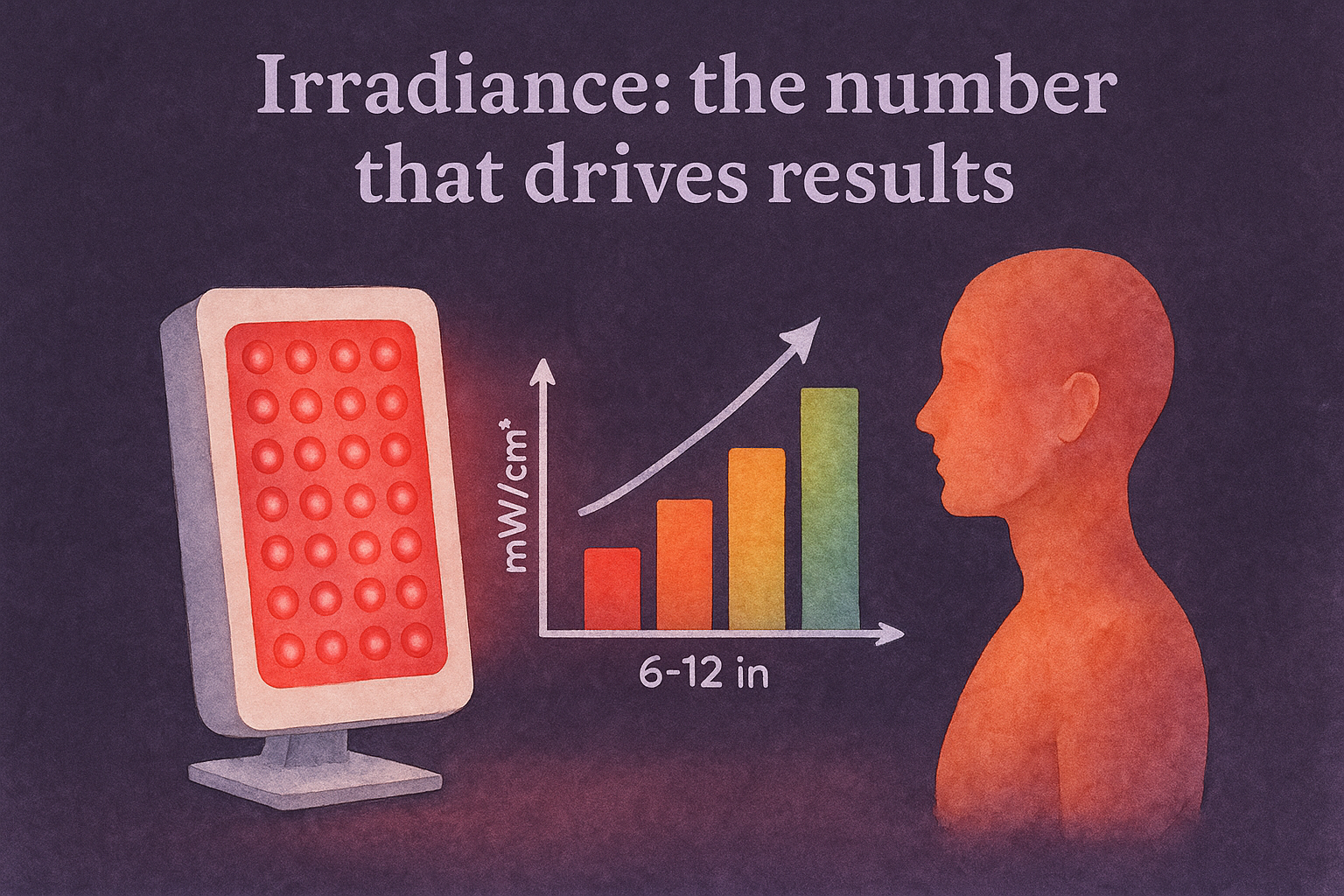
Irradiance: the number that drives results
Irradiance is the measure of light energy hitting your skin per unit area, expressed in milliwatts per square centimeter (mW/cm²). This is the single most important spec you can compare across panels, and it’s also the one brands manipulate most often by measuring at unrealistically short distances. When you evaluate any panel, look for irradiance figures measured at 6 to 12 inches from the panel surface, since that’s where you’ll actually position yourself during a session.
A panel with lower total wattage but higher irradiance at your treatment distance will outperform a higher-wattage panel with poor optical design every time.
PlatinumLED publishes their irradiance data transparently, which makes comparison straightforward. Aim for panels delivering at least 30 to 100 mW/cm² at your intended treatment distance, depending on your goals and session length.
Wavelength accuracy and the five-channel advantage
Wavelength tolerance matters because your mitochondria respond to specific light frequencies, not broad ranges. A panel advertised as "660nm red light" that actually emits anywhere between 640nm and 680nm delivers inconsistent results. PlatinumLED’s BIOMAX line pins its output to five precise wavelengths: 630nm, 660nm, 810nm, 830nm, and 850nm, covering both surface tissue and deeper muscle and nerve structures simultaneously.
Treatment coverage and session time
Larger panels let you treat more body surface area per session, which reduces total session time and improves consistency. A panel covering your full back or chest means one 10-minute session handles what a smaller panel would need multiple repositioning steps to complete. Factor in your available treatment time alongside panel size when you make your final decision.
How to choose the right setup for your goals and space
The right panel for someone focused on full-body recovery after a psychedelic session looks different from the right panel for someone targeting chronic knee pain or skin health. Before you spend money on platinum led therapy lights, get clear on what you’re actually trying to treat and how much time per day you can realistically commit to sessions.
Match panel size to your treatment priorities
If your primary goal is neurological recovery and mood support, you want a panel large enough to cover your head and upper torso simultaneously, since the brain and nervous system benefit from near-infrared wavelengths penetrating the skull and surrounding tissue. A BIOMAX 600 or 900 handles this well and doubles as a full back or chest treatment panel. For targeted work on joints, specific muscle groups, or facial skin, a BIOMAX 300 delivers precise coverage without the added cost of a larger unit.
Buying a panel that matches your specific treatment area saves you money upfront and prevents the frustration of using oversized equipment in a space that can’t accommodate it properly.
Think through your physical space before you buy
PlatinumLED panels require a consistent treatment distance of 6 to 18 inches from your body, which means you need enough clear floor or wall space to set up a stand or mount, plus room to position yourself comfortably in front of it. Measure your available space before ordering. A BIOMAX 1500 full-body panel is roughly five feet tall and needs ceiling clearance plus standing room, which rules it out for small apartments or shared living situations.
Panel stands, mounting hardware, and power requirements also factor into your setup decision. Most BIOMAX panels run on standard household current, but you’ll want a dedicated outlet within easy reach of where you plan to use the device. Building a routine around your setup becomes much easier when the logistics require zero friction to get started each day.
How to use PlatinumLED safely and get consistent results
Getting results from platinum led therapy lights comes down to two things: starting conservatively and showing up consistently. Most people who don’t see progress either begin with sessions that are too long, which can actually reduce benefits through overexposure, or they use their panel sporadically and never let the cumulative effects build. A few straightforward habits make the difference between results you can measure and a panel that collects dust.
Start with shorter sessions and build gradually
Your mitochondria respond to light in a dose-dependent way, which means more time under the panel is not always better. When you’re new to red light therapy, start with 5-minute sessions per body area and increase to 10-15 minutes over the first two weeks. This lets your cells adapt to the stimulus without triggering the diminishing returns that come from overexposure. Most people find that a daily or near-daily schedule produces far more consistent results than longer sessions done twice a week.
Consistency over intensity is the principle that separates people who see real results from those who don’t.
Keep a simple session log and note how you feel in the 24 hours following each treatment. Patterns in mood, sleep quality, and recovery speed will tell you whether your current protocol is working or needs adjustment.
Protect your eyes and maintain the right distance
The LEDs in PlatinumLED panels are extremely bright, and direct eye exposure carries real risk. Always wear the protective goggles included with your panel, even when treating areas away from your face, since reflected light adds up over repeated sessions. Position yourself at the distance specified for your target irradiance level, typically 6 to 12 inches for most BIOMAX models. Moving closer increases intensity but shortens the safe session window, so stick with the manufacturer’s published guidelines unless a qualified practitioner advises otherwise.
Next steps
Red and near-infrared light therapy is a practical, well-researched tool for cellular recovery, and platinum led therapy lights represent one of the strongest options available for anyone serious about consistent results. The key takeaways are straightforward: match your panel size to your actual treatment goals, start with short sessions, and build a daily routine you can sustain.
Recovery doesn’t stop with light therapy. If you use psychedelics for therapeutic or personal growth purposes, your brain and nervous system need targeted nutritional support alongside physical recovery tools. The same mitochondrial and neurological pathways that respond to red and near-infrared light also benefit from specific nutrients that replenish neurotransmitters, reduce oxidative stress, and stabilize mood after an experience.
Understanding how supplementation and light therapy work together gives you a more complete recovery picture. Explore the science behind the Afterglow recovery protocol to see exactly how targeted ingredients support the same systems your light therapy sessions are already working on.
Lukas Nelpela
writes on neuroscience, mental health, and mindful exploration. With a passion in research-driven wellness and years focused on set & setting, integration, and recovery, he turns complex ideas into clear, usable insight.
You’re staring at your screen, reading the same sentence for the fourth time, and nothing sticks. Your thoughts feel like they’re wading through wet cement. So what is brain fog, exactly? It’s not a medical diagnosis, it’s a catch-all term for that frustrating state of mental cloudiness where focus, memory,
Every process in your body, thinking, moving, recovering, runs on energy produced inside your cells. That energy comes from mitochondria, and when they’re not functioning well, you feel it: brain fog, fatigue, slow recovery, and a general sense of running on empty. Mitochondrial support refers to the nutrients, habits, and
You sit down to focus, stare at your screen, and nothing clicks. Thoughts scatter, simple decisions feel impossible, and your mind moves like it’s stuck in wet concrete. If you’ve been looking up how to get rid of brain fog, you already know the frustration, that heavy, hazy state where
Working nights, rotating schedules, or pulling irregular hours throws your body’s internal clock into a constant state of confusion. Around 20% of the global workforce does some form of shift work, and the majority of those people report poor sleep as their number one complaint. Good sleep hygiene for shift
Stiff ankles affect more than just your squat depth. Limited ankle range of motion can mess with your knees, hips, and lower back, and if you spend long hours on your feet at festivals, retreats, or anywhere that keeps you moving, you’ll feel it. A solid ankle mobility routine takes
We use various cookies on our website. Some are essential for the website to function properly, while others we may only use with your consent. You can find more information about cookies on our website here.
This website uses cookies to improve your experience while you navigate through the website. Out of these cookies, the cookies that are categorized as necessary are stored on your browser as they are essential for the working of basic functionalities of the website. We also use third-party cookies that help us analyze and understand how you use this website. These cookies will be stored on your browser only with your consent. You also have the option to opt-out of these cookies. However, opting out of some of these cookies may have an impact on your browsing experience.
Necessary cookies are absolutely essential for the website to function properly. These cookies anonymously ensure basic functionalities and security features of the website.
Cookie
Duration
Description
cookielawinfo-checkbox-advertisement
1 year
Set by the GDPR Cookie Consent plugin, this cookie records the user consent for the cookies in the "Advertisement" category.
cookielawinfo-checkbox-analytics
11 months
This cookie is set by GDPR Cookie Consent plugin. The cookie is used to store the user consent for the cookies in the category "Analytics".
cookielawinfo-checkbox-functional
11 months
The cookie is set by GDPR cookie consent to record the user consent for the cookies in the category "Functional".
cookielawinfo-checkbox-necessary
11 months
This cookie is set by GDPR Cookie Consent plugin. The cookies is used to store the user consent for the cookies in the category "Necessary".
cookielawinfo-checkbox-others
11 months
This cookie is set by GDPR Cookie Consent plugin. The cookie is used to store the user consent for the cookies in the category "Other.
cookielawinfo-checkbox-performance
11 months
This cookie is set by GDPR Cookie Consent plugin. The cookie is used to store the user consent for the cookies in the category "Performance".
CookieLawInfoConsent
1 year
CookieYes sets this cookie to record the default button state of the corresponding category and the status of CCPA. It works only in coordination with the primary cookie.
elementor
never
The website's WordPress theme uses this cookie. It allows the website owner to implement or change the website's content in real-time.
fb_event_id_atc
30 minutes
Used to match client and server events for Meta Conversion API deduplication. Contains only anonymous technical IDs; no personal data stored.
fb_event_id_ic
30 minutes
Used to match client and server events for Meta Conversion API deduplication. Contains only anonymous technical IDs; no personal data stored.
fb_event_id_pur
30 minutes
Used to match client and server events for Meta Conversion API deduplication. Contains only anonymous technical IDs; no personal data stored.
fb_event_id_vc
30 minutes
Used to match client and server events for Meta Conversion API deduplication. Contains only anonymous technical IDs; no personal data stored.
rc::a
never
This cookie is set by the Google recaptcha service to identify bots to protect the website against malicious spam attacks.
rc::c
session
This cookie is set by the Google recaptcha service to identify bots to protect the website against malicious spam attacks.
viewed_cookie_policy
11 months
The cookie is set by the GDPR Cookie Consent plugin and is used to store whether or not user has consented to the use of cookies. It does not store any personal data.
VISITOR_PRIVACY_METADATA
6 months
YouTube sets this cookie to store the user's cookie consent state for the current domain.
wpEmojiSettingsSupports
session
WordPress sets this cookie when a user interacts with emojis on a WordPress site. It helps determine if the user's browser can display emojis properly.
Functional cookies help to perform certain functions, such as sharing website content on social media platforms, collecting feedback, and other third-party functions.
Cookie
Duration
Description
sib_cuid
6 months
SendinBlue sets this cookie to store unique visits.
VISITOR_INFO1_LIVE
6 months
A cookie set by YouTube to measure bandwidth that determines whether the user gets the new or old player interface.
yt-remote-cast-available
session
The yt-remote-cast-available cookie is used to store the user's preferences regarding whether casting is available on their YouTube video player.
yt-remote-cast-installed
session
The yt-remote-cast-installed cookie is used to store the user's video player preferences using embedded YouTube video.
yt-remote-connected-devices
never
YouTube sets this cookie to store the user's video preferences using embedded YouTube videos.
yt-remote-device-id
never
YouTube sets this cookie to store the user's video preferences using embedded YouTube videos.
yt-remote-fast-check-period
session
The yt-remote-fast-check-period cookie is used by YouTube to store the user's video player preferences for embedded YouTube videos.
yt-remote-session-app
session
The yt-remote-session-app cookie is used by YouTube to store user preferences and information about the interface of the embedded YouTube video player.
yt-remote-session-name
session
The yt-remote-session-name cookie is used by YouTube to store the user's video player preferences using embedded YouTube video.
ytidb::LAST_RESULT_ENTRY_KEY
never
The cookie ytidb::LAST_RESULT_ENTRY_KEY is used by YouTube to store the last search result entry that was clicked by the user. This information is used to improve the user experience by providing more relevant search results in the future.
Performance cookies are used to understand and analyze key website performance indexes, which helps in providing a better user experience for visitors.
Cookie
Duration
Description
SRM_B
1 year 24 days
Used by Microsoft Advertising as a unique ID for visitors.
Analytical cookies are used to understand how visitors interact with the website. These cookies help provide information on metrics such as the number of visitors, bounce rate, traffic source, etc.
Cookie
Duration
Description
_clck
1 year
Microsoft Clarity sets this cookie to retain the browser's Clarity User ID and settings exclusive to that website. This guarantees that actions taken during subsequent visits to the same website will be linked to the same user ID.
_clsk
1 day
Microsoft Clarity sets this cookie to store and consolidate a user's pageviews into a single session recording.
_fbp
3 months
Facebook sets this cookie to display advertisements when either on Facebook or on a digital platform powered by Facebook advertising after visiting the website.
_ga
1 year 1 month 4 days
Google Analytics sets this cookie to calculate visitor, session and campaign data and track site usage for the site's analytics report. The cookie stores information anonymously and assigns a randomly generated number to recognise unique visitors.
_ga_*
1 year 1 month 4 days
Google Analytics sets this cookie to store and count page views.
_gcl_au
3 months
Google Tag Manager sets the cookie to experiment advertisement efficiency of websites using their services.
_hjSession_*
1 hour
Hotjar sets this cookie to ensure data from subsequent visits to the same site is attributed to the same user ID, which persists in the Hotjar User ID, which is unique to that site.
_hjSessionUser_*
1 year
Hotjar sets this cookie to ensure data from subsequent visits to the same site is attributed to the same user ID, which persists in the Hotjar User ID, which is unique to that site.
_hjTLDTest
session
To determine the most generic cookie path that has to be used instead of the page hostname, Hotjar sets the _hjTLDTest cookie to store different URL substring alternatives until it fails.
CLID
1 year
Microsoft Clarity set this cookie to store information about how visitors interact with the website. The cookie helps to provide an analysis report. The data collection includes the number of visitors, where they visit the website, and the pages visited.
MR
7 days
This cookie, set by Bing, is used to collect user information for analytics purposes.
sbjs_current
session
Sourcebuster sets this cookie to identify the source of a visit and stores user action information in cookies. This analytical and behavioural cookie is used to enhance the visitor experience on the website.
sbjs_current_add
session
Sourcebuster sets this cookie to identify the source of a visit and stores user action information in cookies. This analytical and behavioural cookie is used to enhance the visitor experience on the website.
sbjs_first
session
Sourcebuster sets this cookie to identify the source of a visit and stores user action information in cookies. This analytical and behavioural cookie is used to enhance the visitor experience on the website.
sbjs_first_add
session
Sourcebuster sets this cookie to identify the source of a visit and stores user action information in cookies. This analytical and behavioural cookie is used to enhance the visitor experience on the website.
sbjs_migrations
session
Sourcebuster sets this cookie to identify the source of a visit and stores user action information in cookies. This analytical and behavioural cookie is used to enhance the visitor experience on the website.
sbjs_session
1 hour
Sourcebuster sets this cookie to identify the source of a visit and stores user action information in cookies. This analytical and behavioural cookie is used to enhance the visitor experience on the website.
sbjs_udata
session
Sourcebuster sets this cookie to identify the source of a visit and stores user action information in cookies. This analytical and behavioural cookie is used to enhance the visitor experience on the website.
SM
session
Microsoft Clarity cookie set this cookie for synchronizing the MUID across Microsoft domains.
YSC
session
YSC cookie is set by Youtube and is used to track the views of embedded videos on Youtube pages.
Advertising cookies are used to deliver relevant advertisements and marketing campaigns to visitors. These cookies track visitors across websites and collect information to deliver tailored advertisements.
Cookie
Duration
Description
_rdt_uuid
3 months
Reddit sets this cookie to build a profile of your interests and show you relevant ads.
ANONCHK
10 minutes
The ANONCHK cookie, set by Bing, is used to store a user's session ID and verify ads' clicks on the Bing search engine. The cookie helps in reporting and personalization as well.
MUID
1 year 24 days
Bing sets this cookie to recognise unique web browsers visiting Microsoft sites. This cookie is used for advertising, site analytics, and other operations.
test_cookie
15 minutes
doubleclick.net sets this cookie to determine if the user's browser supports cookies.
yt.innertube::nextId
never
YouTube sets this cookie to register a unique ID to store data on what videos from YouTube the user has seen.
yt.innertube::requests
never
YouTube sets this cookie to register a unique ID to store data on what videos from YouTube the user has seen.