High Absorption Magnesium Supplement: Best Forms Explained
9 min read
Most magnesium supplements on the shelf share a dirty secret: your body barely absorbs them. You take the pill, feel good about it, and then excrete most of it without any real benefit. If you’ve been searching for a high absorption magnesium supplement, you’ve probably already noticed that "magnesium" isn’t just one thing, it comes in over a dozen forms, and the differences in bioavailability are massive.
So which forms actually make it into your cells, and which ones are essentially expensive toilet water? That’s exactly what this article breaks down. We’ll walk through the science behind magnesium absorption, compare the most common forms head-to-head, and explain what to look for on a label before you spend another euro. Whether you’re dealing with muscle tension, poor sleep, or post-experience recovery, the form you choose matters more than the dose.
At Afterglow Supplements, we spent a long time researching this exact question. Our recovery protocol includes Magnesium Bisglycinate, one of the most bioavailable chelated forms available, specifically because our users need magnesium that actually works. From easing jaw clenching to supporting the nervous system after intense psychedelic experiences, absorption isn’t optional for us. It’s the whole point.
Below, you’ll find a clear, evidence-based breakdown of magnesium forms ranked by absorption, plus practical guidance on picking the right one for your specific needs.
Why high absorption magnesium matters
Magnesium drives over 300 enzymatic reactions in your body, covering everything from muscle contraction to nervous system regulation to energy production. Despite this, a significant portion of adults don’t get enough of it. The problem isn’t only dietary. Even when you supplement, the form you choose determines how much actually enters your bloodstream. A low-absorption form can leave you with the exact same deficiency symptoms you were trying to correct.
The magnesium deficiency problem
Magnesium deficiency is more widespread than most people realize, and the symptoms are easy to misattribute to stress or lifestyle. You might notice muscle cramps, disrupted sleep, low energy, or persistent anxiety without connecting any of it to low magnesium. Studies estimate that up to 50% of people in developed countries consume less than the recommended daily amount, partly because food processing strips magnesium from grains and intensive agriculture depletes it from soil.
Your body also burns through magnesium faster when you’re under physical or psychological stress, when you drink alcohol regularly, or when you exercise hard. That means your baseline intake requirement is higher than the standard recommendation if any of those factors apply to you.
Deficiency symptoms are often treated with band-aid solutions when the real fix is simply getting enough bioavailable magnesium into your cells.
What happens when magnesium doesn’t absorb
Choosing a poorly absorbed form means most of the dose exits through your stool rather than reaching your tissues. Magnesium oxide, for example, has a bioavailability of roughly 4%, which makes it nearly useless for correcting a real deficiency. Your cells don’t care how many milligrams are printed on the label. They only work with what actually crosses the intestinal wall.
This is exactly why finding a high absorption magnesium supplement matters beyond label shopping. After intense physical or psychological stress, like a demanding training session or a deep psychedelic experience, your muscles, nervous system, and mood regulation systems all compete for available magnesium at the same time. You need a form that actually gets there. Some areas where low-absorption magnesium consistently falls short:
Relieving jaw tension and muscle cramping
Supporting deep, restorative sleep
Calming the nervous system after stress
Stabilizing mood after intense experiences
Reducing lingering anxiety symptoms
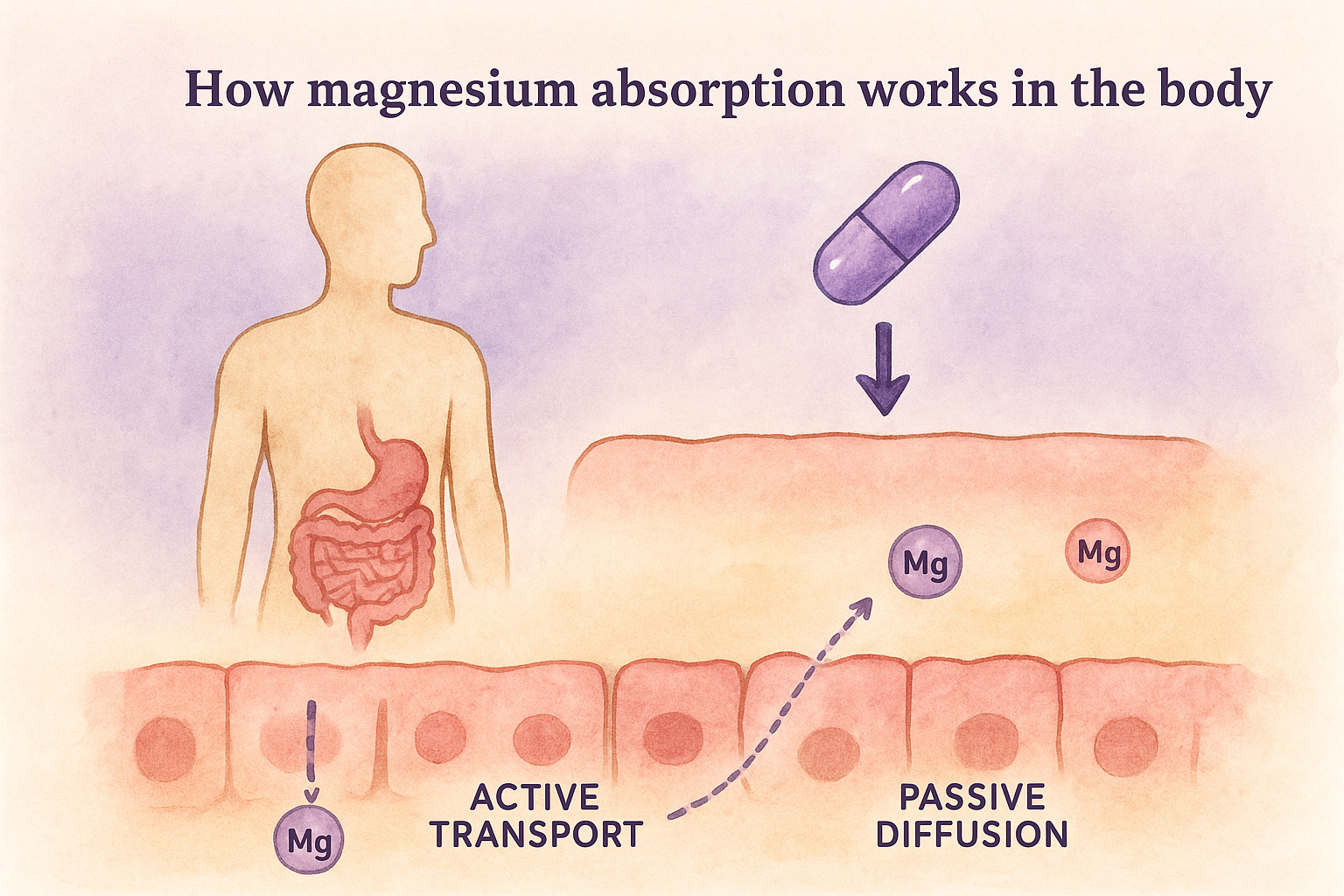
How magnesium absorption works in the body
Magnesium doesn’t absorb uniformly across your gut. The small intestine handles most of the uptake, using two distinct mechanisms: active transport and passive diffusion. Active transport kicks in when magnesium intake is low, pulling it through intestinal cells via specific protein channels. Passive diffusion takes over when concentrations are higher, allowing magnesium to move across the gut lining more freely. The form of magnesium you take directly influences how efficiently these two pathways work, which is why the compound matters as much as the milligram count.
The role of the intestinal wall
The intestinal wall acts as a selective filter. Ionic forms of magnesium, meaning magnesium that has already separated from its companion molecule in stomach acid, are ready for immediate uptake. Chelated forms, where magnesium is bound to an amino acid like glycine, can pass through intestinal cells intact using peptide transport channels. This is one reason chelated magnesium forms consistently outperform inorganic salts in bioavailability studies. Your gut essentially has a dedicated lane for amino acid-bound minerals, and chelated magnesium uses it.
Choosing a chelated magnesium is essentially choosing a better delivery vehicle for the same mineral.
What reduces absorption
Several common factors actively work against your body’s ability to absorb magnesium. High doses taken all at once overwhelm the active transport system, and excess calcium competes for the same absorption pathways. Alcohol, caffeine, and certain medications like diuretics or proton pump inhibitors reduce how much magnesium you retain after each dose. Gastrointestinal conditions such as Crohn’s disease or celiac disease can cut absorption further. This is exactly why picking a high absorption magnesium supplement matters more than simply buying the highest milligram count you can find. Splitting your daily dose across two or three smaller servings helps your gut process it more effectively than one large dose.
Best-absorbed magnesium forms explained
Not all magnesium compounds are created equal. The form determines how well your body recognizes and absorbs it, and the difference between the best and worst options is significant enough to completely change how effective your supplementation is. When you pick a high absorption magnesium supplement, you’re essentially choosing which delivery mechanism works best for your cells.
Magnesium Bisglycinate
Magnesium Bisglycinate is widely considered the gold standard for absorption. In this form, magnesium is chelated to two glycine molecules, an amino acid your gut already has dedicated transport channels for. That means your intestinal wall absorbs it through the peptide pathway rather than competing with other minerals for the same limited ionic transport channels. It’s also gentler on the stomach than most other forms, making it a practical choice if you’ve had issues with digestive upset from magnesium in the past.
Chelated magnesium forms like Bisglycinate consistently outperform inorganic salts in absorption studies because your gut processes them through a separate, dedicated pathway.
Bisglycinate is also the form most commonly used in sleep and nervous system recovery protocols because the glycine component itself has calming properties. That dual action, magnesium relaxing your muscles and glycine supporting sleep quality, makes it a standout choice when your priority is recovery.
Magnesium Malate and Magnesium Citrate
Magnesium Malate bonds magnesium to malic acid, which plays a direct role in energy production via the Krebs cycle. This makes it a practical option if fatigue or muscle soreness is your main concern. Magnesium Citrate bonds magnesium to citric acid and offers solid bioavailability, though it pulls water into the intestines, which can cause loose stools at higher doses.
Form
Bioavailability
Best For
Bisglycinate
Very High
Sleep, recovery, nervous system
Malate
High
Energy, muscle soreness
Citrate
Moderate-High
General deficiency
Oxide
Very Low (~4%)
Laxative effect only
How to choose a high absorption magnesium supplement
Picking the right supplement comes down to three things: the form, the dose, and what you’re actually trying to fix. Most products lead with milligrams on the front label, but that number means very little without knowing how much your body can actually use. Before buying anything, flip the bottle and look at the compound name listed after the word "magnesium."
Prioritize form over milligrams
The form tells you everything about how well your body will absorb the mineral. Bisglycinate and malate are your best options for general recovery, sleep, and nervous system support. Citrate works for general deficiency correction but can cause digestive issues at higher doses. Anything labeled "oxide" or "carbonate" is worth skipping unless you specifically need a laxative effect.
If the label doesn’t specify the form clearly, that’s usually a sign the manufacturer chose the cheapest option available.
Match the form to your goal
Your specific need should guide your final choice. If you struggle with muscle tension, jaw clenching, or disrupted sleep, Bisglycinate is the most practical match because both magnesium and glycine work together to calm your nervous system. If fatigue and low energy are your main complaints, Malate supports cellular energy production directly through the Krebs cycle.
For a full recovery protocol after demanding physical or psychological stress, a high absorption magnesium supplement like Bisglycinate gives your body what it needs without digestive trade-offs. Also check whether the product uses third-party testing, since that confirms the actual mineral content matches what the label states and reduces the risk of contamination or underdosing.
Who should use caution and possible side effects
Magnesium is generally well-tolerated, but that doesn’t mean every dose or form is right for every person. Certain medical conditions and medications interact directly with magnesium metabolism, and ignoring those interactions can cause real problems. Before adding a high absorption magnesium supplement to your routine, it’s worth checking whether your specific situation calls for extra care.
People who should consult a doctor first
If you have kidney disease, magnesium caution is non-negotiable. Your kidneys regulate how much magnesium your body retains and excretes, so impaired kidney function can allow magnesium to accumulate to toxic levels. People taking certain medications, including antibiotics like tetracyclines or fluoroquinolones, diuretics, or drugs for heart rhythm disorders, should also speak with a doctor before supplementing, since magnesium can alter how those drugs are absorbed or how your heart responds.
Kidney disease is the single most important reason to consult a doctor before supplementing with magnesium in any form.
Key situations that warrant a medical check first:
Chronic kidney disease (any stage)
Heart arrhythmia or pacemaker use
Active use of bisphosphonates or certain antibiotics
Low blood pressure conditions
Common side effects to watch for
Most side effects from magnesium come down to dose and form. High doses of poorly absorbed forms like oxide or citrate draw water into the intestines, causing loose stools or cramping. Bisglycinate is far less likely to trigger this because your body absorbs it more completely before it reaches the lower gut. Nausea and stomach discomfort can still occur if you take magnesium on an empty stomach, so pairing it with food reduces that risk considerably.
Starting with a lower dose and building up gradually gives your digestive system time to adjust. Most adults tolerate 200 to 400mg of elemental magnesium per day without issue, but individual responses vary based on diet, stress levels, and gut health.
Final takeaways
The form of magnesium you take decides whether you actually benefit from it or just spend money on something your body flushes out. Magnesium Bisglycinate sits at the top of the bioavailability ladder because your gut absorbs it through dedicated peptide channels, not the same limited pathways that ionic minerals compete for. If your priority is sleep, muscle recovery, or nervous system support, Bisglycinate gives you the best return on that investment.
Beyond the form, dose timing and consistency matter more than most people account for. Splitting your daily intake across two smaller doses, taken with food, outperforms one large dose taken whenever. Side effects are rare with well-absorbed forms, but kidney conditions and certain medications require a conversation with your doctor first.
If you want a high absorption magnesium supplement built into a complete recovery protocol, explore the Afterglow Recovery Protocol and see how Bisglycinate fits into the full system.
Lukas Nelpela
writes on neuroscience, mental health, and mindful exploration. With a passion in research-driven wellness and years focused on set & setting, integration, and recovery, he turns complex ideas into clear, usable insight.
You’re staring at your screen, reading the same sentence for the fourth time, and nothing sticks. Your thoughts feel like they’re wading through wet cement. So what is brain fog, exactly? It’s not a medical diagnosis, it’s a catch-all term for that frustrating state of mental cloudiness where focus, memory,
Every process in your body, thinking, moving, recovering, runs on energy produced inside your cells. That energy comes from mitochondria, and when they’re not functioning well, you feel it: brain fog, fatigue, slow recovery, and a general sense of running on empty. Mitochondrial support refers to the nutrients, habits, and
You sit down to focus, stare at your screen, and nothing clicks. Thoughts scatter, simple decisions feel impossible, and your mind moves like it’s stuck in wet concrete. If you’ve been looking up how to get rid of brain fog, you already know the frustration, that heavy, hazy state where
Working nights, rotating schedules, or pulling irregular hours throws your body’s internal clock into a constant state of confusion. Around 20% of the global workforce does some form of shift work, and the majority of those people report poor sleep as their number one complaint. Good sleep hygiene for shift
Stiff ankles affect more than just your squat depth. Limited ankle range of motion can mess with your knees, hips, and lower back, and if you spend long hours on your feet at festivals, retreats, or anywhere that keeps you moving, you’ll feel it. A solid ankle mobility routine takes
We use various cookies on our website. Some are essential for the website to function properly, while others we may only use with your consent. You can find more information about cookies on our website here.
This website uses cookies to improve your experience while you navigate through the website. Out of these cookies, the cookies that are categorized as necessary are stored on your browser as they are essential for the working of basic functionalities of the website. We also use third-party cookies that help us analyze and understand how you use this website. These cookies will be stored on your browser only with your consent. You also have the option to opt-out of these cookies. However, opting out of some of these cookies may have an impact on your browsing experience.
Necessary cookies are absolutely essential for the website to function properly. These cookies anonymously ensure basic functionalities and security features of the website.
Cookie
Duration
Description
cookielawinfo-checkbox-advertisement
1 year
Set by the GDPR Cookie Consent plugin, this cookie records the user consent for the cookies in the "Advertisement" category.
cookielawinfo-checkbox-analytics
11 months
This cookie is set by GDPR Cookie Consent plugin. The cookie is used to store the user consent for the cookies in the category "Analytics".
cookielawinfo-checkbox-functional
11 months
The cookie is set by GDPR cookie consent to record the user consent for the cookies in the category "Functional".
cookielawinfo-checkbox-necessary
11 months
This cookie is set by GDPR Cookie Consent plugin. The cookies is used to store the user consent for the cookies in the category "Necessary".
cookielawinfo-checkbox-others
11 months
This cookie is set by GDPR Cookie Consent plugin. The cookie is used to store the user consent for the cookies in the category "Other.
cookielawinfo-checkbox-performance
11 months
This cookie is set by GDPR Cookie Consent plugin. The cookie is used to store the user consent for the cookies in the category "Performance".
CookieLawInfoConsent
1 year
CookieYes sets this cookie to record the default button state of the corresponding category and the status of CCPA. It works only in coordination with the primary cookie.
elementor
never
The website's WordPress theme uses this cookie. It allows the website owner to implement or change the website's content in real-time.
fb_event_id_atc
30 minutes
Used to match client and server events for Meta Conversion API deduplication. Contains only anonymous technical IDs; no personal data stored.
fb_event_id_ic
30 minutes
Used to match client and server events for Meta Conversion API deduplication. Contains only anonymous technical IDs; no personal data stored.
fb_event_id_pur
30 minutes
Used to match client and server events for Meta Conversion API deduplication. Contains only anonymous technical IDs; no personal data stored.
fb_event_id_vc
30 minutes
Used to match client and server events for Meta Conversion API deduplication. Contains only anonymous technical IDs; no personal data stored.
rc::a
never
This cookie is set by the Google recaptcha service to identify bots to protect the website against malicious spam attacks.
rc::c
session
This cookie is set by the Google recaptcha service to identify bots to protect the website against malicious spam attacks.
viewed_cookie_policy
11 months
The cookie is set by the GDPR Cookie Consent plugin and is used to store whether or not user has consented to the use of cookies. It does not store any personal data.
VISITOR_PRIVACY_METADATA
6 months
YouTube sets this cookie to store the user's cookie consent state for the current domain.
wpEmojiSettingsSupports
session
WordPress sets this cookie when a user interacts with emojis on a WordPress site. It helps determine if the user's browser can display emojis properly.
Functional cookies help to perform certain functions, such as sharing website content on social media platforms, collecting feedback, and other third-party functions.
Cookie
Duration
Description
sib_cuid
6 months
SendinBlue sets this cookie to store unique visits.
VISITOR_INFO1_LIVE
6 months
A cookie set by YouTube to measure bandwidth that determines whether the user gets the new or old player interface.
yt-remote-cast-available
session
The yt-remote-cast-available cookie is used to store the user's preferences regarding whether casting is available on their YouTube video player.
yt-remote-cast-installed
session
The yt-remote-cast-installed cookie is used to store the user's video player preferences using embedded YouTube video.
yt-remote-connected-devices
never
YouTube sets this cookie to store the user's video preferences using embedded YouTube videos.
yt-remote-device-id
never
YouTube sets this cookie to store the user's video preferences using embedded YouTube videos.
yt-remote-fast-check-period
session
The yt-remote-fast-check-period cookie is used by YouTube to store the user's video player preferences for embedded YouTube videos.
yt-remote-session-app
session
The yt-remote-session-app cookie is used by YouTube to store user preferences and information about the interface of the embedded YouTube video player.
yt-remote-session-name
session
The yt-remote-session-name cookie is used by YouTube to store the user's video player preferences using embedded YouTube video.
ytidb::LAST_RESULT_ENTRY_KEY
never
The cookie ytidb::LAST_RESULT_ENTRY_KEY is used by YouTube to store the last search result entry that was clicked by the user. This information is used to improve the user experience by providing more relevant search results in the future.
Performance cookies are used to understand and analyze key website performance indexes, which helps in providing a better user experience for visitors.
Cookie
Duration
Description
SRM_B
1 year 24 days
Used by Microsoft Advertising as a unique ID for visitors.
Analytical cookies are used to understand how visitors interact with the website. These cookies help provide information on metrics such as the number of visitors, bounce rate, traffic source, etc.
Cookie
Duration
Description
_clck
1 year
Microsoft Clarity sets this cookie to retain the browser's Clarity User ID and settings exclusive to that website. This guarantees that actions taken during subsequent visits to the same website will be linked to the same user ID.
_clsk
1 day
Microsoft Clarity sets this cookie to store and consolidate a user's pageviews into a single session recording.
_fbp
3 months
Facebook sets this cookie to display advertisements when either on Facebook or on a digital platform powered by Facebook advertising after visiting the website.
_ga
1 year 1 month 4 days
Google Analytics sets this cookie to calculate visitor, session and campaign data and track site usage for the site's analytics report. The cookie stores information anonymously and assigns a randomly generated number to recognise unique visitors.
_ga_*
1 year 1 month 4 days
Google Analytics sets this cookie to store and count page views.
_gcl_au
3 months
Google Tag Manager sets the cookie to experiment advertisement efficiency of websites using their services.
_hjSession_*
1 hour
Hotjar sets this cookie to ensure data from subsequent visits to the same site is attributed to the same user ID, which persists in the Hotjar User ID, which is unique to that site.
_hjSessionUser_*
1 year
Hotjar sets this cookie to ensure data from subsequent visits to the same site is attributed to the same user ID, which persists in the Hotjar User ID, which is unique to that site.
_hjTLDTest
session
To determine the most generic cookie path that has to be used instead of the page hostname, Hotjar sets the _hjTLDTest cookie to store different URL substring alternatives until it fails.
CLID
1 year
Microsoft Clarity set this cookie to store information about how visitors interact with the website. The cookie helps to provide an analysis report. The data collection includes the number of visitors, where they visit the website, and the pages visited.
MR
7 days
This cookie, set by Bing, is used to collect user information for analytics purposes.
sbjs_current
session
Sourcebuster sets this cookie to identify the source of a visit and stores user action information in cookies. This analytical and behavioural cookie is used to enhance the visitor experience on the website.
sbjs_current_add
session
Sourcebuster sets this cookie to identify the source of a visit and stores user action information in cookies. This analytical and behavioural cookie is used to enhance the visitor experience on the website.
sbjs_first
session
Sourcebuster sets this cookie to identify the source of a visit and stores user action information in cookies. This analytical and behavioural cookie is used to enhance the visitor experience on the website.
sbjs_first_add
session
Sourcebuster sets this cookie to identify the source of a visit and stores user action information in cookies. This analytical and behavioural cookie is used to enhance the visitor experience on the website.
sbjs_migrations
session
Sourcebuster sets this cookie to identify the source of a visit and stores user action information in cookies. This analytical and behavioural cookie is used to enhance the visitor experience on the website.
sbjs_session
1 hour
Sourcebuster sets this cookie to identify the source of a visit and stores user action information in cookies. This analytical and behavioural cookie is used to enhance the visitor experience on the website.
sbjs_udata
session
Sourcebuster sets this cookie to identify the source of a visit and stores user action information in cookies. This analytical and behavioural cookie is used to enhance the visitor experience on the website.
SM
session
Microsoft Clarity cookie set this cookie for synchronizing the MUID across Microsoft domains.
YSC
session
YSC cookie is set by Youtube and is used to track the views of embedded videos on Youtube pages.
Advertising cookies are used to deliver relevant advertisements and marketing campaigns to visitors. These cookies track visitors across websites and collect information to deliver tailored advertisements.
Cookie
Duration
Description
_rdt_uuid
3 months
Reddit sets this cookie to build a profile of your interests and show you relevant ads.
ANONCHK
10 minutes
The ANONCHK cookie, set by Bing, is used to store a user's session ID and verify ads' clicks on the Bing search engine. The cookie helps in reporting and personalization as well.
MUID
1 year 24 days
Bing sets this cookie to recognise unique web browsers visiting Microsoft sites. This cookie is used for advertising, site analytics, and other operations.
test_cookie
15 minutes
doubleclick.net sets this cookie to determine if the user's browser supports cookies.
yt.innertube::nextId
never
YouTube sets this cookie to register a unique ID to store data on what videos from YouTube the user has seen.
yt.innertube::requests
never
YouTube sets this cookie to register a unique ID to store data on what videos from YouTube the user has seen.