Wahoo TICKR HRV: Can It Measure HRV And Which Apps Work?
7 min read
Heart rate variability is one of the most reliable windows into your nervous system’s recovery state, which is exactly why so many biohackers, psychonauts, and health-conscious people track it. If you’ve been eyeing the Wahoo TICKR HRV setup as your go-to chest strap for measuring HRV, you’re asking the right question. The TICKR line is popular, affordable, and well-built, but Wahoo’s own app doesn’t actually feature dedicated HRV analysis, which creates some understandable confusion.
Here at Afterglow Supplements, we’re focused on helping people recover smarter, whether that means replenishing neurotransmitters after a psychedelic experience or using objective data like HRV to understand how your body bounces back. Tracking HRV before and after intense experiences gives you a concrete read on your autonomic nervous system, moving recovery from guesswork to something measurable.
This article breaks down whether the Wahoo TICKR can actually capture HRV data, which models support it, and, most importantly, which third-party apps pair with it to give you the insights Wahoo’s native software leaves out. We’ll cover everything you need to start tracking HRV with a TICKR chest strap today.
What HRV means and what TICKR can capture
Heart rate variability measures the time gaps between consecutive heartbeats, not just how fast your heart is beating per minute. Your heart doesn’t beat like a metronome. Those tiny fluctuations in timing, measured in milliseconds, reflect how well your autonomic nervous system is balancing its two branches: the sympathetic (stress and activation) and the parasympathetic (rest and recovery). Higher variability generally means your body is managing stress efficiently. Lower variability signals fatigue, poor sleep, or incomplete recovery.
The data behind an HRV reading
To calculate HRV, a device needs to detect R-R intervals, which are the precise time gaps between the R-peaks of each heartbeat’s electrical waveform. The accuracy of your HRV reading depends entirely on how cleanly those intervals are captured. Optical sensors on wrist-based devices read blood volume changes through skin, which introduces noise and missed beats. Chest straps, by contrast, pick up the heart’s electrical signal directly, producing far cleaner interval data.
A chest strap with accurate R-R interval detection gives you significantly more reliable HRV data than any wrist-based optical heart rate monitor.
What the Wahoo TICKR actually records
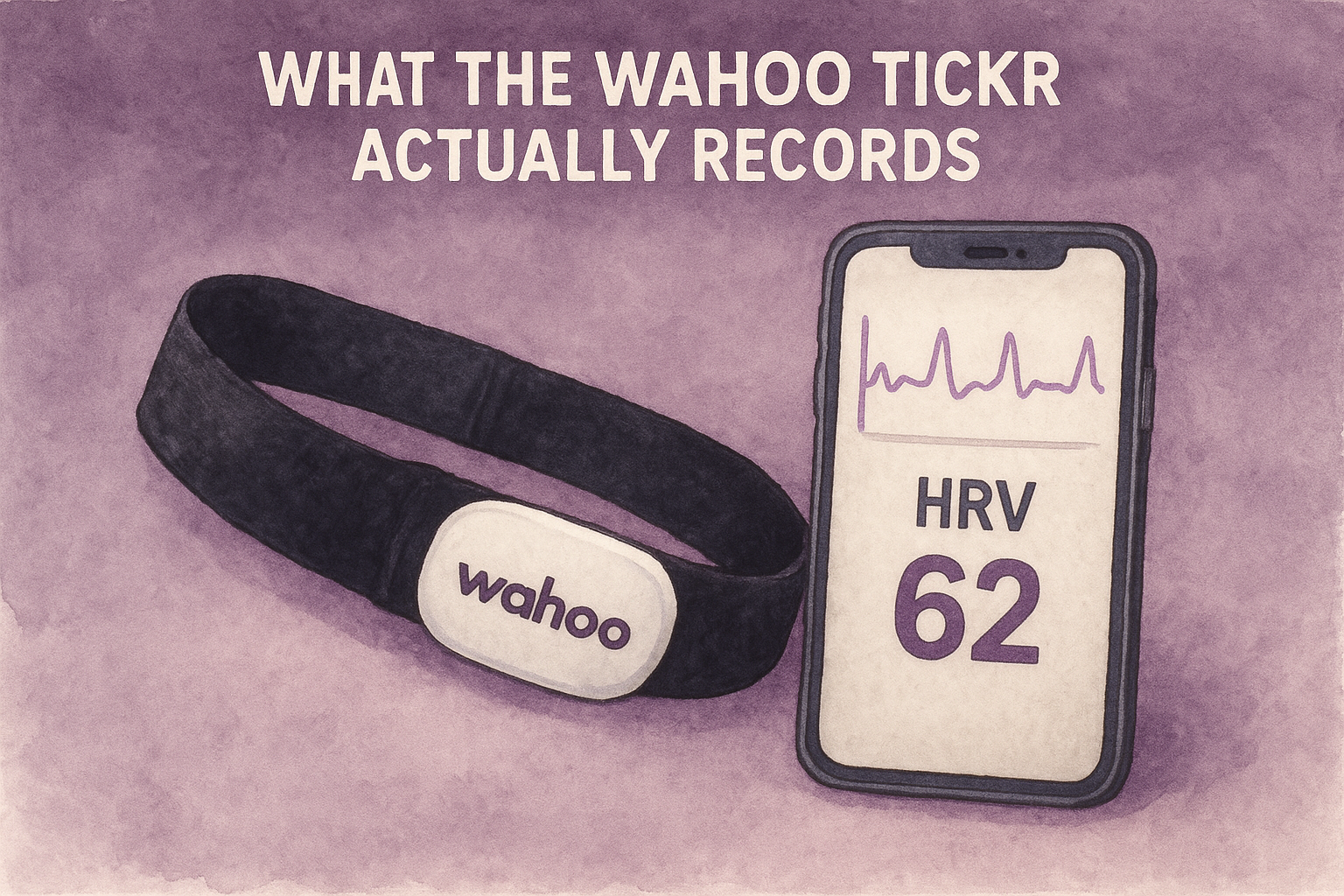
The Wahoo TICKR chest strap uses electrode-based sensors pressed directly against your chest, which pick up the heart’s electrical signal with much better precision than optical alternatives. This is the core reason the wahoo tickr hrv pairing works as well as it does. Both the standard TICKR and the TICKR X broadcast raw R-R interval data over Bluetooth and ANT+ simultaneously, which is exactly what third-party HRV apps need to calculate your score.
Here is a quick comparison of the two models relevant to HRV:
Feature
TICKR
TICKR X
R-R interval broadcast
Yes
Yes
Onboard memory
No
Yes (50 hours)
Dual Bluetooth connections
Yes
Yes
Best use for HRV
Live streaming to app
Live streaming or stored data
For HRV tracking specifically, both models perform equally well since the live R-R data stream is what every compatible app reads.
Can Wahoo TICKR measure HRV
The short answer is yes, but with an important caveat. The Wahoo TICKR measures HRV indirectly by broadcasting the raw R-R interval data your heart generates with each beat. What it does not do is calculate or display an HRV score on its own. You need a compatible third-party app to process that raw data into a usable number. Once you understand that distinction, the wahoo tickr hrv setup becomes straightforward and highly effective.
What the TICKR sends vs. what you see
Your TICKR transmits beat-to-beat interval data in real time over Bluetooth and ANT+. The app you choose receives that stream, applies a mathematical formula such as RMSSD or SDNN, and converts the raw intervals into an HRV score you can actually interpret and track. The TICKR itself never stores or displays HRV numbers natively, which is why Wahoo’s own fitness app feels incomplete for this specific purpose.
The TICKR is a capable HRV sensor, it just needs the right app to turn raw interval data into a score you can act on.
Both the TICKR and TICKR X handle this transmission equally well, so you do not need to upgrade your hardware to get reliable HRV readings. Your app choice matters far more than which TICKR model sits on your chest, which is worth keeping in mind before spending extra money on a hardware upgrade.
Apps that work with Wahoo TICKR for HRV
Since the TICKR broadcasts raw R-R interval data, you need an app that can receive that stream and turn it into a readable HRV score. Several well-regarded apps support the wahoo tickr hrv pairing, each with slightly different approaches to measurement, scoring, and long-term trend tracking.
Elite HRV and HRV4Training
Elite HRV is one of the most widely used options and connects directly to your TICKR via Bluetooth. It guides you through a short morning reading, calculates your score using RMSSD, and builds a daily trend line over time. HRV4Training also supports chest strap input for users who want cleaner signal quality, giving you more reliable interval data than camera-based alternatives.
Using a chest strap-compatible app with consistent morning readings gives you far more actionable trend data than sporadic spot checks throughout the day.
Polar Beat and ithlete
Polar Beat is free, reliable, and accepts R-R data from third-party chest straps including the TICKR over Bluetooth. It logs each session and displays a clear recovery score you can track day over day. Here is a quick comparison of the main app options:
App
Cost
Platform
HRV Method
Elite HRV
Free/paid
iOS, Android
RMSSD
HRV4Training
Paid
iOS, Android
RMSSD
Polar Beat
Free
iOS, Android
RMSSD
ithlete
Paid
iOS, Android
RMSSD
How to measure morning HRV with a TICKR
Morning is the best time to measure HRV because your body has had hours to stabilize without external stressors influencing the result. The wahoo tickr hrv setup works best when you follow a consistent routine, since HRV trends matter far more than any single isolated reading. Strap on the TICKR within a minute or two of waking, before checking your phone or getting out of bed.
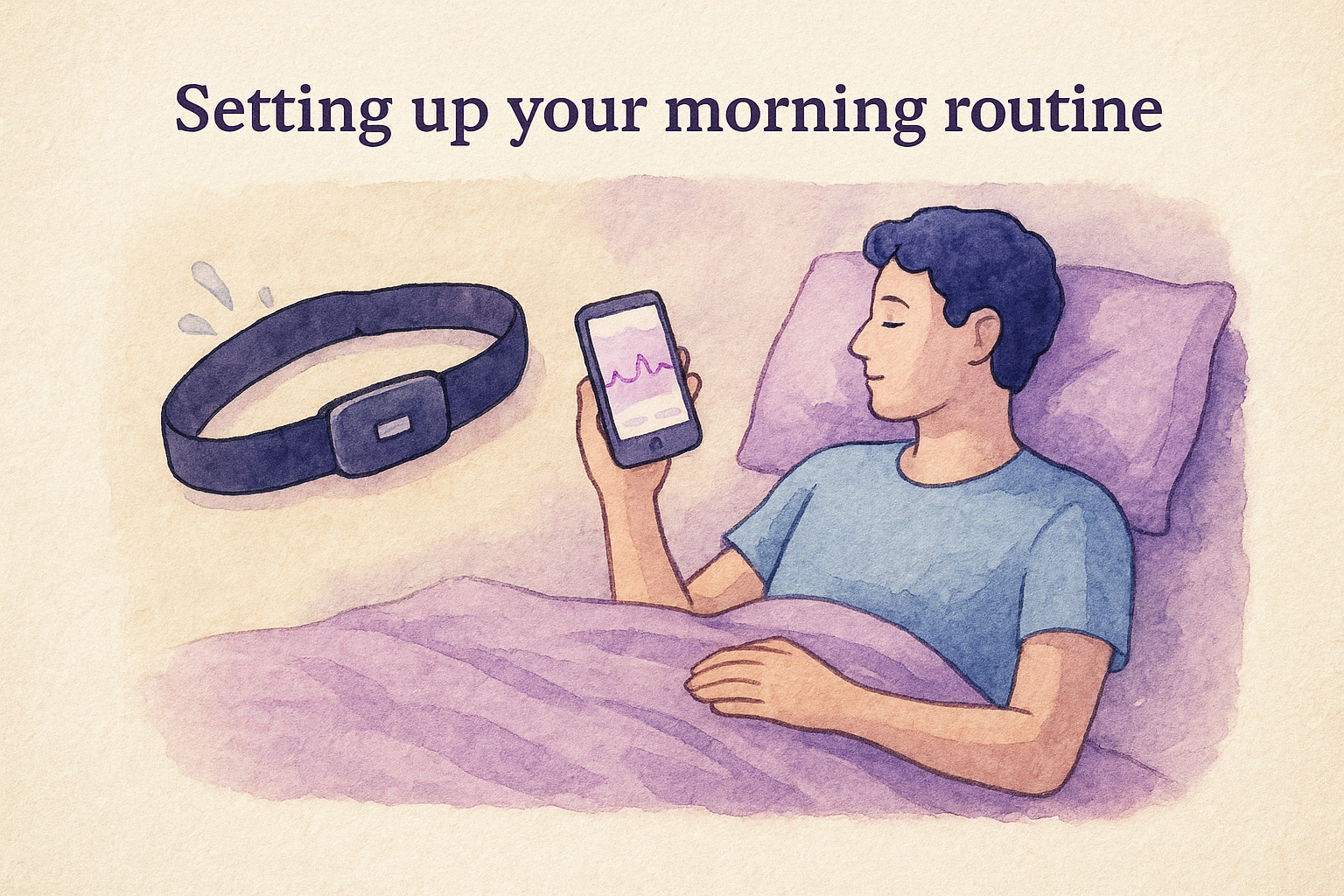
Setting up your morning routine
Wet the electrodes on the back of your TICKR before putting it on, since dry contact produces noisy signal data and unreliable R-R intervals. Once the strap is on, open your chosen HRV app and start the measurement while lying still on your back. Most apps need 60 to 120 seconds of clean interval data to calculate an accurate score.
Taking your reading at the same time each morning, in the same body position, is the single most important factor for building reliable HRV trend data over time.
What to do after each reading
Log any relevant context alongside your HRV score, such as sleep quality, alcohol intake, or other recovery-related factors from the previous day. Over time, clear patterns emerge that tell you far more than the number alone. Tracking those contextual notes alongside your daily score turns raw data into a genuinely useful recovery tool.
Troubleshooting and accuracy tips
Even with a solid wahoo tickr hrv setup, a few common issues can throw off your readings. Most problems trace back to electrode contact or app connectivity, both of which are straightforward to fix once you know what to look for.
Fix poor signal quality
Dry electrodes are the most frequent cause of erratic R-R interval data. Always wet the sensor pads with water or a small amount of electrode gel before putting on the strap. If your app shows irregular spikes or gaps in the signal, tighten the strap slightly so the electrodes sit flush against your skin throughout the entire reading.
A snug, moist strap connection consistently produces cleaner interval data than any software correction an app can apply after the fact.
Interpret your scores correctly
Your absolute HRV number matters far less than your personal baseline trend. A score of 55 might be excellent for one person and below average for another, so compare your readings to your own history rather than published population averages.
If your scores swing wildly without clear lifestyle reasons, run through these quick checks before assuming a hardware problem:
Confirm the app is receiving R-R interval data, not just standard heart rate
Check that no other app is connected to the TICKR simultaneously
Restart Bluetooth if the signal drops within the first 10 seconds of a reading
Key takeaways
The wahoo tickr hrv setup gives you a genuinely capable HRV tracking tool at an accessible price point. Your TICKR broadcasts raw R-R interval data over Bluetooth and ANT+, which is exactly what dedicated HRV apps like Elite HRV, HRV4Training, and Polar Beat need to calculate your score. Wahoo’s native app doesn’t handle HRV analysis, so pairing your chest strap with a third-party app is the only path to usable data.
Consistency matters more than any single reading. Wet your electrodes every morning, take your measurement before getting out of bed, and log context like sleep quality alongside each score. Over weeks, those numbers reveal patterns your body can’t communicate any other way.
If you’re also thinking about recovery from a more intense experience, understanding your autonomic baseline is just one piece. Check out the Afterglow Recovery Protocol for a structured, science-backed approach to helping your body fully reset.
Lukas Nelpela
writes on neuroscience, mental health, and mindful exploration. With a passion in research-driven wellness and years focused on set & setting, integration, and recovery, he turns complex ideas into clear, usable insight.
You’re staring at your screen, reading the same sentence for the fourth time, and nothing sticks. Your thoughts feel like they’re wading through wet cement. So what is brain fog, exactly? It’s not a medical diagnosis, it’s a catch-all term for that frustrating state of mental cloudiness where focus, memory,
Every process in your body, thinking, moving, recovering, runs on energy produced inside your cells. That energy comes from mitochondria, and when they’re not functioning well, you feel it: brain fog, fatigue, slow recovery, and a general sense of running on empty. Mitochondrial support refers to the nutrients, habits, and
You sit down to focus, stare at your screen, and nothing clicks. Thoughts scatter, simple decisions feel impossible, and your mind moves like it’s stuck in wet concrete. If you’ve been looking up how to get rid of brain fog, you already know the frustration, that heavy, hazy state where
Working nights, rotating schedules, or pulling irregular hours throws your body’s internal clock into a constant state of confusion. Around 20% of the global workforce does some form of shift work, and the majority of those people report poor sleep as their number one complaint. Good sleep hygiene for shift
Stiff ankles affect more than just your squat depth. Limited ankle range of motion can mess with your knees, hips, and lower back, and if you spend long hours on your feet at festivals, retreats, or anywhere that keeps you moving, you’ll feel it. A solid ankle mobility routine takes
We use various cookies on our website. Some are essential for the website to function properly, while others we may only use with your consent. You can find more information about cookies on our website here.
This website uses cookies to improve your experience while you navigate through the website. Out of these cookies, the cookies that are categorized as necessary are stored on your browser as they are essential for the working of basic functionalities of the website. We also use third-party cookies that help us analyze and understand how you use this website. These cookies will be stored on your browser only with your consent. You also have the option to opt-out of these cookies. However, opting out of some of these cookies may have an impact on your browsing experience.
Necessary cookies are absolutely essential for the website to function properly. These cookies anonymously ensure basic functionalities and security features of the website.
Cookie
Duration
Description
cookielawinfo-checkbox-advertisement
1 year
Set by the GDPR Cookie Consent plugin, this cookie records the user consent for the cookies in the "Advertisement" category.
cookielawinfo-checkbox-analytics
11 months
This cookie is set by GDPR Cookie Consent plugin. The cookie is used to store the user consent for the cookies in the category "Analytics".
cookielawinfo-checkbox-functional
11 months
The cookie is set by GDPR cookie consent to record the user consent for the cookies in the category "Functional".
cookielawinfo-checkbox-necessary
11 months
This cookie is set by GDPR Cookie Consent plugin. The cookies is used to store the user consent for the cookies in the category "Necessary".
cookielawinfo-checkbox-others
11 months
This cookie is set by GDPR Cookie Consent plugin. The cookie is used to store the user consent for the cookies in the category "Other.
cookielawinfo-checkbox-performance
11 months
This cookie is set by GDPR Cookie Consent plugin. The cookie is used to store the user consent for the cookies in the category "Performance".
CookieLawInfoConsent
1 year
CookieYes sets this cookie to record the default button state of the corresponding category and the status of CCPA. It works only in coordination with the primary cookie.
elementor
never
The website's WordPress theme uses this cookie. It allows the website owner to implement or change the website's content in real-time.
fb_event_id_atc
30 minutes
Used to match client and server events for Meta Conversion API deduplication. Contains only anonymous technical IDs; no personal data stored.
fb_event_id_ic
30 minutes
Used to match client and server events for Meta Conversion API deduplication. Contains only anonymous technical IDs; no personal data stored.
fb_event_id_pur
30 minutes
Used to match client and server events for Meta Conversion API deduplication. Contains only anonymous technical IDs; no personal data stored.
fb_event_id_vc
30 minutes
Used to match client and server events for Meta Conversion API deduplication. Contains only anonymous technical IDs; no personal data stored.
rc::a
never
This cookie is set by the Google recaptcha service to identify bots to protect the website against malicious spam attacks.
rc::c
session
This cookie is set by the Google recaptcha service to identify bots to protect the website against malicious spam attacks.
viewed_cookie_policy
11 months
The cookie is set by the GDPR Cookie Consent plugin and is used to store whether or not user has consented to the use of cookies. It does not store any personal data.
VISITOR_PRIVACY_METADATA
6 months
YouTube sets this cookie to store the user's cookie consent state for the current domain.
wpEmojiSettingsSupports
session
WordPress sets this cookie when a user interacts with emojis on a WordPress site. It helps determine if the user's browser can display emojis properly.
Functional cookies help to perform certain functions, such as sharing website content on social media platforms, collecting feedback, and other third-party functions.
Cookie
Duration
Description
sib_cuid
6 months
SendinBlue sets this cookie to store unique visits.
VISITOR_INFO1_LIVE
6 months
A cookie set by YouTube to measure bandwidth that determines whether the user gets the new or old player interface.
yt-remote-cast-available
session
The yt-remote-cast-available cookie is used to store the user's preferences regarding whether casting is available on their YouTube video player.
yt-remote-cast-installed
session
The yt-remote-cast-installed cookie is used to store the user's video player preferences using embedded YouTube video.
yt-remote-connected-devices
never
YouTube sets this cookie to store the user's video preferences using embedded YouTube videos.
yt-remote-device-id
never
YouTube sets this cookie to store the user's video preferences using embedded YouTube videos.
yt-remote-fast-check-period
session
The yt-remote-fast-check-period cookie is used by YouTube to store the user's video player preferences for embedded YouTube videos.
yt-remote-session-app
session
The yt-remote-session-app cookie is used by YouTube to store user preferences and information about the interface of the embedded YouTube video player.
yt-remote-session-name
session
The yt-remote-session-name cookie is used by YouTube to store the user's video player preferences using embedded YouTube video.
ytidb::LAST_RESULT_ENTRY_KEY
never
The cookie ytidb::LAST_RESULT_ENTRY_KEY is used by YouTube to store the last search result entry that was clicked by the user. This information is used to improve the user experience by providing more relevant search results in the future.
Performance cookies are used to understand and analyze key website performance indexes, which helps in providing a better user experience for visitors.
Cookie
Duration
Description
SRM_B
1 year 24 days
Used by Microsoft Advertising as a unique ID for visitors.
Analytical cookies are used to understand how visitors interact with the website. These cookies help provide information on metrics such as the number of visitors, bounce rate, traffic source, etc.
Cookie
Duration
Description
_clck
1 year
Microsoft Clarity sets this cookie to retain the browser's Clarity User ID and settings exclusive to that website. This guarantees that actions taken during subsequent visits to the same website will be linked to the same user ID.
_clsk
1 day
Microsoft Clarity sets this cookie to store and consolidate a user's pageviews into a single session recording.
_fbp
3 months
Facebook sets this cookie to display advertisements when either on Facebook or on a digital platform powered by Facebook advertising after visiting the website.
_ga
1 year 1 month 4 days
Google Analytics sets this cookie to calculate visitor, session and campaign data and track site usage for the site's analytics report. The cookie stores information anonymously and assigns a randomly generated number to recognise unique visitors.
_ga_*
1 year 1 month 4 days
Google Analytics sets this cookie to store and count page views.
_gcl_au
3 months
Google Tag Manager sets the cookie to experiment advertisement efficiency of websites using their services.
_hjSession_*
1 hour
Hotjar sets this cookie to ensure data from subsequent visits to the same site is attributed to the same user ID, which persists in the Hotjar User ID, which is unique to that site.
_hjSessionUser_*
1 year
Hotjar sets this cookie to ensure data from subsequent visits to the same site is attributed to the same user ID, which persists in the Hotjar User ID, which is unique to that site.
_hjTLDTest
session
To determine the most generic cookie path that has to be used instead of the page hostname, Hotjar sets the _hjTLDTest cookie to store different URL substring alternatives until it fails.
CLID
1 year
Microsoft Clarity set this cookie to store information about how visitors interact with the website. The cookie helps to provide an analysis report. The data collection includes the number of visitors, where they visit the website, and the pages visited.
MR
7 days
This cookie, set by Bing, is used to collect user information for analytics purposes.
sbjs_current
session
Sourcebuster sets this cookie to identify the source of a visit and stores user action information in cookies. This analytical and behavioural cookie is used to enhance the visitor experience on the website.
sbjs_current_add
session
Sourcebuster sets this cookie to identify the source of a visit and stores user action information in cookies. This analytical and behavioural cookie is used to enhance the visitor experience on the website.
sbjs_first
session
Sourcebuster sets this cookie to identify the source of a visit and stores user action information in cookies. This analytical and behavioural cookie is used to enhance the visitor experience on the website.
sbjs_first_add
session
Sourcebuster sets this cookie to identify the source of a visit and stores user action information in cookies. This analytical and behavioural cookie is used to enhance the visitor experience on the website.
sbjs_migrations
session
Sourcebuster sets this cookie to identify the source of a visit and stores user action information in cookies. This analytical and behavioural cookie is used to enhance the visitor experience on the website.
sbjs_session
1 hour
Sourcebuster sets this cookie to identify the source of a visit and stores user action information in cookies. This analytical and behavioural cookie is used to enhance the visitor experience on the website.
sbjs_udata
session
Sourcebuster sets this cookie to identify the source of a visit and stores user action information in cookies. This analytical and behavioural cookie is used to enhance the visitor experience on the website.
SM
session
Microsoft Clarity cookie set this cookie for synchronizing the MUID across Microsoft domains.
YSC
session
YSC cookie is set by Youtube and is used to track the views of embedded videos on Youtube pages.
Advertising cookies are used to deliver relevant advertisements and marketing campaigns to visitors. These cookies track visitors across websites and collect information to deliver tailored advertisements.
Cookie
Duration
Description
_rdt_uuid
3 months
Reddit sets this cookie to build a profile of your interests and show you relevant ads.
ANONCHK
10 minutes
The ANONCHK cookie, set by Bing, is used to store a user's session ID and verify ads' clicks on the Bing search engine. The cookie helps in reporting and personalization as well.
MUID
1 year 24 days
Bing sets this cookie to recognise unique web browsers visiting Microsoft sites. This cookie is used for advertising, site analytics, and other operations.
test_cookie
15 minutes
doubleclick.net sets this cookie to determine if the user's browser supports cookies.
yt.innertube::nextId
never
YouTube sets this cookie to register a unique ID to store data on what videos from YouTube the user has seen.
yt.innertube::requests
never
YouTube sets this cookie to register a unique ID to store data on what videos from YouTube the user has seen.