7 Mindful Eating Techniques To Slow Down And Savor Food
11 min read
You’ve probably eaten at least one meal today without really tasting it. Maybe you scrolled through your phone, rushed between tasks, or simply checked out mentally. Most people do. But if you’ve ever come out of a psychedelic experience with a sharper sense of how your body actually feels, what it needs, what it’s telling you, you already know that awareness changes everything, including how you eat.
Mindful eating techniques aren’t just wellness buzzwords. They’re practical tools that help you slow down, recognize hunger and fullness signals, and rebuild a healthier relationship with food. For anyone focused on recovery and integration after a psychedelic journey, paying attention to how you nourish your body is one of the most grounding things you can do. At Afterglow Supplements, we think a lot about what happens after the experience, the nutrients you replenish, the habits you build, the care you put back into your body.
This article breaks down seven techniques you can start using right away. No meditation retreats required. Just simple, actionable shifts in how you approach your next meal, whether that’s part of a broader recovery protocol or simply a decision to stop eating on autopilot.
1. Start with an Afterglow-style pre-meal check-in
Most mindful eating techniques begin with attention, but attention doesn’t just switch on by itself. A pre-meal check-in is a brief, intentional pause before you eat. It bridges the gap between whatever you were doing and the act of nourishing your body, giving your nervous system a moment to shift gears.
What it is
A pre-meal check-in is a 30-to-60-second pause you take before your first bite. You stop, breathe, and ask yourself a few simple questions about your physical and mental state. The Afterglow approach borrows from recovery protocols: just as you’d assess how your body feels after an intense experience, you apply that same body-awareness lens before you eat.
Tuning into your body before a meal is one of the fastest ways to shift from automatic eating to intentional eating.
How to do it step by step
The process takes less than a minute and works before any meal. Follow these steps consistently and it becomes automatic within a week:
Stop all activity for 30 seconds before picking up your fork.
Take three slow breaths to lower your heart rate and shift attention inward.
Ask yourself: "Am I actually hungry, or am I stressed, bored, or tired?"
Notice any tension in your body, especially in your jaw, shoulders, or stomach.
Set a loose intention for the meal, something like "I want to eat slowly and stop when I’m satisfied."
When it helps most
This technique works especially well when you’re eating after a high-stress period, a long work session, or a night with disrupted sleep. Your nervous system carries that stress forward, and eating while activated often leads to rushing and overeating.
It also makes a real difference during post-experience recovery periods, when your body is recalibrating and needs you to pay closer attention to what it actually needs rather than what habit or emotion pulls you toward.
Common mistakes and quick fixes
The most common mistake is skipping the check-in because it feels unnecessary when you’re already hungry. Hunger is exactly when the pause matters most, because that urgency is what drives mindless eating. Another frequent issue is treating it as a rigid ritual rather than a flexible habit. If 30 seconds feels like too much, start with one breath and one honest question. Build the habit from there, not from perfection.
2. Sit down and eat screen-free
Eating in front of a screen is probably the most normalized form of distracted eating there is. You sit down with a meal, open your phone or laptop, and by the time you look up, the food is gone. You barely registered a single bite. This habit quietly disconnects you from hunger signals, portion awareness, and the act of actually tasting your food.
What it is
Screen-free eating means you remove all digital devices from your eating environment before starting a meal. No phone, no TV, no laptop. The goal is to make your food the main focus, not a background activity while you consume content.
Eating without screens is one of the most underrated mindful eating techniques because it requires no new skill, just the decision to remove a distraction.
How to do it step by step
Put your phone face-down or in another room before you sit down. Turn off the TV. Close the laptop. Sit at a table, not a desk or couch. Give yourself permission to do nothing except eat for the next 10 to 20 minutes.
When it helps most
This technique works well during lunch breaks, when the temptation to scroll or keep working is strongest. It’s also valuable during post-recovery meals, when your body needs you present to pick up on what it actually needs.
Common mistakes and quick fixes
The most common mistake is keeping your phone nearby "just in case." Out of sight is genuinely out of mind here. If silence feels uncomfortable at first, try eating with someone else rather than replacing one screen with background noise from another.
3. Take a first-bite sensory scan
Most people chew through their first bite the same way they chew through every other one: automatically. The first-bite sensory scan changes that by turning your opening bite into a deliberate moment of awareness. It’s one of the simplest mindful eating techniques you can use, and it resets your attention before the rest of the meal runs away from you.
What it is
A first-bite sensory scan is a brief mental check where you notice the texture, temperature, flavor, and smell of your very first bite. You slow down just long enough to register what’s actually in your mouth before swallowing. This single moment of attention signals your brain to stay present throughout the rest of the meal rather than drifting elsewhere.
How to do it step by step
Take your first bite and put your utensil down immediately. Chew slowly and notice at least two distinct sensory details, such as how the food feels against your tongue or how the flavor shifts as you chew. Swallow fully before picking up your fork again.
The first bite is the most flavorful. Paying attention to it trains your brain to stay engaged throughout the meal.
When it helps most
This works best when you’ve been rushing all day and need a fast mental reset before a meal, or when you’re eating something new or unfamiliar and want to genuinely experience it.
Common mistakes and quick fixes
The most common mistake is overanalyzing the scan and turning it into a chore. Keep it simple. Notice two sensory details, then move on naturally.
4. Put your utensil down between bites
Eating fast is a habit most people don’t realize they have. One of the simplest mindful eating techniques is also the most physical: you set your utensil down after each bite instead of loading it up for the next one while you’re still chewing.
What it is
Putting your utensil down between bites is a mechanical intervention that forces a pause in your eating rhythm. Instead of moving straight from swallowing to scooping, you break the automatic loop by resting your fork on the plate and giving your body time to catch up.
This pause is enough for your brain to start picking up fullness signals that fast eating routinely overrides.
How to do it step by step
Take a bite and set your utensil on the plate immediately. Chew fully, swallow, and take one breath before picking it back up. Start practicing this during one meal per day until the pattern becomes automatic.
When it helps most
This technique works best during larger meals or when you sit down after a long gap without food. Hunger speeds up your eating pace, and slowing the mechanics of eating gives your satiety signals a real chance to reach your brain before you’ve eaten past fullness.
Common mistakes and quick fixes
The most common mistake is reverting to habit after the first few bites. When that happens, simply restart the pattern without judgment. Placing your utensil on a napkin between bites makes the cue more visible and helps the habit stay consistent throughout the meal.
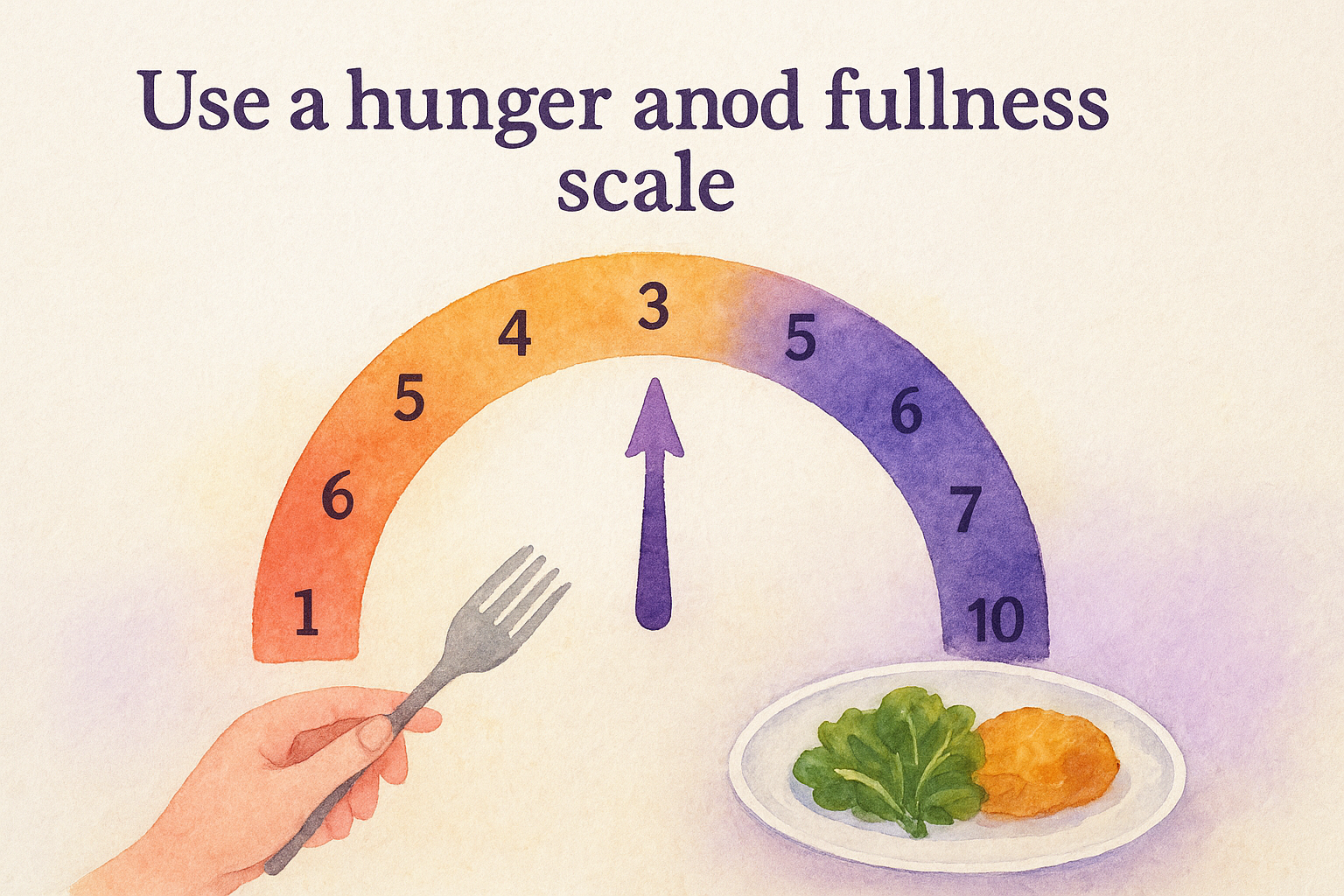
5. Use a hunger and fullness scale
Most people eat by the clock or by habit rather than by actual need. A hunger and fullness scale gives you a concrete reference point to check in with your body before, during, and after eating, replacing guesswork with a simple numbered framework you can apply to any meal.
What it is
A hunger and fullness scale runs from 1 to 10, where 1 is painfully empty and 10 is uncomfortably stuffed. The goal is to start eating around a 3 or 4 and stop around a 6 or 7. This is one of the most practical mindful eating techniques for people who regularly eat past comfort without noticing.
Checking your number mid-meal is more useful than checking it only at the start, because that’s when you still have the option to slow down.
How to do it step by step
Rate your hunger before your first bite. Then check in again at the halfway point by pausing with your utensil down. Use these three reference points consistently:
Before eating: Aim to start at a 3 or 4, clearly hungry but not desperate.
Midway through: Slow down if you’ve reached a 6.
After eating: Note your final number to build self-awareness over time.
When it helps most
This technique works best when you eat large portions by default or when stress and boredom drive you to eat past fullness without realizing it.
Common mistakes and quick fixes
The most common mistake is only checking in at the start. The mid-meal check is where the real shift happens. If you forget, set a brief reminder on your phone until the habit becomes automatic.
6. Plate your food and pre-portion it
Eating straight from a bag, pot, or container removes one of your most useful feedback tools: visual portion awareness. When you can’t see how much you’ve eaten, you rely on the container emptying rather than your body signaling fullness. Plating your food before you sit down is one of the most overlooked mindful eating techniques for resetting this default.
What it is
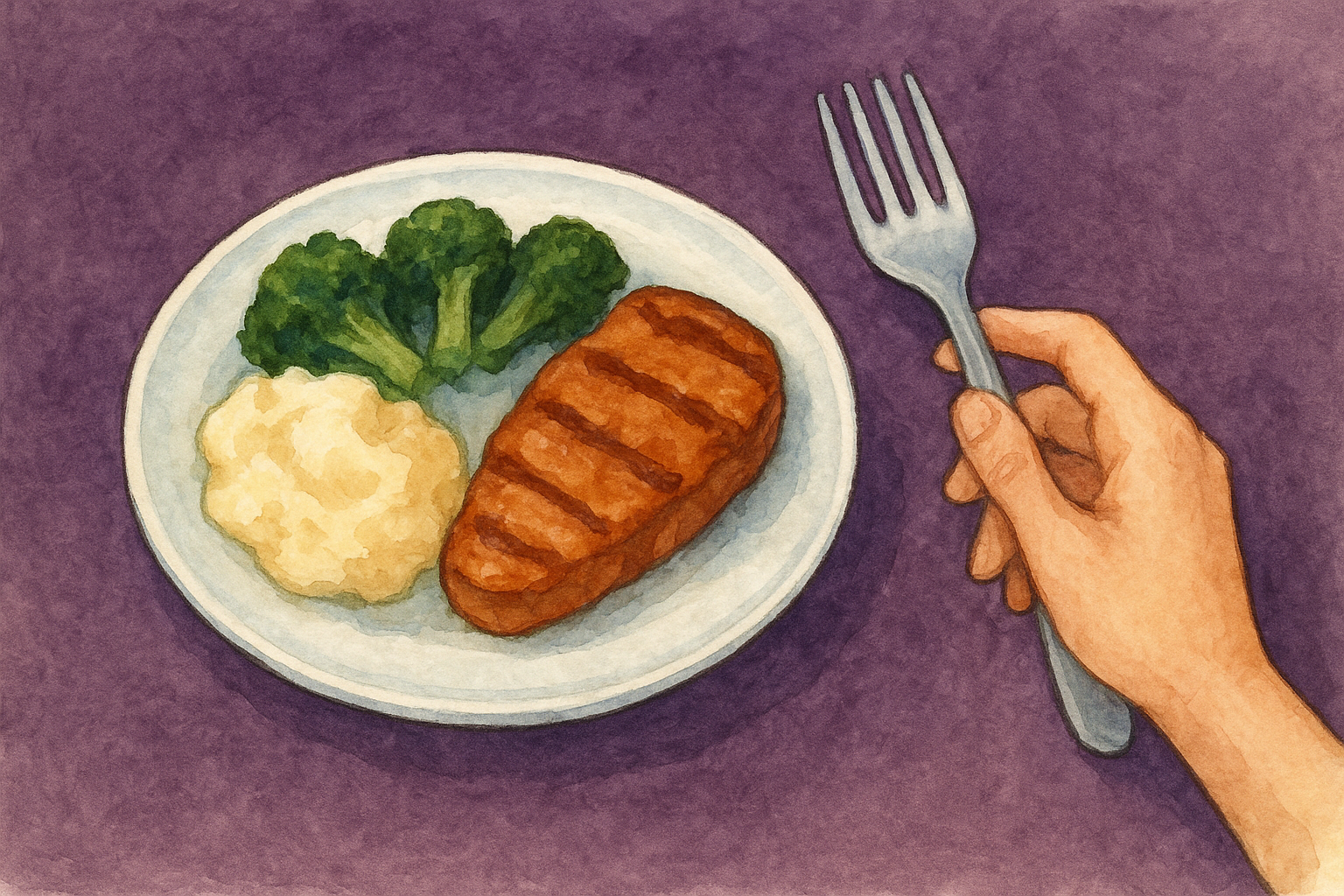
Pre-portioning means you serve a defined amount onto a plate or bowl before you start eating, rather than eating from the original package or serving dish. This creates a clear visual boundary for your meal and removes the easy option of unconscious second helpings.
How to do it step by step
Serve your food onto a plate or bowl in the kitchen before you bring it to the table. Put the remaining food away or cover it. Sit down with only what’s in front of you.
Removing the serving dish from the table turns the decision to eat more into a conscious choice rather than an automatic reach.
When it helps most
This technique works well when you eat snacks, leftovers, or takeout, where the original container gives no visual cue about how much you’re actually consuming.
Common mistakes and quick fixes
The most common mistake is plating too little deliberately as a restriction tactic rather than a neutral awareness tool. That approach backfires quickly and builds a tense relationship with food. Plate a realistic amount you’d normally eat, then check in with your hunger scale at the halfway point.
7. Change the mechanics to slow yourself down
Sometimes the most effective mindful eating techniques work at the physical level rather than the mental one. When you change how you physically interact with your food, your eating pace slows down automatically, without relying entirely on willpower or sustained focus.
What it is
Changing the mechanics means using deliberate physical strategies to interrupt your normal eating rhythm. This includes switching your dominant hand, eating with chopsticks, or using a smaller utensil than usual. Each approach introduces enough friction to make fast, automatic eating harder to sustain.
Small physical barriers do more to slow your eating than reminders to "eat slowly" ever will.
How to do it step by step
Pick one mechanical change and apply it to a single meal per day. Options that work well include switching your fork to your non-dominant hand, using chopsticks with foods you’d normally eat with a spoon, or swapping a large spoon for a teaspoon. Each option forces more deliberate movement, which naturally extends the time between bites.
When it helps most
This approach works best when you eat quickly by default and find mental cues like the utensil-down technique hard to maintain consistently. It also helps during social meals, where conversation and distraction speed up your pace without you noticing.
Common mistakes and quick fixes
The most common mistake is abandoning the strategy mid-meal because it feels slow or awkward. That friction is the point. Start with just one meal per week to build tolerance before increasing frequency.
A calmer way to eat, starting today
None of these mindful eating techniques require a lifestyle overhaul. Each one works on its own, and you can start with whichever feels most relevant to where you are right now. Pick one technique, apply it to a single meal today, and build from there. Consistency over a few weeks will do more than trying all seven at once and burning out by Thursday.
Your body gives you signals constantly. The problem is that most eating habits are designed to override them, not listen to them. Slowing down your meals is one of the most direct ways to close that gap and start actually nourishing yourself instead of just feeding a habit.
If you care about recovery, integration, and putting good things back into your body, that mindset extends beyond what you eat to how you eat. Learn more about our approach at Afterglow Supplements.
Lukas Nelpela
writes on neuroscience, mental health, and mindful exploration. With a passion in research-driven wellness and years focused on set & setting, integration, and recovery, he turns complex ideas into clear, usable insight.
Sleep quality shapes how you think, feel, and recover, whether you’re bouncing back from a tough week or integrating a psychedelic experience. The Harvard sleep hygiene guidelines, developed by researchers at Harvard Medical School, remain some of the most cited and practical recommendations for improving rest. They’re not trendy hacks
If you’ve ever woken up after a psychedelic experience with a locked jaw, tight shoulders, or a neck that barely turns, you already know the toll that sustained muscle tension can take on your body. That tightness doesn’t just sit on the surface, it often lives deeper, in the connective
Your mitochondria produce roughly 90% of the energy your body runs on. Every thought, every heartbeat, every moment of focus or fatigue traces back to these tiny organelles inside your cells. When they’re thriving, you feel sharp, resilient, and recharged. When they’re not, you feel it, brain fog, sluggish recovery,
Stiff hips, locked-up shoulders, a jaw that still feels like a vice grip from last weekend, your body keeps a receipt for everything you put it through. Whether you’re recovering from a heavy festival, an intense psychedelic session, or just sitting at a desk for ten hours straight, mobility work
You already know the drill: you’re lying in bed after a long day (or a long night), scrolling your phone, and sleep feels miles away. Your brain won’t shut off, your eyes sting, and that melatonin you took 40 minutes ago hasn’t kicked in. One of the simplest fixes? Blue
We use various cookies on our website. Some are essential for the website to function properly, while others we may only use with your consent. You can find more information about cookies on our website here.
This website uses cookies to improve your experience while you navigate through the website. Out of these cookies, the cookies that are categorized as necessary are stored on your browser as they are essential for the working of basic functionalities of the website. We also use third-party cookies that help us analyze and understand how you use this website. These cookies will be stored on your browser only with your consent. You also have the option to opt-out of these cookies. However, opting out of some of these cookies may have an impact on your browsing experience.
Necessary cookies are absolutely essential for the website to function properly. These cookies anonymously ensure basic functionalities and security features of the website.
Cookie
Duration
Description
cookielawinfo-checkbox-advertisement
1 year
Set by the GDPR Cookie Consent plugin, this cookie records the user consent for the cookies in the "Advertisement" category.
cookielawinfo-checkbox-analytics
11 months
This cookie is set by GDPR Cookie Consent plugin. The cookie is used to store the user consent for the cookies in the category "Analytics".
cookielawinfo-checkbox-functional
11 months
The cookie is set by GDPR cookie consent to record the user consent for the cookies in the category "Functional".
cookielawinfo-checkbox-necessary
11 months
This cookie is set by GDPR Cookie Consent plugin. The cookies is used to store the user consent for the cookies in the category "Necessary".
cookielawinfo-checkbox-others
11 months
This cookie is set by GDPR Cookie Consent plugin. The cookie is used to store the user consent for the cookies in the category "Other.
cookielawinfo-checkbox-performance
11 months
This cookie is set by GDPR Cookie Consent plugin. The cookie is used to store the user consent for the cookies in the category "Performance".
CookieLawInfoConsent
1 year
CookieYes sets this cookie to record the default button state of the corresponding category and the status of CCPA. It works only in coordination with the primary cookie.
elementor
never
The website's WordPress theme uses this cookie. It allows the website owner to implement or change the website's content in real-time.
fb_event_id_atc
30 minutes
Used to match client and server events for Meta Conversion API deduplication. Contains only anonymous technical IDs; no personal data stored.
fb_event_id_ic
30 minutes
Used to match client and server events for Meta Conversion API deduplication. Contains only anonymous technical IDs; no personal data stored.
fb_event_id_pur
30 minutes
Used to match client and server events for Meta Conversion API deduplication. Contains only anonymous technical IDs; no personal data stored.
fb_event_id_vc
30 minutes
Used to match client and server events for Meta Conversion API deduplication. Contains only anonymous technical IDs; no personal data stored.
rc::a
never
This cookie is set by the Google recaptcha service to identify bots to protect the website against malicious spam attacks.
rc::c
session
This cookie is set by the Google recaptcha service to identify bots to protect the website against malicious spam attacks.
viewed_cookie_policy
11 months
The cookie is set by the GDPR Cookie Consent plugin and is used to store whether or not user has consented to the use of cookies. It does not store any personal data.
VISITOR_PRIVACY_METADATA
6 months
YouTube sets this cookie to store the user's cookie consent state for the current domain.
wpEmojiSettingsSupports
session
WordPress sets this cookie when a user interacts with emojis on a WordPress site. It helps determine if the user's browser can display emojis properly.
Functional cookies help to perform certain functions, such as sharing website content on social media platforms, collecting feedback, and other third-party functions.
Cookie
Duration
Description
sib_cuid
6 months
SendinBlue sets this cookie to store unique visits.
VISITOR_INFO1_LIVE
6 months
A cookie set by YouTube to measure bandwidth that determines whether the user gets the new or old player interface.
yt-remote-cast-available
session
The yt-remote-cast-available cookie is used to store the user's preferences regarding whether casting is available on their YouTube video player.
yt-remote-cast-installed
session
The yt-remote-cast-installed cookie is used to store the user's video player preferences using embedded YouTube video.
yt-remote-connected-devices
never
YouTube sets this cookie to store the user's video preferences using embedded YouTube videos.
yt-remote-device-id
never
YouTube sets this cookie to store the user's video preferences using embedded YouTube videos.
yt-remote-fast-check-period
session
The yt-remote-fast-check-period cookie is used by YouTube to store the user's video player preferences for embedded YouTube videos.
yt-remote-session-app
session
The yt-remote-session-app cookie is used by YouTube to store user preferences and information about the interface of the embedded YouTube video player.
yt-remote-session-name
session
The yt-remote-session-name cookie is used by YouTube to store the user's video player preferences using embedded YouTube video.
ytidb::LAST_RESULT_ENTRY_KEY
never
The cookie ytidb::LAST_RESULT_ENTRY_KEY is used by YouTube to store the last search result entry that was clicked by the user. This information is used to improve the user experience by providing more relevant search results in the future.
Performance cookies are used to understand and analyze key website performance indexes, which helps in providing a better user experience for visitors.
Cookie
Duration
Description
SRM_B
1 year 24 days
Used by Microsoft Advertising as a unique ID for visitors.
Analytical cookies are used to understand how visitors interact with the website. These cookies help provide information on metrics such as the number of visitors, bounce rate, traffic source, etc.
Cookie
Duration
Description
_clck
1 year
Microsoft Clarity sets this cookie to retain the browser's Clarity User ID and settings exclusive to that website. This guarantees that actions taken during subsequent visits to the same website will be linked to the same user ID.
_clsk
1 day
Microsoft Clarity sets this cookie to store and consolidate a user's pageviews into a single session recording.
_fbp
3 months
Facebook sets this cookie to display advertisements when either on Facebook or on a digital platform powered by Facebook advertising after visiting the website.
_ga
1 year 1 month 4 days
Google Analytics sets this cookie to calculate visitor, session and campaign data and track site usage for the site's analytics report. The cookie stores information anonymously and assigns a randomly generated number to recognise unique visitors.
_ga_*
1 year 1 month 4 days
Google Analytics sets this cookie to store and count page views.
_gcl_au
3 months
Google Tag Manager sets the cookie to experiment advertisement efficiency of websites using their services.
_hjSession_*
1 hour
Hotjar sets this cookie to ensure data from subsequent visits to the same site is attributed to the same user ID, which persists in the Hotjar User ID, which is unique to that site.
_hjSessionUser_*
1 year
Hotjar sets this cookie to ensure data from subsequent visits to the same site is attributed to the same user ID, which persists in the Hotjar User ID, which is unique to that site.
_hjTLDTest
session
To determine the most generic cookie path that has to be used instead of the page hostname, Hotjar sets the _hjTLDTest cookie to store different URL substring alternatives until it fails.
CLID
1 year
Microsoft Clarity set this cookie to store information about how visitors interact with the website. The cookie helps to provide an analysis report. The data collection includes the number of visitors, where they visit the website, and the pages visited.
MR
7 days
This cookie, set by Bing, is used to collect user information for analytics purposes.
sbjs_current
session
Sourcebuster sets this cookie to identify the source of a visit and stores user action information in cookies. This analytical and behavioural cookie is used to enhance the visitor experience on the website.
sbjs_current_add
session
Sourcebuster sets this cookie to identify the source of a visit and stores user action information in cookies. This analytical and behavioural cookie is used to enhance the visitor experience on the website.
sbjs_first
session
Sourcebuster sets this cookie to identify the source of a visit and stores user action information in cookies. This analytical and behavioural cookie is used to enhance the visitor experience on the website.
sbjs_first_add
session
Sourcebuster sets this cookie to identify the source of a visit and stores user action information in cookies. This analytical and behavioural cookie is used to enhance the visitor experience on the website.
sbjs_migrations
session
Sourcebuster sets this cookie to identify the source of a visit and stores user action information in cookies. This analytical and behavioural cookie is used to enhance the visitor experience on the website.
sbjs_session
1 hour
Sourcebuster sets this cookie to identify the source of a visit and stores user action information in cookies. This analytical and behavioural cookie is used to enhance the visitor experience on the website.
sbjs_udata
session
Sourcebuster sets this cookie to identify the source of a visit and stores user action information in cookies. This analytical and behavioural cookie is used to enhance the visitor experience on the website.
SM
session
Microsoft Clarity cookie set this cookie for synchronizing the MUID across Microsoft domains.
YSC
session
YSC cookie is set by Youtube and is used to track the views of embedded videos on Youtube pages.
Advertising cookies are used to deliver relevant advertisements and marketing campaigns to visitors. These cookies track visitors across websites and collect information to deliver tailored advertisements.
Cookie
Duration
Description
_rdt_uuid
3 months
Reddit sets this cookie to build a profile of your interests and show you relevant ads.
ANONCHK
10 minutes
The ANONCHK cookie, set by Bing, is used to store a user's session ID and verify ads' clicks on the Bing search engine. The cookie helps in reporting and personalization as well.
MUID
1 year 24 days
Bing sets this cookie to recognise unique web browsers visiting Microsoft sites. This cookie is used for advertising, site analytics, and other operations.
test_cookie
15 minutes
doubleclick.net sets this cookie to determine if the user's browser supports cookies.
yt.innertube::nextId
never
YouTube sets this cookie to register a unique ID to store data on what videos from YouTube the user has seen.
yt.innertube::requests
never
YouTube sets this cookie to register a unique ID to store data on what videos from YouTube the user has seen.