Yoga Nidra vs Meditation: Differences, Benefits, Best Use
11 min read
If you’ve ever tried to process a powerful experience, psychedelic or otherwise, you’ve probably been told to meditate. But sit down to do it, and the questions start piling up. Should you focus on your breath? Try a body scan? Lie down and let go completely? That confusion often leads people to compare yoga nidra vs meditation, two practices that overlap in some ways but differ sharply in technique, intention, and outcome.
Both practices can support stress relief, deeper sleep, and mental clarity, three things anyone serious about recovery and integration already prioritizes. At Afterglow Supplements, we build protocols to help your body bounce back after intense experiences. But physical recovery is only half the picture. What you do with your mind matters just as much, and choosing the right practice can make the difference between feeling scattered and feeling grounded.
This article breaks down how yoga nidra and meditation actually work, where they diverge, and which one fits specific goals, whether that’s calming post-experience anxiety, improving sleep quality, or sharpening focus in the days that follow.
What yoga nidra is and what meditation is
Before comparing yoga nidra vs meditation, you need a clear picture of what each practice actually does at a technical level. They share surface-level similarities, like quiet environments and a focus on calming the nervous system, but they operate through very different mechanisms. Knowing the difference gives you a foundation to decide which one actually fits your recovery or integration goals.
What yoga nidra is
Yoga nidra, often translated as "yogic sleep," is a guided, systematic practice that leads you into a state of conscious deep rest. You lie down flat on your back and follow a facilitator’s voice through a structured rotation of awareness across different body parts, sensations, and sometimes visualizations. You are not trying to empty your mind or control anything. You are allowing the mind to become a passive observer while the body enters a rest state close to sleep.
The practice deliberately targets the hypnagogic state, the threshold between waking and sleeping, where brainwave activity shifts from beta and alpha waves toward theta and even delta waves. Research explored through institutions like the National Institutes of Health has looked at how this state supports emotional processing, stress hormone regulation, and deep physical recovery. A single 45-minute session is often said to provide rest comparable to several hours of sleep, though individual results vary significantly.
The core idea in yoga nidra is that you do not control the experience. You receive it.
What meditation is
Meditation is a broad category that includes many techniques, ranging from focused attention practices (concentrating on the breath or a mantra) to open awareness practices (observing thoughts without engaging them) to movement-based approaches like walking meditation. Unlike yoga nidra, most meditation forms ask you to stay alert, either seated or upright, so that falling asleep is considered a lapse in practice rather than part of the process.
What ties all meditation forms together is intentional mental training. You practice directing or releasing attention on purpose. Over time, this builds a kind of cognitive muscle, making it easier to stay present, recognize reactive thought patterns, and reduce the grip of anxiety and emotional reactivity. Studies through organizations like the National Center for Complementary and Integrative Health have documented measurable changes in cortisol levels, amygdala reactivity, and overall emotional regulation in regular meditators.
Flexible in both position and duration, meditation can fit into five minutes at your desk or an hour in a dedicated space. That flexibility makes it easier to build into daily life, but it also means the results depend heavily on which technique you use and what you’re trying to accomplish. A mindfulness practice aimed at sharpening focus looks and feels very different from a loving-kindness practice aimed at processing difficult emotions after an intense experience.
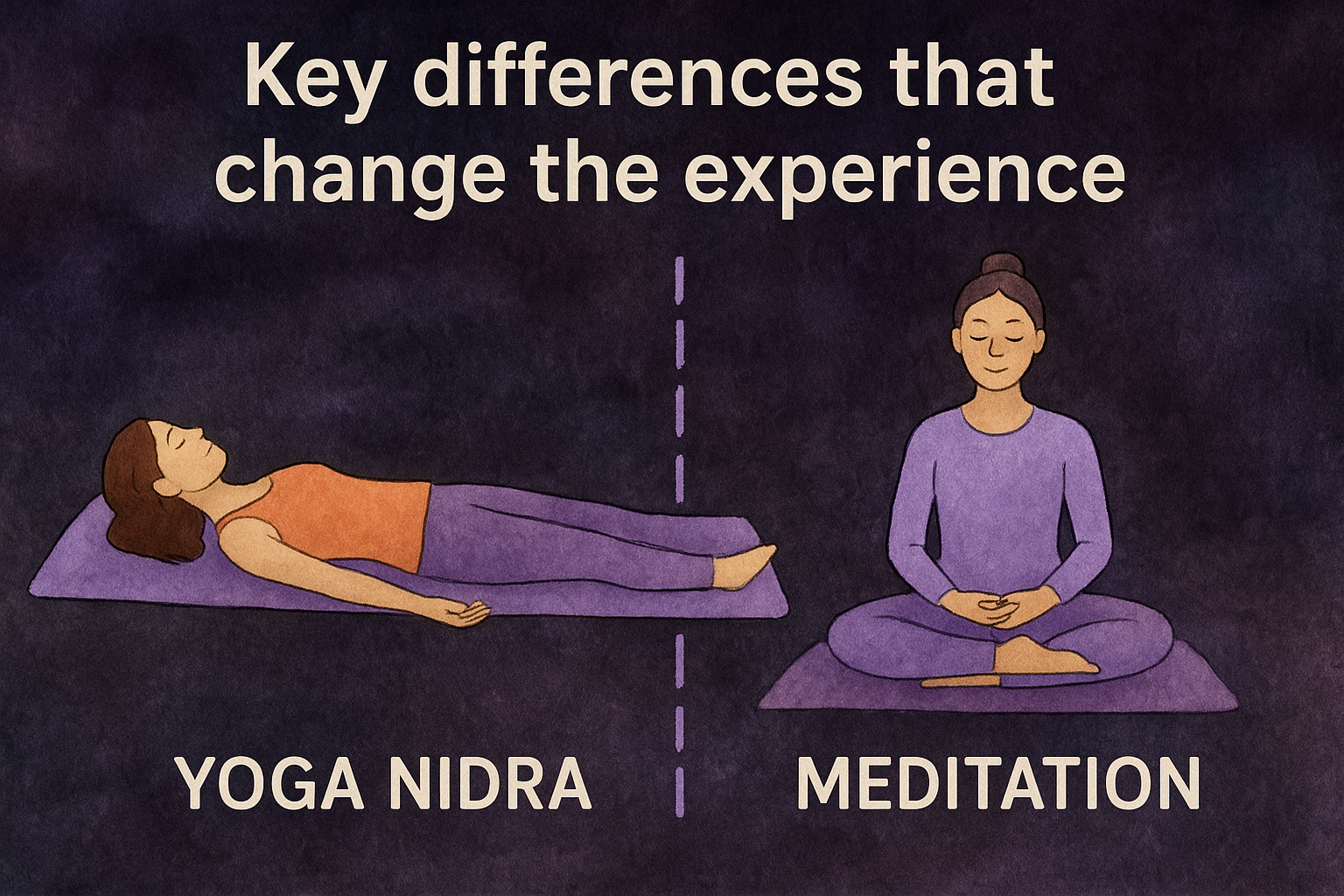
Key differences that change the experience
When comparing yoga nidra vs meditation, the surface similarities can mask how different these practices are in practice. Both involve stillness and intentional attention, but the direction, posture, and mental state each requires will determine what you actually get out of them and when each one serves you better.
Consciousness stays active in meditation, but softens in yoga nidra
The most fundamental difference is what you do with your conscious awareness. In meditation, you keep consciousness sharp. You notice when attention drifts, and you redirect it. That active correction is the whole point. In yoga nidra, you let consciousness soften. You follow guidance but place no effort into staying focused or redirecting the mind. Drifting toward sleep is normal, even welcomed up to a point.
This distinction matters most when your nervous system is depleted, because forcing alertness during recovery can work against you.
Posture signals something deeper
Meditation typically asks you to sit upright, keeping the spine straight and the body alert. That posture sends a signal to your brain: stay awake, stay engaged. Yoga nidra requires lying flat on your back in savasana, a position your brain already associates with sleep and deep rest. This is not just comfort preference. The body position directly influences the neurological state you can access, and yoga nidra’s horizontal posture helps lower the threshold into theta brainwaves faster than most seated practices can.
Structure versus technique
Yoga nidra follows a fixed, sequential structure that a guide delivers to you. You rotate awareness through the body, move through pairs of opposites, and follow a defined arc. You do not choose the path mid-session. Meditation techniques vary widely, but even in their simplest forms, they require you to make ongoing micro-decisions about where to place attention. That self-direction builds skill over time, but it also demands more cognitive overhead. For someone processing a heavy experience or running on poor sleep, that overhead can become a barrier rather than a benefit.
These structural differences are not about one practice being harder or easier. They reflect different goals and different mechanisms, which is why understanding both helps you deploy each one at the right moment.
Benefits and best times to use each practice
Each practice delivers real benefits, but timing matters as much as technique. Understanding when to reach for yoga nidra vs meditation can save you from pushing a depleted nervous system in the wrong direction or missing a window where one practice would serve you far better than the other.
When yoga nidra works best
Yoga nidra is most effective when your nervous system needs to downshift rather than engage. If you’re lying awake with a racing mind, carrying residual tension in your body after an intense experience, or struggling with the emotional weight of integration, yoga nidra gives your system permission to release without demanding anything from you in return. The guided structure removes the cognitive load of self-direction entirely.
The practice is particularly useful in the days following a psychedelic experience, when sleep quality often drops and the brain needs time to restore neurotransmitter balance.
The benefits it reliably delivers include deeper physical rest, lower cortisol output, and reduced emotional reactivity. Research highlighted by the National Institutes of Health has linked regular yoga nidra practice to improved sleep onset, reduced anxiety markers, and a measurable shift toward parasympathetic nervous system dominance. Those effects make it a strong tool during any recovery period, not just in the context of psychedelics.
When meditation works best
Meditation builds value over time in a way that yoga nidra does not prioritize. Its core strength is developing your capacity to regulate attention and interrupt reactive thought loops. That cognitive training pays off most on ordinary days when you’re not in acute recovery but still want to improve how you handle stress, sharpen focus before demanding work, or build long-term emotional resilience.
Specific situations where meditation outperforms yoga nidra include:
Morning routines, when you want to set a clear mental baseline before the day gets noisy
Focus sessions, particularly before creative or analytical work that demands sustained attention
Emotional processing, when you need to sit with difficult thoughts rather than soften away from them
Long-term habit building, since seated practices are easier to stack with daily routines
Both practices reduce anxiety and support mental clarity, but they do it through different levers and at different points in your day or recovery arc.
How to choose and combine yoga nidra and meditation
Choosing between yoga nidra vs meditation doesn’t have to be an either-or decision. The two practices complement each other well when you understand what each one is built for. The key is matching the right tool to the right moment in your day or recovery arc, rather than forcing one practice into every situation and hoping it sticks.
When to prioritize one over the other
Your current physical and mental state tells you more than any fixed schedule ever will. If you’re coming off an intense experience, dealing with poor sleep, or running on a nervous system that’s clearly overloaded, yoga nidra is the stronger starting point. It asks nothing of you cognitively, which matters when your capacity for self-direction is already stretched thin. Give yourself two to five days of prioritizing yoga nidra before reintroducing any more active meditation practice.
When your body is in recovery mode, adding cognitive effort to your rest practice can slow the process rather than support it.
Once you feel physically rested and mentally stable, meditation becomes the more useful daily tool. Use it to rebuild focus, process lingering thoughts with intention, and sharpen your capacity to handle the ordinary stress that follows any period of emotional intensity.
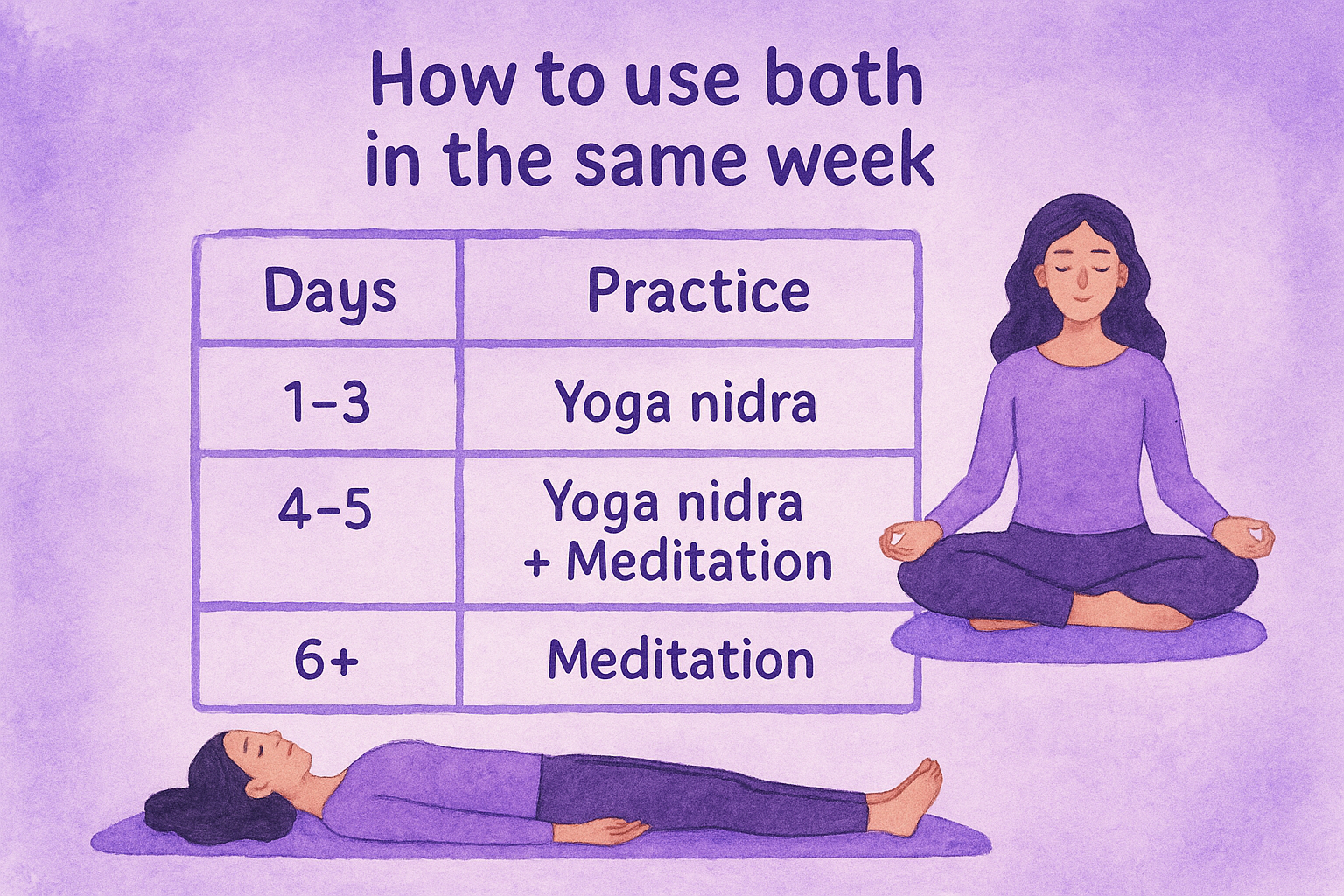
How to use both in the same week
You don’t need a rigid alternating schedule, but a loose structure helps. One practical approach is to use yoga nidra in the evenings, particularly in the three to five days following an intense experience, and short seated meditation in the mornings on days when you feel grounded enough to sustain attention. This arrangement splits the workload in a way that respects your nervous system’s actual state rather than an idealized version of it.
A simple weekly pattern might look like this:
Days 1-3 post-experience: Yoga nidra only, 30-45 minutes before sleep
Days 4-5: Yoga nidra in the evening, optional 10-minute meditation in the morning
Day 6 onward: Daily meditation as your anchor, yoga nidra as needed for sleep or stress
This framework is flexible by design. The goal is to use both practices with intention rather than defaulting to one out of habit or convenience.
How to start and practice safely
Starting either practice doesn’t require special equipment or prior experience, but how you begin shapes whether you stick with it or abandon it after two sessions. The biggest mistake most people make is choosing a format that’s too demanding for where they actually are. Knowing what to expect from each practice, and how to build in safely, keeps the process sustainable and genuinely useful.
Starting with yoga nidra
Your first yoga nidra session should be guided and passive. Find a free recording from a qualified teacher, ideally between 20 and 45 minutes, and lie flat in a comfortable position with a blanket if needed. You don’t need to understand the technique beforehand. The guide handles the structure. Your only job is to stay awake enough to follow the voice, which sounds easy until you realize how quickly the practice pulls you toward sleep.
If you fall asleep during your first few sessions, that’s not failure; it’s your body taking the rest it needs most.
Give yourself at least three to four sessions before you evaluate whether it’s working. The effects of yoga nidra compound over time, and the first session rarely shows you the full range of what the practice can do. Keep the environment dark, put your phone on silent, and protect the time as seriously as you would any recovery protocol.
Starting with meditation
Meditation rewards short, consistent sessions far more than occasional long ones. Start with five to ten minutes using a simple breath-focused technique. Sit comfortably upright, close your eyes, and count each exhale from one to ten, restarting when you lose count. That single method gives you enough structure to begin building attentional control without overwhelming you with choices about which technique to use.
When you’re deciding between yoga nidra vs meditation as a starting point, let your current energy level and sleep quality guide you. Both practices carry low physical risk for most healthy adults, but anyone managing a diagnosed anxiety disorder, PTSD, or dissociative symptoms should speak with a mental health professional before using either practice as a primary intervention. The goal is to support your nervous system, not pressure it into a technique it isn’t ready for.
Final takeaways
The comparison between yoga nidra vs meditation comes down to one core question: what does your nervous system actually need right now? Yoga nidra works best when you need passive, structured rest without cognitive effort. Meditation builds long-term capacity for focus, attention, and emotional regulation when you have the mental bandwidth to engage actively. Neither practice is superior. They serve different moments, and using both intentionally gives you a more complete toolkit than leaning on one alone.
Recovery after intense experiences, whether from psychedelics, stress, or poor sleep, requires more than one lever. Your mind and body both need support, and layering smart practices on top of solid physical recovery gives you the best chance of feeling clear, grounded, and fully integrated. If you want to understand how targeted supplementation supports that physical side of recovery, explore the Afterglow recovery protocol and see what a structured approach actually looks like.
Lukas Nelpela
writes on neuroscience, mental health, and mindful exploration. With a passion in research-driven wellness and years focused on set & setting, integration, and recovery, he turns complex ideas into clear, usable insight.
Sleep quality shapes how you think, feel, and recover, whether you’re bouncing back from a tough week or integrating a psychedelic experience. The Harvard sleep hygiene guidelines, developed by researchers at Harvard Medical School, remain some of the most cited and practical recommendations for improving rest. They’re not trendy hacks
If you’ve ever woken up after a psychedelic experience with a locked jaw, tight shoulders, or a neck that barely turns, you already know the toll that sustained muscle tension can take on your body. That tightness doesn’t just sit on the surface, it often lives deeper, in the connective
Your mitochondria produce roughly 90% of the energy your body runs on. Every thought, every heartbeat, every moment of focus or fatigue traces back to these tiny organelles inside your cells. When they’re thriving, you feel sharp, resilient, and recharged. When they’re not, you feel it, brain fog, sluggish recovery,
Stiff hips, locked-up shoulders, a jaw that still feels like a vice grip from last weekend, your body keeps a receipt for everything you put it through. Whether you’re recovering from a heavy festival, an intense psychedelic session, or just sitting at a desk for ten hours straight, mobility work
You already know the drill: you’re lying in bed after a long day (or a long night), scrolling your phone, and sleep feels miles away. Your brain won’t shut off, your eyes sting, and that melatonin you took 40 minutes ago hasn’t kicked in. One of the simplest fixes? Blue
We use various cookies on our website. Some are essential for the website to function properly, while others we may only use with your consent. You can find more information about cookies on our website here.
This website uses cookies to improve your experience while you navigate through the website. Out of these cookies, the cookies that are categorized as necessary are stored on your browser as they are essential for the working of basic functionalities of the website. We also use third-party cookies that help us analyze and understand how you use this website. These cookies will be stored on your browser only with your consent. You also have the option to opt-out of these cookies. However, opting out of some of these cookies may have an impact on your browsing experience.
Necessary cookies are absolutely essential for the website to function properly. These cookies anonymously ensure basic functionalities and security features of the website.
Cookie
Duration
Description
cookielawinfo-checkbox-advertisement
1 year
Set by the GDPR Cookie Consent plugin, this cookie records the user consent for the cookies in the "Advertisement" category.
cookielawinfo-checkbox-analytics
11 months
This cookie is set by GDPR Cookie Consent plugin. The cookie is used to store the user consent for the cookies in the category "Analytics".
cookielawinfo-checkbox-functional
11 months
The cookie is set by GDPR cookie consent to record the user consent for the cookies in the category "Functional".
cookielawinfo-checkbox-necessary
11 months
This cookie is set by GDPR Cookie Consent plugin. The cookies is used to store the user consent for the cookies in the category "Necessary".
cookielawinfo-checkbox-others
11 months
This cookie is set by GDPR Cookie Consent plugin. The cookie is used to store the user consent for the cookies in the category "Other.
cookielawinfo-checkbox-performance
11 months
This cookie is set by GDPR Cookie Consent plugin. The cookie is used to store the user consent for the cookies in the category "Performance".
CookieLawInfoConsent
1 year
CookieYes sets this cookie to record the default button state of the corresponding category and the status of CCPA. It works only in coordination with the primary cookie.
elementor
never
The website's WordPress theme uses this cookie. It allows the website owner to implement or change the website's content in real-time.
fb_event_id_atc
30 minutes
Used to match client and server events for Meta Conversion API deduplication. Contains only anonymous technical IDs; no personal data stored.
fb_event_id_ic
30 minutes
Used to match client and server events for Meta Conversion API deduplication. Contains only anonymous technical IDs; no personal data stored.
fb_event_id_pur
30 minutes
Used to match client and server events for Meta Conversion API deduplication. Contains only anonymous technical IDs; no personal data stored.
fb_event_id_vc
30 minutes
Used to match client and server events for Meta Conversion API deduplication. Contains only anonymous technical IDs; no personal data stored.
rc::a
never
This cookie is set by the Google recaptcha service to identify bots to protect the website against malicious spam attacks.
rc::c
session
This cookie is set by the Google recaptcha service to identify bots to protect the website against malicious spam attacks.
viewed_cookie_policy
11 months
The cookie is set by the GDPR Cookie Consent plugin and is used to store whether or not user has consented to the use of cookies. It does not store any personal data.
VISITOR_PRIVACY_METADATA
6 months
YouTube sets this cookie to store the user's cookie consent state for the current domain.
wpEmojiSettingsSupports
session
WordPress sets this cookie when a user interacts with emojis on a WordPress site. It helps determine if the user's browser can display emojis properly.
Functional cookies help to perform certain functions, such as sharing website content on social media platforms, collecting feedback, and other third-party functions.
Cookie
Duration
Description
sib_cuid
6 months
SendinBlue sets this cookie to store unique visits.
VISITOR_INFO1_LIVE
6 months
A cookie set by YouTube to measure bandwidth that determines whether the user gets the new or old player interface.
yt-remote-cast-available
session
The yt-remote-cast-available cookie is used to store the user's preferences regarding whether casting is available on their YouTube video player.
yt-remote-cast-installed
session
The yt-remote-cast-installed cookie is used to store the user's video player preferences using embedded YouTube video.
yt-remote-connected-devices
never
YouTube sets this cookie to store the user's video preferences using embedded YouTube videos.
yt-remote-device-id
never
YouTube sets this cookie to store the user's video preferences using embedded YouTube videos.
yt-remote-fast-check-period
session
The yt-remote-fast-check-period cookie is used by YouTube to store the user's video player preferences for embedded YouTube videos.
yt-remote-session-app
session
The yt-remote-session-app cookie is used by YouTube to store user preferences and information about the interface of the embedded YouTube video player.
yt-remote-session-name
session
The yt-remote-session-name cookie is used by YouTube to store the user's video player preferences using embedded YouTube video.
ytidb::LAST_RESULT_ENTRY_KEY
never
The cookie ytidb::LAST_RESULT_ENTRY_KEY is used by YouTube to store the last search result entry that was clicked by the user. This information is used to improve the user experience by providing more relevant search results in the future.
Performance cookies are used to understand and analyze key website performance indexes, which helps in providing a better user experience for visitors.
Cookie
Duration
Description
SRM_B
1 year 24 days
Used by Microsoft Advertising as a unique ID for visitors.
Analytical cookies are used to understand how visitors interact with the website. These cookies help provide information on metrics such as the number of visitors, bounce rate, traffic source, etc.
Cookie
Duration
Description
_clck
1 year
Microsoft Clarity sets this cookie to retain the browser's Clarity User ID and settings exclusive to that website. This guarantees that actions taken during subsequent visits to the same website will be linked to the same user ID.
_clsk
1 day
Microsoft Clarity sets this cookie to store and consolidate a user's pageviews into a single session recording.
_fbp
3 months
Facebook sets this cookie to display advertisements when either on Facebook or on a digital platform powered by Facebook advertising after visiting the website.
_ga
1 year 1 month 4 days
Google Analytics sets this cookie to calculate visitor, session and campaign data and track site usage for the site's analytics report. The cookie stores information anonymously and assigns a randomly generated number to recognise unique visitors.
_ga_*
1 year 1 month 4 days
Google Analytics sets this cookie to store and count page views.
_gcl_au
3 months
Google Tag Manager sets the cookie to experiment advertisement efficiency of websites using their services.
_hjSession_*
1 hour
Hotjar sets this cookie to ensure data from subsequent visits to the same site is attributed to the same user ID, which persists in the Hotjar User ID, which is unique to that site.
_hjSessionUser_*
1 year
Hotjar sets this cookie to ensure data from subsequent visits to the same site is attributed to the same user ID, which persists in the Hotjar User ID, which is unique to that site.
_hjTLDTest
session
To determine the most generic cookie path that has to be used instead of the page hostname, Hotjar sets the _hjTLDTest cookie to store different URL substring alternatives until it fails.
CLID
1 year
Microsoft Clarity set this cookie to store information about how visitors interact with the website. The cookie helps to provide an analysis report. The data collection includes the number of visitors, where they visit the website, and the pages visited.
MR
7 days
This cookie, set by Bing, is used to collect user information for analytics purposes.
sbjs_current
session
Sourcebuster sets this cookie to identify the source of a visit and stores user action information in cookies. This analytical and behavioural cookie is used to enhance the visitor experience on the website.
sbjs_current_add
session
Sourcebuster sets this cookie to identify the source of a visit and stores user action information in cookies. This analytical and behavioural cookie is used to enhance the visitor experience on the website.
sbjs_first
session
Sourcebuster sets this cookie to identify the source of a visit and stores user action information in cookies. This analytical and behavioural cookie is used to enhance the visitor experience on the website.
sbjs_first_add
session
Sourcebuster sets this cookie to identify the source of a visit and stores user action information in cookies. This analytical and behavioural cookie is used to enhance the visitor experience on the website.
sbjs_migrations
session
Sourcebuster sets this cookie to identify the source of a visit and stores user action information in cookies. This analytical and behavioural cookie is used to enhance the visitor experience on the website.
sbjs_session
1 hour
Sourcebuster sets this cookie to identify the source of a visit and stores user action information in cookies. This analytical and behavioural cookie is used to enhance the visitor experience on the website.
sbjs_udata
session
Sourcebuster sets this cookie to identify the source of a visit and stores user action information in cookies. This analytical and behavioural cookie is used to enhance the visitor experience on the website.
SM
session
Microsoft Clarity cookie set this cookie for synchronizing the MUID across Microsoft domains.
YSC
session
YSC cookie is set by Youtube and is used to track the views of embedded videos on Youtube pages.
Advertising cookies are used to deliver relevant advertisements and marketing campaigns to visitors. These cookies track visitors across websites and collect information to deliver tailored advertisements.
Cookie
Duration
Description
_rdt_uuid
3 months
Reddit sets this cookie to build a profile of your interests and show you relevant ads.
ANONCHK
10 minutes
The ANONCHK cookie, set by Bing, is used to store a user's session ID and verify ads' clicks on the Bing search engine. The cookie helps in reporting and personalization as well.
MUID
1 year 24 days
Bing sets this cookie to recognise unique web browsers visiting Microsoft sites. This cookie is used for advertising, site analytics, and other operations.
test_cookie
15 minutes
doubleclick.net sets this cookie to determine if the user's browser supports cookies.
yt.innertube::nextId
never
YouTube sets this cookie to register a unique ID to store data on what videos from YouTube the user has seen.
yt.innertube::requests
never
YouTube sets this cookie to register a unique ID to store data on what videos from YouTube the user has seen.