Breathwork for Beginners: 5 Simple Techniques to Start Today
11 min read
You don’t need a retreat, a guru, or years of meditation practice to start changing how you feel. You just need your breath. Breathwork for beginners might sound like another wellness buzzword, but it’s one of the most researched and accessible tools for reducing stress, calming anxiety, and sharpening focus, all things that matter whether you’re navigating daily life or recovering from a deep psychedelic experience.
At Afterglow Supplements, we build recovery protocols around what your body actually needs after intense experiences. Breathwork fits right into that picture. It activates your parasympathetic nervous system, helps regulate mood, and supports the kind of grounded integration that makes transformative experiences stick, no capsule required.
This guide breaks down five simple breathwork techniques you can try today, even if you’ve never done a single conscious breath exercise before. You’ll learn what breathwork actually does in your body, which methods work best for specific goals, and how to build a practice that fits your life without overcomplicating it.
What breathwork is and why it works
Breathwork is the deliberate practice of controlling your breathing patterns to influence your physical and mental state. Unlike unconscious breathing, which your body handles automatically, breathwork asks you to take over that process with intention and structure. At its simplest, this means slowing down, deepening, or altering the rhythm of your breath to trigger specific responses in your body. You don’t need equipment, a subscription, or a quiet mountain retreat to do it. You already have everything you need.
Your nervous system is the target
Your body runs on two main modes: the sympathetic nervous system (fight-or-flight) and the parasympathetic nervous system (rest-and-digest). Most people stuck in stress, anxiety, or the foggy aftermath of an intense experience are running too hot on the sympathetic side. Breathwork gives you a direct way to shift that balance. When you slow your exhale or breathe through your nose, you stimulate the vagus nerve, the main pathway of your parasympathetic system, and your body starts to downregulate.
Slow, controlled breathing is one of the few tools that gives you direct, real-time access to your autonomic nervous system.
This matters for anyone starting breathwork for beginners because the effect is not subtle or delayed. You can feel a measurable shift within two to three minutes of deliberate practice. Your heart rate variability (HRV) improves, cortisol levels drop, and your brain moves away from reactive, high-alert thinking. Research catalogued through the National Institutes of Health confirms that slow-paced breathing at around five to six breaths per minute produces consistent reductions in physiological stress markers.
The CO2 and oxygen balance
Most people assume that breathing more air faster is better when they feel anxious. It is actually the opposite. Rapid, shallow breathing drops your carbon dioxide levels below the threshold your body needs to transfer oxygen efficiently into your cells, a process called the Bohr effect. This creates a feedback loop where you feel more anxious, breathe faster, and feel worse.
Controlled breathwork breaks that cycle. By extending your exhale or introducing brief breath holds, you allow CO2 to rebuild to functional levels. Your blood vessels dilate, oxygen delivery to your cells improves, and your nervous system registers the situation as safe. The physical calm you feel after a breathing exercise is not a placebo. It is your body responding to a real, measurable shift in blood chemistry.
Understanding this mechanism helps you pick the right technique for the right moment. A technique that energizes you works through different mechanisms than one that sedates you, and the difference usually comes down to breath rate, hold timing, and the ratio between your inhale and exhale. Each of the five techniques in this guide is built around these variables, adjusted to produce a specific outcome you can actually feel.
Safety, risks, and who should skip it
Breathwork for beginners is generally safe, but it is not a zero-risk activity. Changing your breathing patterns shifts your blood chemistry, and for most people that shift is beneficial. For some, though, it can produce uncomfortable or even dangerous effects if done without awareness. Before you dive into any of the five techniques below, spend a few minutes understanding what can happen and whether you fall into a category that needs extra caution.
Common side effects to expect
The most frequent side effect is tingling or numbness in your hands, feet, or face. This happens because lowered CO2 causes your blood vessels to constrict temporarily, reducing circulation to your extremities. It is harmless and fades within a minute or two of returning to normal breathing. You may also feel lightheadedness, a mild head rush, or an emotional release during or after a session. These are normal responses to increased oxygen delivery and nervous system shifts.
If you feel strong dizziness or chest tightness at any point, stop and return to your natural breath immediately.
Muscle cramping, particularly in your hands, is another occasional effect tied to CO2 reduction. Staying seated or lying down during practice removes the risk of falling if lightheadedness hits.
Who should avoid or modify breathwork
Some people need to consult a doctor before trying breathwork, and some should skip certain techniques entirely. The conditions below are not a complete medical list, but they represent the most common situations where breathwork carries real risk.
Avoid or get medical clearance if you have any of the following:
Cardiovascular conditions, including heart disease, arrhythmia, or a history of stroke
Epilepsy or seizure disorders, as intense breathing patterns can lower the seizure threshold
Severe anxiety disorders or PTSD, where breath focus can trigger panic responses without proper guidance
Pregnancy, particularly for techniques involving breath holds or intense exhalation
Respiratory conditions like asthma or COPD, where airflow control can be unpredictable
Recent surgery or injury affecting the abdomen or chest
If you are in active psychedelic integration or recovering from a particularly intense experience, stick to the gentler techniques like belly breathing or the physiological sigh. Avoid any high-intensity connected breathing until your nervous system feels stable.
Five techniques: belly, box, 4-7-8, nostrils, sigh
These five techniques cover the full range of what breathwork for beginners can offer: calming, focusing, energizing, and resetting. Each one targets a different physiological mechanism, so knowing how they work helps you use them with confidence rather than guessing.
Belly breathing
Belly breathing, also called diaphragmatic breathing, is your foundation. It teaches your body to use the full capacity of your lungs instead of shallow chest breathing, which is the default pattern for most people under stress. Start here before trying anything else.
How to do it:
Sit or lie down with one hand on your chest and one on your belly.
Inhale slowly through your nose for 4 counts, letting your belly rise while your chest stays relatively still.
Exhale through your nose or mouth for 4 to 6 counts, feeling your belly fall.
Repeat for 5 minutes.
Box breathing
Box breathing uses equal timing on every phase, which gives your mind a simple structure to follow. It’s widely used in high-stress environments because it reduces cortisol and restores mental clarity quickly.
How to do it:
Inhale through your nose for 4 counts.
Hold for 4 counts.
Exhale through your mouth for 4 counts.
Hold for 4 counts.
Repeat for 4 to 8 cycles.
4-7-8 breathing
This technique uses an extended exhale and a longer hold to activate your parasympathetic nervous system fast. It works well before sleep or when anxiety spikes unexpectedly.
Inhale for 4, hold for 7, exhale for 8. The extended exhale is what drives the calming effect.
Repeat the cycle four times maximum in your first week. It feels intense, and your body needs time to adapt to the hold duration.
Alternate nostril breathing
Alternate nostril breathing balances nervous system activity by alternating airflow between sides of the nose. Use your right thumb to close your right nostril, inhale left for 4 counts, switch fingers, exhale right for 4 counts, inhale right, then exhale left. That is one full cycle.
Physiological sigh
A double inhale through the nose followed by a long, slow exhale through the mouth is the fastest single-breath reset available. Two sharp sniffs fully inflate your lungs, and the extended exhale deflates them completely, clearing excess CO2 in seconds.
Choose the right technique for your goal
Knowing five techniques is only half the work. The other half is matching the right technique to what your body and mind actually need in that moment. Each method in this guide targets a specific physiological state, so using them randomly wastes their potential. Once you understand which technique fits which goal, your breathwork for beginners practice becomes a precise tool rather than a guessing game.
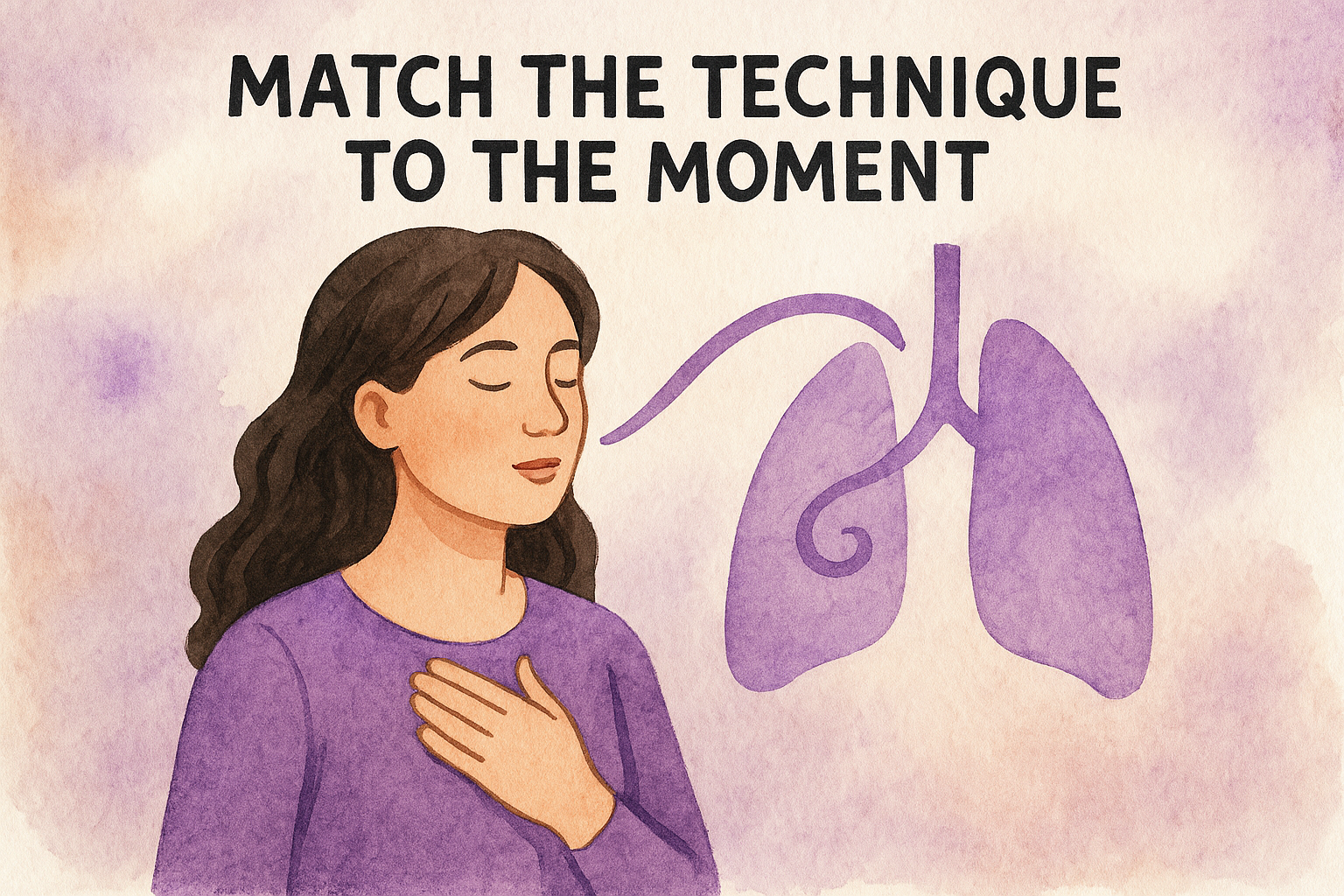
Match the technique to the moment
The table below maps each technique to a specific goal, the best time to use it, and the session length that produces reliable results. Use this as a quick reference when you are deciding where to start.
Technique
Primary goal
Best time to use
Recommended session
Belly breathing
Build baseline calm
Morning or anytime
5 minutes
Box breathing
Restore focus and reduce cortisol
Before work or a stressful task
4 to 8 cycles
4-7-8 breathing
Fall asleep faster, stop anxiety spikes
Evening or during a panic moment
4 cycles
Alternate nostril
Balance and mental clarity
Midday reset or pre-meditation
5 minutes
Physiological sigh
Instant stress reset
Any moment, on demand
1 to 3 breaths
The physiological sigh is the only technique you can use mid-conversation, at your desk, or in a public space without drawing any attention.
When your state doesn’t fit a single category
Some situations call for layering techniques rather than picking just one. If you wake up anxious and need to function clearly, start with two physiological sighs to break the acute stress response, then move into five minutes of belly breathing to stabilize your baseline. Combining a fast reset with a slower sustained practice works better than forcing a long session when your nervous system is already dysregulated.
Recovery days after an intense experience are a practical example of when sequencing matters. Your energy and mental clarity may shift unevenly throughout the day, making a single technique insufficient. Box breathing in the morning supports focus without overstimulating you, while 4-7-8 breathing in the evening signals your body to prepare for deep, restorative sleep. Building short sequences like these turns five standalone techniques into a flexible toolkit you can adapt to any situation you face.
Build a daily breathwork habit that lasts
Knowing the techniques is the easy part. Doing them consistently is where most beginners stall. The good news is that a sustainable breathwork practice does not require long sessions or rigid schedules. What it requires is a clear trigger, a manageable starting point, and a way to track progress without turning the whole thing into a chore.
Attach breathwork to something you already do
The fastest way to make any new behavior stick is to link it to an existing one. This approach, called habit stacking, removes the need to find extra motivation because the cue is already built into your day. Pick one anchor behavior you do every single day and attach a short breathwork session to it.
Morning coffee or tea: Do 5 minutes of belly breathing before your first sip.
Before opening your laptop: Run one round of box breathing to set a focused baseline.
After brushing your teeth at night: Use 4 cycles of 4-7-8 breathing to wind down.
Before getting out of bed: Take 3 physiological sighs to clear morning grogginess fast.
Pairing breathwork with a habit you already own eliminates the decision fatigue that kills most new practices.
Keep your first two weeks simple
Your first two weeks should involve nothing more than one technique, once a day, for five minutes or less. Overloading yourself with multiple methods early on is one of the most common mistakes beginners make. Pick belly breathing as your anchor technique, practice it daily, and only add a second method once the first one feels automatic.
Use a basic weekly template to stay on track:
Day
Technique
Duration
Anchor habit
Monday to Friday
Belly breathing
5 minutes
Morning, before work
Saturday
Alternate nostril
5 minutes
Midday break
Sunday
4-7-8 breathing
4 cycles
Evening wind-down
After two weeks, swap in any technique from this guide based on your goal for that day. Your practice stays flexible because the habit structure is already solid. Consistency in timing matters more than perfection in technique, so prioritize showing up daily over doing every session flawlessly.
A calm starting point
Breathwork for beginners does not need to be complicated or time-consuming to work. You now have five techniques, a clear understanding of when to use each one, and a simple habit structure to build consistency from day one. The hardest part is the first breath, and you already know how to take it.
Start with belly breathing tomorrow morning, keep your first two weeks simple, and layer in other techniques as your practice grows. Your nervous system responds to consistency, not perfection, so a five-minute session done daily will outperform a forty-minute session done once a week every time.
If you combine breathwork with targeted physical and nutritional recovery support, the results compound. The Afterglow Recovery Protocol is built to complement exactly this kind of practice, helping your body and mind land smoothly after intense experiences so you can integrate what matters most.
Lukas Nelpela
writes on neuroscience, mental health, and mindful exploration. With a passion in research-driven wellness and years focused on set & setting, integration, and recovery, he turns complex ideas into clear, usable insight.
You’re staring at your screen, reading the same sentence for the fourth time, and nothing sticks. Your thoughts feel like they’re wading through wet cement. So what is brain fog, exactly? It’s not a medical diagnosis, it’s a catch-all term for that frustrating state of mental cloudiness where focus, memory,
Every process in your body, thinking, moving, recovering, runs on energy produced inside your cells. That energy comes from mitochondria, and when they’re not functioning well, you feel it: brain fog, fatigue, slow recovery, and a general sense of running on empty. Mitochondrial support refers to the nutrients, habits, and
You sit down to focus, stare at your screen, and nothing clicks. Thoughts scatter, simple decisions feel impossible, and your mind moves like it’s stuck in wet concrete. If you’ve been looking up how to get rid of brain fog, you already know the frustration, that heavy, hazy state where
Working nights, rotating schedules, or pulling irregular hours throws your body’s internal clock into a constant state of confusion. Around 20% of the global workforce does some form of shift work, and the majority of those people report poor sleep as their number one complaint. Good sleep hygiene for shift
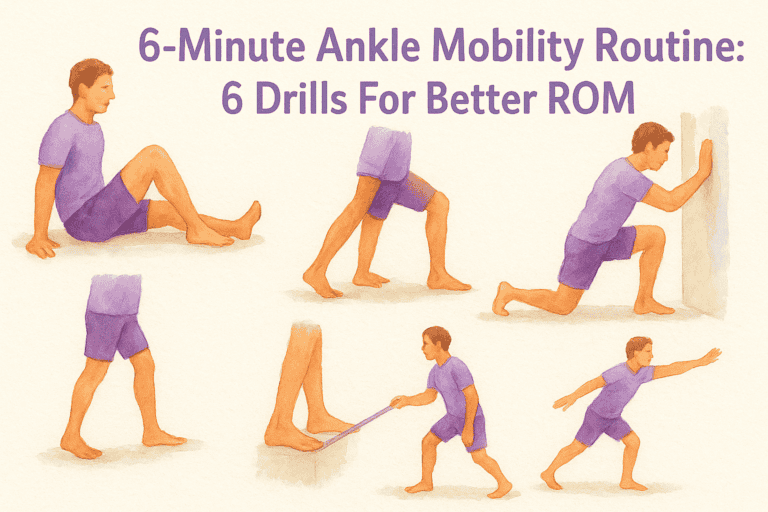
Stiff ankles affect more than just your squat depth. Limited ankle range of motion can mess with your knees, hips, and lower back, and if you spend long hours on your feet at festivals, retreats, or anywhere that keeps you moving, you’ll feel it. A solid ankle mobility routine takes
We use various cookies on our website. Some are essential for the website to function properly, while others we may only use with your consent. You can find more information about cookies on our website here.
This website uses cookies to improve your experience while you navigate through the website. Out of these cookies, the cookies that are categorized as necessary are stored on your browser as they are essential for the working of basic functionalities of the website. We also use third-party cookies that help us analyze and understand how you use this website. These cookies will be stored on your browser only with your consent. You also have the option to opt-out of these cookies. However, opting out of some of these cookies may have an impact on your browsing experience.
Necessary cookies are absolutely essential for the website to function properly. These cookies anonymously ensure basic functionalities and security features of the website.
Cookie
Duration
Description
cookielawinfo-checkbox-advertisement
1 year
Set by the GDPR Cookie Consent plugin, this cookie records the user consent for the cookies in the "Advertisement" category.
cookielawinfo-checkbox-analytics
11 months
This cookie is set by GDPR Cookie Consent plugin. The cookie is used to store the user consent for the cookies in the category "Analytics".
cookielawinfo-checkbox-functional
11 months
The cookie is set by GDPR cookie consent to record the user consent for the cookies in the category "Functional".
cookielawinfo-checkbox-necessary
11 months
This cookie is set by GDPR Cookie Consent plugin. The cookies is used to store the user consent for the cookies in the category "Necessary".
cookielawinfo-checkbox-others
11 months
This cookie is set by GDPR Cookie Consent plugin. The cookie is used to store the user consent for the cookies in the category "Other.
cookielawinfo-checkbox-performance
11 months
This cookie is set by GDPR Cookie Consent plugin. The cookie is used to store the user consent for the cookies in the category "Performance".
CookieLawInfoConsent
1 year
CookieYes sets this cookie to record the default button state of the corresponding category and the status of CCPA. It works only in coordination with the primary cookie.
elementor
never
The website's WordPress theme uses this cookie. It allows the website owner to implement or change the website's content in real-time.
fb_event_id_atc
30 minutes
Used to match client and server events for Meta Conversion API deduplication. Contains only anonymous technical IDs; no personal data stored.
fb_event_id_ic
30 minutes
Used to match client and server events for Meta Conversion API deduplication. Contains only anonymous technical IDs; no personal data stored.
fb_event_id_pur
30 minutes
Used to match client and server events for Meta Conversion API deduplication. Contains only anonymous technical IDs; no personal data stored.
fb_event_id_vc
30 minutes
Used to match client and server events for Meta Conversion API deduplication. Contains only anonymous technical IDs; no personal data stored.
rc::a
never
This cookie is set by the Google recaptcha service to identify bots to protect the website against malicious spam attacks.
rc::c
session
This cookie is set by the Google recaptcha service to identify bots to protect the website against malicious spam attacks.
viewed_cookie_policy
11 months
The cookie is set by the GDPR Cookie Consent plugin and is used to store whether or not user has consented to the use of cookies. It does not store any personal data.
VISITOR_PRIVACY_METADATA
6 months
YouTube sets this cookie to store the user's cookie consent state for the current domain.
wpEmojiSettingsSupports
session
WordPress sets this cookie when a user interacts with emojis on a WordPress site. It helps determine if the user's browser can display emojis properly.
Functional cookies help to perform certain functions, such as sharing website content on social media platforms, collecting feedback, and other third-party functions.
Cookie
Duration
Description
sib_cuid
6 months
SendinBlue sets this cookie to store unique visits.
VISITOR_INFO1_LIVE
6 months
A cookie set by YouTube to measure bandwidth that determines whether the user gets the new or old player interface.
yt-remote-cast-available
session
The yt-remote-cast-available cookie is used to store the user's preferences regarding whether casting is available on their YouTube video player.
yt-remote-cast-installed
session
The yt-remote-cast-installed cookie is used to store the user's video player preferences using embedded YouTube video.
yt-remote-connected-devices
never
YouTube sets this cookie to store the user's video preferences using embedded YouTube videos.
yt-remote-device-id
never
YouTube sets this cookie to store the user's video preferences using embedded YouTube videos.
yt-remote-fast-check-period
session
The yt-remote-fast-check-period cookie is used by YouTube to store the user's video player preferences for embedded YouTube videos.
yt-remote-session-app
session
The yt-remote-session-app cookie is used by YouTube to store user preferences and information about the interface of the embedded YouTube video player.
yt-remote-session-name
session
The yt-remote-session-name cookie is used by YouTube to store the user's video player preferences using embedded YouTube video.
ytidb::LAST_RESULT_ENTRY_KEY
never
The cookie ytidb::LAST_RESULT_ENTRY_KEY is used by YouTube to store the last search result entry that was clicked by the user. This information is used to improve the user experience by providing more relevant search results in the future.
Performance cookies are used to understand and analyze key website performance indexes, which helps in providing a better user experience for visitors.
Cookie
Duration
Description
SRM_B
1 year 24 days
Used by Microsoft Advertising as a unique ID for visitors.
Analytical cookies are used to understand how visitors interact with the website. These cookies help provide information on metrics such as the number of visitors, bounce rate, traffic source, etc.
Cookie
Duration
Description
_clck
1 year
Microsoft Clarity sets this cookie to retain the browser's Clarity User ID and settings exclusive to that website. This guarantees that actions taken during subsequent visits to the same website will be linked to the same user ID.
_clsk
1 day
Microsoft Clarity sets this cookie to store and consolidate a user's pageviews into a single session recording.
_fbp
3 months
Facebook sets this cookie to display advertisements when either on Facebook or on a digital platform powered by Facebook advertising after visiting the website.
_ga
1 year 1 month 4 days
Google Analytics sets this cookie to calculate visitor, session and campaign data and track site usage for the site's analytics report. The cookie stores information anonymously and assigns a randomly generated number to recognise unique visitors.
_ga_*
1 year 1 month 4 days
Google Analytics sets this cookie to store and count page views.
_gcl_au
3 months
Google Tag Manager sets the cookie to experiment advertisement efficiency of websites using their services.
_hjSession_*
1 hour
Hotjar sets this cookie to ensure data from subsequent visits to the same site is attributed to the same user ID, which persists in the Hotjar User ID, which is unique to that site.
_hjSessionUser_*
1 year
Hotjar sets this cookie to ensure data from subsequent visits to the same site is attributed to the same user ID, which persists in the Hotjar User ID, which is unique to that site.
_hjTLDTest
session
To determine the most generic cookie path that has to be used instead of the page hostname, Hotjar sets the _hjTLDTest cookie to store different URL substring alternatives until it fails.
CLID
1 year
Microsoft Clarity set this cookie to store information about how visitors interact with the website. The cookie helps to provide an analysis report. The data collection includes the number of visitors, where they visit the website, and the pages visited.
MR
7 days
This cookie, set by Bing, is used to collect user information for analytics purposes.
sbjs_current
session
Sourcebuster sets this cookie to identify the source of a visit and stores user action information in cookies. This analytical and behavioural cookie is used to enhance the visitor experience on the website.
sbjs_current_add
session
Sourcebuster sets this cookie to identify the source of a visit and stores user action information in cookies. This analytical and behavioural cookie is used to enhance the visitor experience on the website.
sbjs_first
session
Sourcebuster sets this cookie to identify the source of a visit and stores user action information in cookies. This analytical and behavioural cookie is used to enhance the visitor experience on the website.
sbjs_first_add
session
Sourcebuster sets this cookie to identify the source of a visit and stores user action information in cookies. This analytical and behavioural cookie is used to enhance the visitor experience on the website.
sbjs_migrations
session
Sourcebuster sets this cookie to identify the source of a visit and stores user action information in cookies. This analytical and behavioural cookie is used to enhance the visitor experience on the website.
sbjs_session
1 hour
Sourcebuster sets this cookie to identify the source of a visit and stores user action information in cookies. This analytical and behavioural cookie is used to enhance the visitor experience on the website.
sbjs_udata
session
Sourcebuster sets this cookie to identify the source of a visit and stores user action information in cookies. This analytical and behavioural cookie is used to enhance the visitor experience on the website.
SM
session
Microsoft Clarity cookie set this cookie for synchronizing the MUID across Microsoft domains.
YSC
session
YSC cookie is set by Youtube and is used to track the views of embedded videos on Youtube pages.
Advertising cookies are used to deliver relevant advertisements and marketing campaigns to visitors. These cookies track visitors across websites and collect information to deliver tailored advertisements.
Cookie
Duration
Description
_rdt_uuid
3 months
Reddit sets this cookie to build a profile of your interests and show you relevant ads.
ANONCHK
10 minutes
The ANONCHK cookie, set by Bing, is used to store a user's session ID and verify ads' clicks on the Bing search engine. The cookie helps in reporting and personalization as well.
MUID
1 year 24 days
Bing sets this cookie to recognise unique web browsers visiting Microsoft sites. This cookie is used for advertising, site analytics, and other operations.
test_cookie
15 minutes
doubleclick.net sets this cookie to determine if the user's browser supports cookies.
yt.innertube::nextId
never
YouTube sets this cookie to register a unique ID to store data on what videos from YouTube the user has seen.
yt.innertube::requests
never
YouTube sets this cookie to register a unique ID to store data on what videos from YouTube the user has seen.